
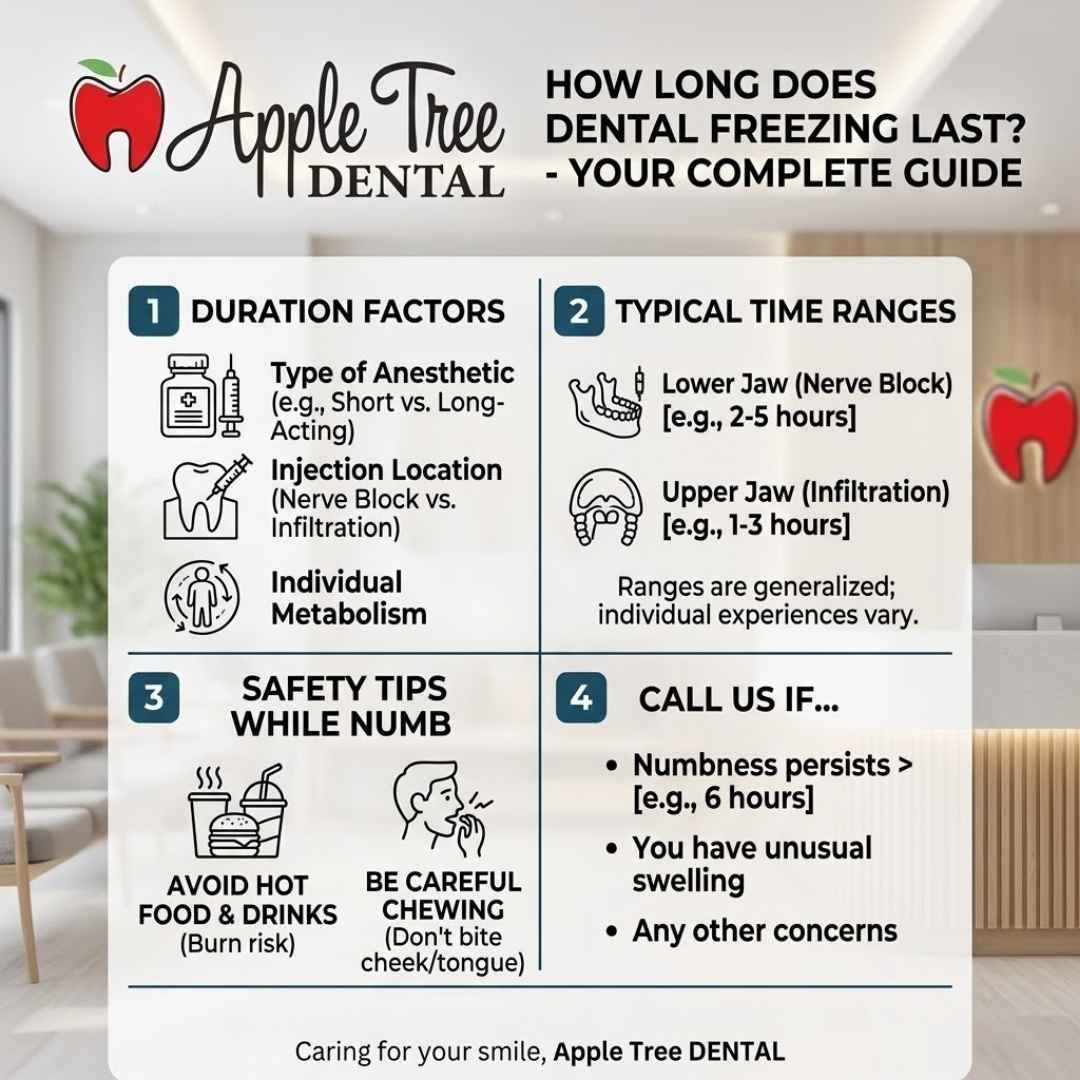
If you’ve ever left a dental appointment in London, Ontario with half your face feeling like a marshmallow, you’ve already experienced dental freezing firsthand. But the question most patients ask on the way out the door is: how long does dental freezing last? The answer depends on more than just the clock — and this guide gives you the complete, honest breakdown so you know exactly what to expect before, during, and after your next procedure at Apple Tree Dental.
Key Takeaways
- Dental freezing typically lasts 2 to 5 hours, depending on the procedure and anesthetic type.
- Your lips, cheeks, and tongue stay numb longer than the treated tooth itself.
- Lower jaw injections last significantly longer than upper jaw injections.
- The most common — and preventable — side effect is accidentally biting your numb lip or cheek.
- If numbness has not fully worn off after 8 hours, contact your dentist.
What Is Dental Freezing and How Does It Work?
Dental freezing is the Canadian term for local anesthesia — the injection your dentist gives you to block pain signals before a filling, extraction, root canal, or deep cleaning. The drug temporarily prevents nerve signals from reaching your brain, so you feel pressure but not pain.
Why It Lasts Longer Than You Expect
Almost all dental anesthetics used in Canadian clinics — including lidocaine and articaine — are mixed with a small amount of epinephrine (adrenaline). This is not to stimulate you. It constricts the blood vessels around the injection site, dramatically slowing how fast your body absorbs and clears the drug. Without epinephrine, the same dose of lidocaine would wear off in under 45 minutes. With it, you can expect 2 to 5 hours of numbness depending on your procedure.
For families wanting to understand how anesthesia works during children’s appointments, children’s dentistry services at Apple Tree Dental are tailored to make the experience as gentle and predictable as possible for young patients.
How Long Does Dental Freezing Last? (Direct Answer)
Dental freezing typically lasts between 2 and 5 hours after a dental procedure. Your tooth regains sensitivity first — usually within 1 to 2 hours — while soft tissues like your lips, cheeks, and tongue stay numb for 3 to 5 hours. Lower jaw procedures last significantly longer than upper jaw procedures due to the type of nerve block required.
How Long Does Numbing Last by Procedure Type?
Not all dental procedures produce the same duration of freezing. Here is a realistic breakdown based on clinical experience at Apple Tree Dental in London, Ontario:
| Procedure | Tooth Numbness | Lip / Cheek Numbness |
|---|---|---|
| Simple upper filling | 45 min – 1.5 hrs | 2 – 3 hrs |
| Lower molar filling | 1.5 – 2 hrs | 3 – 5 hrs |
| Upper tooth extraction | 1 – 2 hrs | 2 – 4 hrs |
| Lower molar extraction | 2 – 3 hrs | 3 – 5 hrs |
| Root canal | 2 – 3 hrs | 3 – 5 hrs |
| Deep cleaning / scaling | 1.5 – 2.5 hrs | 2 – 4 hrs |
Lower jaw procedures consistently last longer because they require an inferior alveolar nerve block — an injection placed deep alongside a major nerve trunk. Upper jaw procedures use a shallower infiltration technique through more porous bone, so the anesthetic disperses and clears more quickly.
From the Desk of Dr. Nagham Altalib — Apple Tree Dental, London Ontario
I graduated from Baghdad University’s dental school in 1998, completed my internship at a specialized prosthodontics centre in Baghdad, and later joined the DHCC European University team in Dubai where I led clinical research on orthodontic needs in children. After completing my NDEB certification in Canada, I established Apple Tree Dental here in London, Ontario — where I now see patients of all ages at our two locations.
In over two decades of practice across three countries, the question I am asked more consistently than almost any other is some version of: “When is this going to wear off?” The answer genuinely matters — especially if you are driving, picking up your children, or sitting down to lunch right after your appointment.
Why Does Freezing Wear Off at Different Rates for Different People?
Several factors genuinely affect how long local anesthetic lasts in your body. Understanding them helps explain why two patients receiving the same procedure can have very different experiences.
The Anesthetic Agent Used
Lidocaine 2% with 1:100,000 epinephrine is the most commonly used combination in Canadian dental offices. Articaine 4% offers slightly better bone penetration, which is useful for difficult lower molar cases. Mepivacaine — sometimes used when epinephrine is a concern for certain medical conditions — wears off considerably faster, usually within 1.5 to 2 hours.
Injection Site and Technique
A nerve block (used for lower jaw procedures) produces deeper, longer-lasting numbness than an infiltration injection (used for upper teeth). This is determined by anatomy, not preference.
Your Metabolism and Age
Lidocaine is processed by the liver. Younger patients and those with faster metabolisms may experience shorter duration. Older adults and patients with slower hepatic function often stay numb longer. If you are over 65 or take medications affecting liver function, let your dentist know before your procedure.
Anxiety and Adrenaline Levels
High dental anxiety raises your body’s own adrenaline levels, which increases circulation and can shorten how long the anesthetic stays effective. At Apple Tree Dental, managing patient anxiety is part of our clinical process — calmer patients consistently get more complete, predictable anesthesia. Patients who want to discuss anxiety management options can learn more about sedation dentistry at Apple Tree Dental.
Infection in the Treatment Area
Infected tissue is chemically more acidic than healthy tissue. Most local anesthetics work best at neutral pH — in an infected area, the drug’s ability to penetrate the nerve membrane is significantly reduced. This is why it can be genuinely difficult to fully freeze an abscessed tooth, and why dentists sometimes need multiple cartridges or alternative injection techniques to achieve complete numbness.
Dental Freezing Side Effects: What Is Normal and What Is Not
Common and Expected Side Effects
- Prolonged numbness in lips, tongue, and cheeks (up to 5 hours for lower jaw procedures)
- Drooling or difficulty speaking clearly — particularly after lower jaw injections
- Soreness or a mild bruised feeling at the injection site, lasting 1 to 3 days
- Tingling or a “pins and needles” sensation as feeling returns — completely normal
- Brief rapid heartbeat if epinephrine enters a small blood vessel — resolves in 30 to 60 seconds and is harmless
The Side Effect Nobody Warns You About
The most underreported dental freezing side effect has nothing to do with the drug itself — it is self-inflicted soft tissue injury. When your lip, cheek, or tongue is numb, you lose the feedback that tells you how hard you are biting. Patients — especially children — can chew right through their numb lip without feeling a thing, resulting in a painful ulcer that takes one to two weeks to heal.
At Apple Tree Dental, we remind every patient before leaving the clinic: no eating until the numbness is fully gone. If you have children coming in for a procedure, supervise them closely for at least two hours after their appointment and offer only soft, cool foods.
When to Call Your Dentist
- Numbness that has not resolved after 8 hours
- Persistent tingling or altered sensation after 24 hours (possible paresthesia — rare, but worth documenting)
- Increasing pain rather than decreasing pain once the anesthetic wears off
- Signs of allergic reaction: spreading swelling, hives, or difficulty breathing — this is a medical emergency, call 911 immediately
True allergy to amide-type local anesthetics like lidocaine and articaine is extremely rare — under 1% of adverse reactions. Most reactions are vasovagal (fainting from anxiety) or a brief epinephrine response. Both are harmless and resolve quickly. If you have experienced an adverse reaction to dental anesthesia in the past, discuss it with Dr. Altalib before your next procedure so the right anesthetic can be selected for you.
For patients who experience acute dental pain after their freezing wears off, emergency dental care at Apple Tree Dental offers same-day appointments for urgent situations.
How to Make Dental Freezing Wear Off Faster
There is no instant reversal, but a few things genuinely help — and several popular ideas simply do not work.
What Actually Helps
- Gentle movement and light walking — modestly increases circulation and supports drug clearance
- Staying warm — cold causes vasoconstriction and can slow clearance at the injection site
- Phentolamine mesylate (OraVerse®) — a reversal agent available at some dental offices that can cut soft tissue numbing time roughly in half. Ask your dentist if it is available before your appointment if timing matters to you
What Does Not Help
- Coffee or energy drinks — caffeine has no meaningful effect on lidocaine metabolism
- Heat packs applied too soon — can worsen bruising at the injection site
- Vigorous exercise immediately after an extraction — increases bleeding risk
What to Eat While Your Mouth Is Still Frozen
While numbness is still present, stick to cool or room-temperature soft foods such as yogurt, smoothies, apple sauce, and soft bread. Drink plenty of water and stay hydrated. Avoid hot drinks and hot food — you cannot accurately judge temperature when numb, and burns are a genuine risk. Avoid hard, crunchy, or chewy foods, chewing gum, and alcohol immediately after treatment.
Wait until you have full sensation before eating normally. This is especially important following extractions. For post-extraction care guidance, restorative dental services at Apple Tree Dental include full post-procedure instructions for every patient.
Special Considerations: Children, Seniors, and Anxious Patients
Children
Children between ages 2 and 8 are at the highest risk for post-appointment lip and cheek biting. At Apple Tree Dental, we always take time to explain this to parents before the child leaves the clinic. Keep children on soft, cool foods and check on them regularly for two to three hours after their visit. Our children’s dentistry team provides specific post-procedure guidance tailored to each child’s age and procedure type.
Older Adults
Liver metabolism naturally slows with age. Patients over 65 or those on medications that affect liver function may experience longer-lasting numbness than younger adults receiving the same dose. Always disclose your full medication list before any procedure — beta-blockers, certain antidepressants, and blood thinners all interact in different ways with local anesthetics and vasoconstrictors.
Medically Complex Patients
There is always a safe anesthetic option for medically complex cases — your dentist simply needs the full picture to choose correctly. Never withhold medication information before a dental procedure.
Why You Can Trust This Information
This content is based on over two decades of real clinical experience, official Canadian dental pharmacology guidelines, and current patient care standards at Apple Tree Dental in London, Ontario. The goal is to provide clear, actionable guidance — not just theory. For professional oversight and licensing of dental providers in Ontario, the Ontario Government’s dentist finder offers a government-verified resource to support patient decisions. For dental standards and member guidelines, the Canadian Dental Association (CDA) provides regularly updated professional guidance.
What to Expect: The Bottom Line
Dental freezing is one of the most reliably effective tools in modern dentistry. When you understand what to realistically expect — 2 to 5 hours total, soft tissues longer than teeth, lower jaw longer than upper — the experience becomes far less mysterious and far less stressful. Plan your day accordingly, eat beforehand, arrange soft foods at home, and if you have children, have a post-appointment supervision plan ready.
If you are in London, Ontario and have questions about anesthesia options before your next procedure, we are happy to walk you through exactly what to expect for your specific treatment. To book an appointment or learn more, visit the Apple Tree Dental appointment page or check our current special offers to reduce your out-of-pocket costs.
North Location: 1365 Beaverbrook Ave, Unit 102, London, ON N6H 0J1
South Location: 3429 Wonderland Rd S, Unit 6, London, ON N6L 0E3
Phone calls accepted: 8 AM – 9 PM | We speak English & Arabic
Frequently Asked Questions
How long does dental freezing last on average?
For most procedures, dental freezing lasts 2 to 5 hours. Your tooth regains sensitivity within 1 to 2 hours, while your lips, cheeks, and tongue may stay numb for 3 to 5 hours depending on the injection type and anesthetic used.
How long does it take for freezing to wear off after a filling?
For an upper tooth filling, expect about 2 to 3 hours of numbness. For a lower molar filling requiring a nerve block, plan for 3 to 5 hours. If your appointment was in the morning, you may still feel mild numbness at lunchtime.
How long does dentist freezing last after a tooth extraction?
After a lower molar extraction, expect 3 to 5 hours of soft tissue numbness. Upper tooth extractions typically wear off in 2 to 4 hours.
How long does numbing last after a root canal?
Root canals often require more anesthetic than routine fillings. Plan for 3 to 5 hours of numbness after your appointment, particularly for lower molars.
Is it normal for dental freezing to last 5 hours?
Yes, five hours is within the normal range for lower jaw procedures, particularly when epinephrine-containing anesthetics are used. If you are completely numb beyond 8 hours, contact your dental office.
What are the main tooth freezing side effects?
The most common side effects are temporary numbness, drooling, mild difficulty speaking, and soreness at the injection site lasting 1 to 3 days. The most preventable side effect is accidentally biting your numb lip or cheek — avoid eating until full sensation returns.
Can dental freezing wear off during a procedure?
It is uncommon but possible, particularly for infected teeth or longer procedures. If you feel discomfort during treatment, signal your dentist immediately. Additional anesthetic can almost always be administered safely. Never endure pain without communicating it.
Does dental anesthesia wear off faster in some people?
Yes. Younger patients, those with faster metabolisms, and people with high anxiety can experience shorter anesthetic duration. Older adults and those with slower liver metabolism often stay numb longer. The specific anesthetic agent also plays a significant role.
Is it safe to drive after dental freezing?
Local anesthesia alone does not impair your ability to drive. However, if you also received sedation or nitrous oxide, different rules apply — confirm with your dentist before your appointment. For local anesthesia only, driving is generally fine once you feel comfortable and alert.
When should I call the dentist after dental freezing?
Call if numbness has not resolved after 8 hours, if you experience increasing pain once the anesthetic wears off, or if you notice unusual swelling or allergic symptoms after leaving the clinic. Apple Tree Dental accepts phone calls from 8 AM to 9 PM for exactly these situations.
About the Author
Dr. Nagham Altalib is the founder of Apple Tree Dental, serving London, Ontario at two convenient locations. She graduated from Baghdad University’s Faculty of Dentistry in 1998, completed a prosthodontics internship in Baghdad, and later joined the DHCC European University team in Dubai to lead orthodontic research focused on children’s oral health. After relocating to Canada and completing her NDEB certification, she established Apple Tree Dental in London, Ontario, where she now practices general, cosmetic, and orthodontic dentistry. As a mother of two, Dr. Altalib brings clinical expertise and genuine empathy to every patient visit — particularly with children and anxious patients. She speaks English and Arabic. Learn more at appletreedental.ca.