
Teeth Filling vs Crown: How to Know Which One Your Tooth Actually Needs

A cracked or decayed tooth leaves you with one big question: teeth filling vs crown — which one do you need? The answer depends almost entirely on how much healthy tooth structure remains. Small to moderate damage usually means a filling. Large damage, deep cracks, or a tooth weakened by a root canal usually means a crown. If you are unsure which side your tooth falls on, Apple Tree Dental in London, Ontario can examine it and give you a straight answer.

✦ Quick Answer

Teeth Filling vs Crown: What Is the Difference?

The teeth filling vs crown decision comes down to damage size. A filling repairs a small to moderate cavity by filling the hole with composite resin or another material — most of your natural tooth stays untouched. A crown replaces the entire outer surface of a badly damaged tooth with a custom cap that covers it down to the gumline. Dentists choose a filling when enough strong tooth remains, and a crown when the tooth is too weak, cracked, or hollowed out to hold a filling. Fillings take one visit. Crowns usually take two. Apple Tree Dental in London, Ontario offers both and will recommend the option that protects your tooth for the long term.

✦ Key Takeaways

Teeth Filling vs Crown — At a Glance

  • Fillings fix small problems. They repair cavities and minor chips while keeping most of your natural tooth.
  • Crowns fix big problems. They cover and protect teeth that are cracked, heavily decayed, or weakened by a root canal.
  • Size of the damage decides it. Once decay covers more than half the tooth, a filling can actually make the tooth weaker.
  • Fillings are faster and cheaper. One visit, less tooth preparation, lower cost.
  • Crowns last longer under heavy load. A well-made crown often serves 10 to 15 years or more with good care.
  • Apple Tree Dental in London, Ontario places both fillings and crowns and accepts the Canadian Dental Care Plan.

Teeth Filling vs Crown: How London, Ontario Dentists Decide Which One You Need

Your dentist looks at one thing above everything else: how much healthy tooth is left. A tooth with a small cavity and strong walls can hold a filling for years. A tooth with a large cavity, thin walls, or a crack running through it cannot.

Put a filling in a tooth that really needs a crown, and the tooth often fractures later. That fracture can run below the gumline — and at that point, the tooth may not be saveable at all. This is why the crown vs filling decision matters more than most patients realise.

The Canadian Dental Association lists both fillings and crowns as standard restorative treatments. Neither is “better.” Each solves a different problem.

Teeth Filling vs Crown: The Key Differences Side by Side

✓ Filling vs Crown Comparison

Dental Filling

  • Repairs small to moderate cavities and chips
  • Keeps most of your natural tooth intact
  • Done in a single visit — usually under an hour
  • Lower cost, often well covered by insurance
  • Lasts roughly 5 to 10 years on average

Dental Crown

  • Covers the whole tooth above the gumline
  • Protects cracked, weak, or root-canal-treated teeth
  • Usually two visits, two to three weeks apart
  • Higher cost, but built for heavy chewing forces
  • Lasts roughly 10 to 15+ years with good care

Think of the teeth filling vs crown choice this way. A filling patches a pothole. A crown repaves the whole road surface. Both work — but only when matched to the right amount of damage.

One more term worth clearing up: “filler dental” searches usually mean dental fillings, not cosmetic facial filler. If your dentist mentions a filling, they mean the tooth repair described here.

What to Expect: Step-by-Step Process

Step 1: Exam and X-rays

Your dentist examines the tooth and takes X-rays to see how deep the decay or crack runs. This is where the filling-or-crown decision gets made. You will know your options before any drilling starts.

Step 2: Numbing the area

Local anaesthetic keeps the procedure pain-free for both treatments. Nervous about needles or dental work in general? Say so. Your provider can adjust the pace and explain each step as it happens.

Step 3 (Filling): Removing decay and filling the tooth

For a filling, the dentist removes the decayed portion, cleans the space, and places composite resin in layers. Each layer hardens under a curing light. The dentist then shapes and polishes it to match your bite. You are done in one visit.

Step 3 (Crown): Shaping the tooth and taking impressions

For a crown, the dentist reshapes the tooth so the cap fits over it. Impressions or a digital scan go to a lab where your custom crown gets made. A temporary crown protects the tooth in the meantime.

Step 4 (Crown): Fitting the permanent crown

Two to three weeks later, you return. The dentist removes the temporary, checks the fit and colour of the permanent crown, and cements it in place. A quick bite check, minor adjustments, and you leave with a fully restored tooth.

Step 5: Aftercare for both

Mild sensitivity for a few days is normal after either procedure. Brush twice daily, floss around the restoration, and keep regular checkups. Fillings and crowns both fail early when the tooth around them gets neglected.

Cost of Fillings and Crowns in London, Ontario — What You’ll Actually Pay

Here is the honest picture. A filling costs a fraction of what a crown does — a crown involves lab work, custom fabrication, and two appointments. That gap tempts some patients to push for a filling when their tooth needs a crown. It rarely ends well. A fractured tooth later can mean extraction and an implant, which costs far more than the crown would have.

✓ Ways to Manage Your Treatment Costs in Ontario
  • Private dental insurance: Most group plans cover fillings well. Crown coverage varies — many plans pay a percentage after a deductible. Check your policy before booking.
  • Canadian Dental Care Plan (CDCP): Eligible Canadians without private insurance may access coverage under the federal CDCP program. Apple Tree Dental accepts CDCP — confirm eligibility when you book.
  • Flexible payment plans: Apple Tree Dental offers payment options that spread the cost of a crown over time. Ask the clinic what works for your budget.
  • Act early: A small cavity treated now is a filling. The same cavity ignored for a year can become a root canal plus a crown. Early treatment is always the cheaper path.

Contact Apple Tree Dental directly for a personalised estimate based on your exam and X-rays. You get real numbers before committing to anything.

When a Filling Fails: Why Dentists Sometimes Upgrade You to a Crown

Fillings have a size limit. Composite resin bonds to tooth structure — but it needs enough of that structure to bond to. Once decay eats away more than about half the tooth, the remaining walls become thin and brittle.

A large filling in a thin-walled tooth acts like a wedge. Every bite pushes outward on those weak walls. Over months or years, the walls crack. This is the most common reason a dentist recommends replacing an old, oversized filling with a crown before anything breaks.

Root canal treatment is the other big trigger. A tooth loses moisture and strength after a root canal, especially molars that take heavy chewing force. The Royal College of Dental Surgeons of Ontario (RCDSO) holds Ontario dentists to evidence-based standards — and the evidence strongly supports crowning back teeth after root canal treatment to prevent fracture.

Teeth Filling vs Crown: Which One Is Right for You? (Signs + Candidacy)

✓ Which Treatment Fits Your Tooth?

A Filling Likely Fits If

  • The cavity is small to moderate in size
  • The tooth has strong, intact walls
  • You have a minor chip or worn edge
  • No cracks show on the exam or X-ray
  • The tooth has never had a root canal

A Crown Likely Fits If

  • Decay covers half the tooth or more
  • The tooth is cracked or fractured
  • A large old filling is breaking down
  • The tooth had root canal treatment
  • The tooth is badly worn from grinding

Some teeth sit in the grey zone between the two. In those cases, your dentist may suggest an inlay or onlay — a lab-made restoration that covers part of the tooth without a full crown. An exam and X-ray at Apple Tree Dental in London, Ontario will tell you exactly where your tooth stands.

Frequently Asked Questions: Teeth Filling vs Crown

Which is better, a filling or a crown?

Neither is universally better. A filling is better for small damage because it preserves natural tooth. A crown is better for large damage because it protects the whole tooth from fracture. The right choice depends on how much healthy tooth structure remains — which only an exam can confirm.

Does a crown hurt more than a filling?

No. Both procedures happen under local anaesthetic, so you feel pressure but not pain. A crown appointment runs longer, and some patients notice more sensitivity for a few days afterward. Over-the-counter pain relief handles it in almost every case.

How long do fillings and crowns last?

Composite fillings typically last 5 to 10 years. Crowns typically last 10 to 15 years, and many last 20 or more. Daily habits decide the outcome — brushing, flossing, avoiding ice chewing, and wearing a night guard if you grind your teeth all extend the life of either restoration.

Can a tooth with a large filling be crowned later?

Yes — and it happens often. Many crowns go on teeth that carried large fillings for years. The dentist removes the old filling, builds up the core if needed, and shapes the tooth for the crown. Doing this before the tooth cracks gives a far better outcome than waiting for a fracture.

Do I always need a crown after a root canal?

Back teeth — molars and premolars — almost always need a crown after a root canal because they take heavy chewing force and become brittle. Front teeth sometimes manage with a filling alone if enough structure remains. Your dentist will assess the specific tooth and tell you which applies.

What happens if I delay getting a crown my dentist recommended?

The tooth stays at risk of cracking. If the crack stays above the gumline, a crown can still save the tooth. If it runs below the gumline or splits the root, extraction often becomes the only option — followed by a bridge or implant at much higher cost. Delaying rarely saves money in the end.

Get a Clear Answer on Filling vs Crown in London, Ontario

The teeth filling vs crown decision comes down to your tooth — not a general rule. A short exam with X-rays at Apple Tree Dental gives you a clear recommendation and real cost numbers before anything starts. Book your appointment in London, Ontario today and stop guessing.

Book Your Exam at Apple Tree Dental

Apple Tree Dental provides fillings, crowns, and full restorative care for adults and families across London, Ontario. We accept the Canadian Dental Care Plan and most private insurance. Not sure whether your tooth needs a filling or a crown? We will examine it and give you a straight answer — no pressure, no jargon.

Book Your Appointment Today →

✦ About the Author
Apple Tree Dental London Ontario logo

📍 London, Ontario

Apple Tree Dental

Your Family Dental Clinic in London, Ontario

The clinical team at Apple Tree Dental in London, Ontario provides general, preventive, and restorative dental care for adults and families. All care follows RCDSO standards and Canadian Dental Association guidelines.

Serving patients across London, Ontario and surrounding neighbourhoods

Book a Consultation →

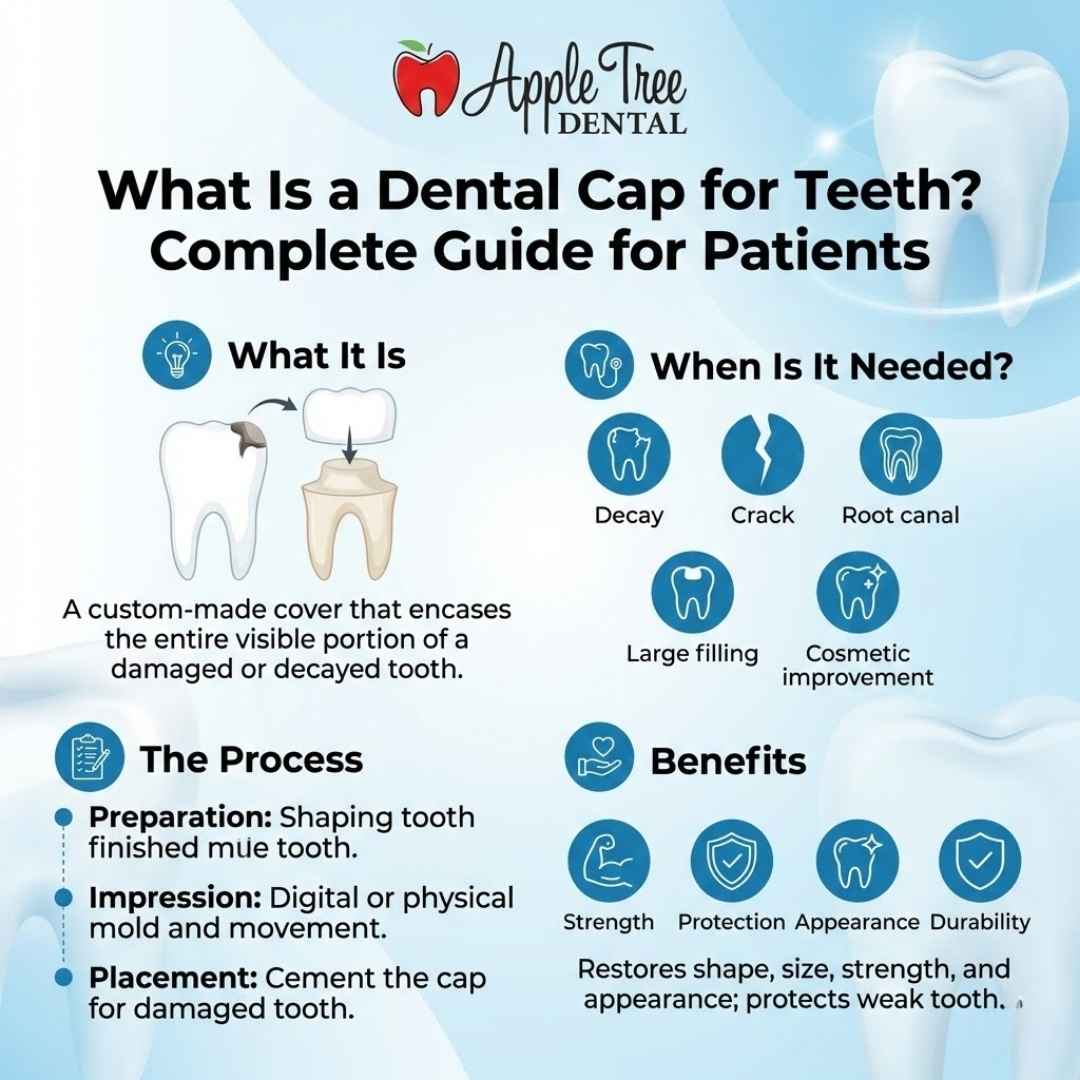
What Is a Dental Cap for Teeth? Complete Guide for Patients

Protecting your natural teeth is essential for long-term oral health. When a tooth becomes weakened due to decay, fracture, or dental treatment, restoring it early can prevent serious complications. One of the most trusted restorative solutions in modern dentistry is a dental cap for teeth.

For patients in London, Ontario, understanding how dental caps work can help you make confident treatment decisions. At Apple Tree Dental, patient education is considered a key part of delivering safe, comfortable, and evidence-based dental care.


What Is a Dental Cap for Teeth?

A dental cap for teeth, also known as a dental crown, is a custom-made restoration that fully covers a damaged or weakened tooth above the gum line. It restores strength, shape, and function while protecting the tooth from further damage.

Dental caps are widely recommended in restorative dentistry and are supported by clinical guidelines followed by dental professionals across Canada.


When Is a Dental Cap Needed?

A dental cap may be recommended when a tooth is no longer strong enough to function on its own.

Common situations include:

  • Large cavities that cannot support fillings
  • Cracked or fractured teeth
  • Teeth weakened after root canal treatment
  • Severe tooth wear from grinding
  • Broken teeth due to injury
  • Cosmetic concerns such as discoloration or uneven shape

According to standards followed by dentists registered with Canadian dental regulatory authorities, preserving the natural tooth structure is always preferred whenever possible.


Types of Dental Caps for Teeth

Several materials are used in modern dentistry, each selected based on durability and appearance.

Porcelain Dental Caps

  • Natural tooth-like appearance
  • Commonly used for front teeth

Ceramic Dental Caps

  • Metal-free
  • Biocompatible and aesthetic

Porcelain-Fused-to-Metal (PFM)

  • Strong internal structure
  • Balanced durability and appearance

Metal Dental Caps

  • Highly durable
  • Often recommended for molars

Treatment selection follows evidence-based dentistry principles supported by Canadian oral health guidelines.


Dental Cap for Teeth Procedure: Step-by-Step

Step 1: Clinical Examination

The dentist evaluates the tooth using digital X-rays to assess decay, infection, or structural damage.

Step 2: Tooth Preparation

The damaged area is cleaned, and the tooth is reshaped slightly to allow proper crown placement.

Step 3: Impression or Digital Scan

A precise mold or digital scan ensures accurate fit and bite alignment.

Step 4: Temporary Dental Cap

A temporary crown protects the tooth during fabrication.

Step 5: Final Placement

The permanent dental cap is securely bonded and adjusted for comfort.

This approach follows standard restorative dentistry protocols used by licensed dentists throughout Ontario.


Benefits of a Dental Cap for Teeth

A dental cap provides both restorative and preventive advantages:

  • Strengthens weakened teeth
  • Restores natural chewing ability
  • Prevents further decay
  • Improves smile appearance
  • Helps avoid tooth extraction
  • Supports long-term oral health

These benefits align with patient education resources published by Canadian dental health organizations that promote early restorative treatment.


How Long Does a Dental Cap Last?

With proper care, a dental cap typically lasts 10 to 15 years or longer.

Longevity depends on:

  • Oral hygiene practices
  • Regular professional cleanings
  • Bite forces and grinding habits
  • Gum health

Routine dental visits recommended by oral health professionals in Canada play an important role in maintaining crown stability.


Dental Cap vs Dental Filling

Dental FillingDental Cap
Repairs small decayRestores major damage
Partial tooth coverageFull tooth coverage
Shorter lifespanLong-term durability

When structural integrity is compromised, dental professionals generally recommend a dental cap for teeth instead of repeated fillings.


Cost of Dental Cap for Teeth in London, Ontario

The cost may vary based on:

  • Crown material
  • Tooth position
  • Treatment complexity
  • Dental insurance coverage

Guidance from Ontario dental fee structures and Canadian dental care standards helps dentists provide transparent and fair treatment planning.

A consultation with a dentist in London, Ontario, allows for accurate cost assessment and personalized care.


Caring for Your Dental Cap

To maintain your dental cap:

  • Brush twice daily with fluoride toothpaste
  • Floss carefully around the crown margins
  • Avoid chewing hard objects
  • Attend routine dental checkups
  • Use a night guard if recommended

Preventive care practices promoted by Canadian oral health education programs emphasize consistency and early intervention.


Why Choose Apple Tree Dental in London, Ontario?

At Apple Tree Dental, treatments are delivered following recognized Canadian dental care standards, with a focus on patient comfort, accuracy, and long-term results.

For families searching for a trusted dental clinic in London, Ontario, professional evaluation ensures that dental caps are designed to function naturally and support lifelong oral health.

Final Thoughts

A dental cap for teeth plays a critical role in protecting damaged teeth, restoring function, and maintaining long-term oral health. Supported by Canadian dental care principles and evidence-based practices, dental caps remain one of the most effective restorative solutions available today.

For patients in London, Ontario, early treatment and professional guidance from Apple Tree Dental can help prevent complications and support a healthy, confident smile for years to come.

Frequently Asked Questions (FAQs)

Is a dental cap the same as a crown?

Yes. A dental cap and a dental crown are different terms for the same treatment.

Can a dental cap fall off?

This is uncommon, but if it occurs, your dentist can reattach or replace it safely.

Is the procedure painful?

Local anesthesia is used, making the process comfortable for most patients.

Can I eat normally after treatment?

Yes. Once placed, the tooth functions like a natural tooth.

Is saving the tooth better than extraction?

In most cases, preserving the natural tooth with a dental cap is strongly preferred.

More Topic About Apple Tree Dental

Patients often explore additional topics such as dental crowns, tooth restoration, preventive dental care, and root canal treatment to better understand their oral health options.

https://caphd.ca/Educational guidance published by Canadian dental associations, provincial dental regulatory bodies, and national oral health organizations in Canada helps reinforce why restorative treatments like dental caps are widely recommended by licensed professionals.

These references strengthen trust, accuracy, and patient confidence — important elements of healthcare decision-making.