
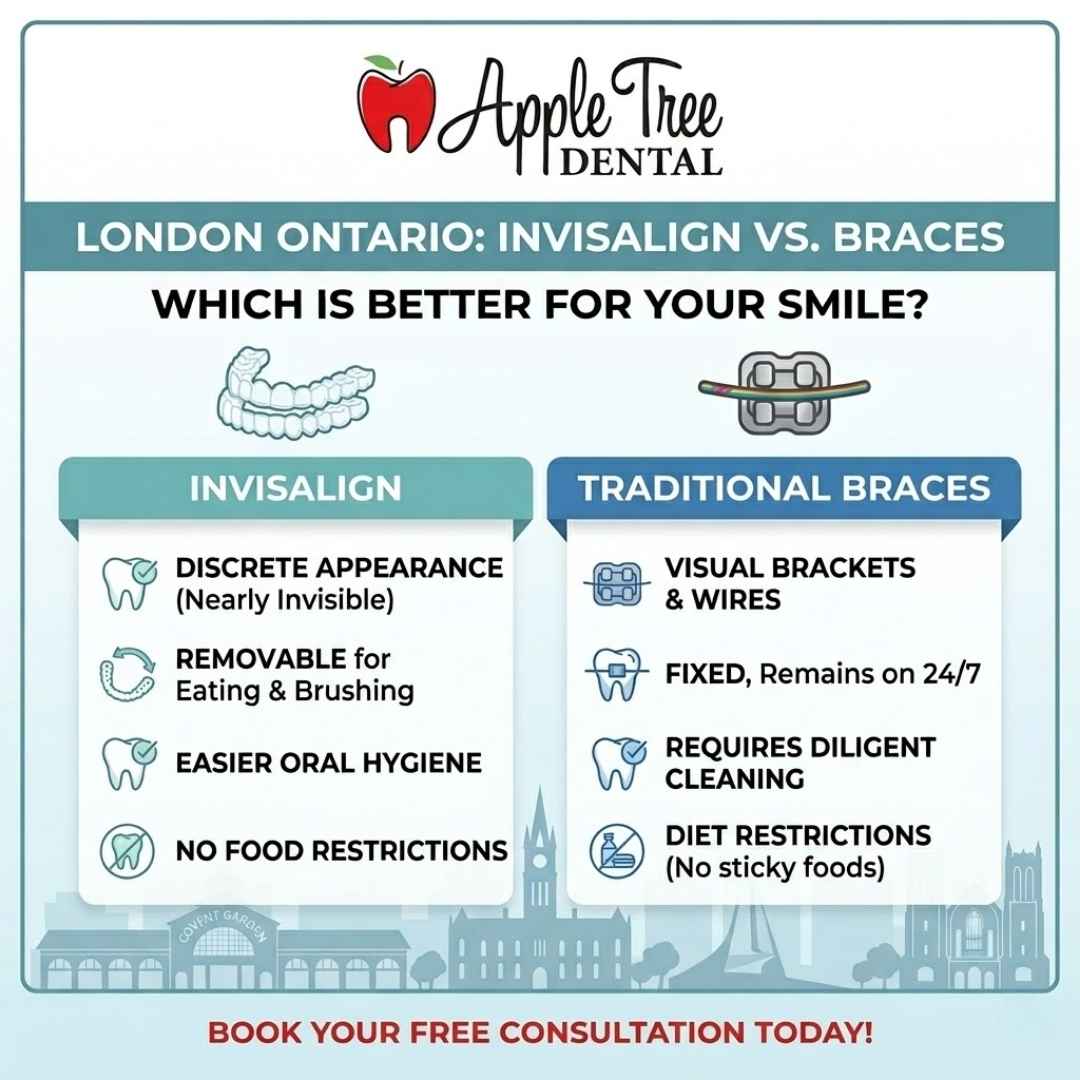
If you are comparing Invisalign vs braces in London Ontario, you are likely asking one key question: which option is faster, more comfortable, and worth your investment? The answer depends on your dental condition, lifestyle, and goals. Both treatments are highly effective — but choosing the right one can significantly impact your experience and results. At Apple Tree Dental in London Ontario, patients frequently ask which orthodontic solution is best. This guide breaks everything down clearly so you can make the right decision.
Quick Answer: Invisalign vs Braces
Choose Invisalign if you want a clear, removable, and comfortable option. Choose traditional braces if you have complex alignment or bite issues.
What Is Invisalign?
Invisalign is a modern orthodontic treatment that uses clear, custom-made aligners to gradually move your teeth into the correct position. According to the American Dental Association (ADA), clear aligner therapy has become one of the most widely adopted orthodontic approaches for adult patients seeking discreet correction.
Key Benefits of Invisalign
- Nearly invisible appearance
- Removable for eating and brushing
- Smooth and comfortable material
- Fewer in-clinic visits
- No food restrictions
This makes Invisalign one of the most popular choices for adults and professionals in London Ontario who want a discreet solution.
What Are Traditional Braces?
Traditional braces use metal or ceramic brackets attached to your teeth, connected by wires that apply consistent pressure to shift teeth over time. The Canadian Dental Association (CDA) recognises orthodontic treatment — including traditional braces — as a clinically proven method for correcting a wide range of bite and alignment issues across all age groups.
Key Benefits of Braces
- Effective for all types of cases, including severe issues
- Precise control over tooth movement
- Suitable for children, teens, and adults
- No need to remember to wear them
Braces remain the gold standard for complex orthodontic corrections.
Invisalign vs Braces: Side-by-Side Comparison
| Feature | Invisalign | Traditional Braces |
|---|---|---|
| Appearance | Clear, nearly invisible | Visible metal or ceramic |
| Comfort | Smooth, less irritation | Can cause discomfort |
| Removability | Yes | No |
| Cleaning | Easy | Requires extra effort |
| Effectiveness | Mild to moderate cases | All cases |
| Dental Visits | Fewer | More frequent |
Is Invisalign Faster Than Braces?
In many cases, yes.
- Invisalign treatment: 6–18 months
- Braces treatment: 12–24 months
When Invisalign Is Faster
- Mild crowding
- Small gaps
- Minor alignment issues
When Braces May Be Faster
- Severe bite problems
- Complex tooth rotations
- Significant crowding
At Apple Tree Dental, advanced 3D digital scans are used to map your treatment and estimate your exact timeline before starting. Ask about our digital dental exams and X-rays to get a precise picture of your orthodontic needs.
Cost of Invisalign vs Braces in London Ontario
The cost of orthodontic treatment varies depending on your specific case. Health Canada’s oral health resources note that patients are encouraged to discuss full treatment costs and insurance coverage with their dental provider before beginning any orthodontic plan.
What Affects the Cost?
- Severity of your case
- Treatment duration
- Type of braces (metal vs ceramic)
- Insurance coverage
Every smile is different, and so is every treatment plan. For an accurate cost estimate tailored to your specific needs, contact Apple Tree Dental in London Ontario or book a consultation — our team will provide a full breakdown of costs, payment options, and insurance coverage before you commit to any treatment. Patients eligible for the Canada Dental Care Plan (CDCP) can also ask our team about available coverage.
Which Option Is More Comfortable?
If comfort is your priority, Invisalign clearly stands out.
Invisalign
- No wires or brackets
- Minimal irritation
- Gentle pressure
Braces
- Can cause soreness after adjustments
- Brackets may irritate cheeks and gums
Patients who want a smoother experience typically prefer Invisalign.
Which Option Looks Better?
Appearance is one of the biggest deciding factors. Invisalign aligners are virtually invisible, while braces remain noticeable even with ceramic options. For adults — especially those working in professional environments — Invisalign is often the preferred choice for maintaining a confident, natural smile throughout treatment. Learn more about our full range of cosmetic dentistry services at Apple Tree Dental.
Oral Hygiene: Invisalign vs Braces
The Canadian Dental Association emphasises that maintaining proper oral hygiene during orthodontic treatment is essential to preventing cavities and gum disease. The two options differ significantly in how easy they make this.
Invisalign
- Remove aligners to brush and floss normally
- Better overall oral hygiene during treatment
Braces
- Food can get stuck around brackets and wires
- Requires special cleaning tools such as floss threaders
- Higher risk of plaque buildup
Better hygiene during treatment means lower chances of cavities and gum issues. Our team at Apple Tree Dental also recommends regular professional teeth cleanings throughout your orthodontic treatment regardless of which option you choose.
Pain Level: Invisalign vs Braces
Both treatments involve some discomfort, but the experience differs. Invisalign causes mild pressure when switching to a new set of aligners, while braces typically produce more noticeable pain following each adjustment appointment. Overall, Invisalign is considered less painful. If you experience significant discomfort at any stage, our emergency dental care team is available to help.
Who Should Choose Invisalign?
You are a good candidate for Invisalign if you:
- Have mild to moderate alignment issues
- Want a discreet orthodontic solution
- Can commit to wearing aligners 20–22 hours per day
- Prefer flexibility with eating and oral hygiene
Who Should Choose Braces?
Braces are the better choice if you:
- Have severe crowding or bite problems
- Need precise and complex tooth movement
- Prefer a fixed, low-maintenance option that requires no daily discipline
Invisalign vs Braces for Adults in London Ontario
Most adults prefer Invisalign because it is discreet, fits busy lifestyles, requires fewer dental visits, and places no dietary restrictions on patients. The ADA notes that orthodontic treatment for adults is increasingly common, with clear aligner systems representing one of the fastest-growing treatment categories. At Apple Tree Dental, a large percentage of adult patients choose Invisalign for its convenience and aesthetics. Book a consultation appointment to find out which option suits your smile goals.
Invisalign vs Braces for Teens
For teenagers, both options can work effectively. Traditional braces are more reliable when patient compliance is uncertain, since they are fixed and cannot be removed. Invisalign Teen includes compliance indicators — small blue dots that fade with wear — to help parents and dentists confirm the aligners are being worn as prescribed. The right choice depends on the teen’s level of responsibility and daily habits. Our family dentistry team can evaluate your child and make a personalised recommendation.
Maintenance Tips for Best Results
Invisalign
- Wear aligners consistently — 20–22 hours per day minimum
- Clean aligners daily with a soft toothbrush and lukewarm water
- Never eat or drink (except plain water) while wearing aligners
Braces
- Brush after every meal to remove food trapped around brackets
- Avoid sticky, hard, or chewy foods that can damage wires
- Attend all scheduled adjustment appointments
Proper care ensures faster and better results regardless of the option you choose. Health Canada’s oral health guidelines recommend maintaining consistent brushing and flossing habits throughout all stages of dental treatment.
Frequently Asked Questions
Is Invisalign better than braces?
Invisalign is better for comfort and appearance, while braces are more effective for complex dental corrections. The best option depends on the severity of your case — your dentist can advise you after a clinical evaluation.
Is Invisalign faster than braces?
Yes, Invisalign can be faster for mild to moderate cases, typically completing treatment in 6 to 18 months compared to 12 to 24 months for braces. However, braces may be more efficient for severe alignment issues.
Is Invisalign worth it?
Yes, especially if you want a discreet, comfortable, and flexible orthodontic solution. The slightly higher cost is offset by fewer clinic visits, no dietary restrictions, and significantly easier oral hygiene during treatment.
Can Invisalign fix severe problems?
In some cases, yes — but braces are usually more effective for complex orthodontic issues involving significant crowding, bite problems, or large rotations. A consultation with your dentist will determine candidacy.
How do I choose between braces and Invisalign?
The best way is to consult a dentist in London Ontario who can evaluate your specific dental condition, lifestyle, and goals. Contact Apple Tree Dental to schedule a personalised orthodontic consultation.
Does insurance cover Invisalign or braces in London Ontario?
Many dental insurance plans provide partial coverage for orthodontic treatment. Coverage varies by plan and case. Apple Tree Dental accepts most major insurance plans and can provide a pre-treatment estimate. Eligible patients can also inquire about the Canada Dental Care Plan (CDCP).
Final Verdict: Invisalign vs Braces
Choose Invisalign for comfort, aesthetics, and flexibility. Choose braces for powerful and precise correction of complex alignment issues. The best choice depends entirely on your smile — and getting expert advice is the first step toward the right decision.
For patients in London Ontario ready to take that step, book your consultation at Apple Tree Dental today. Our team will assess your dental condition, walk you through your options, and provide a customised treatment plan complete with a timeline and cost estimate — so you can move forward with confidence. Explore our full range of dental services or visit our dental health blog to learn more about caring for your smile.