
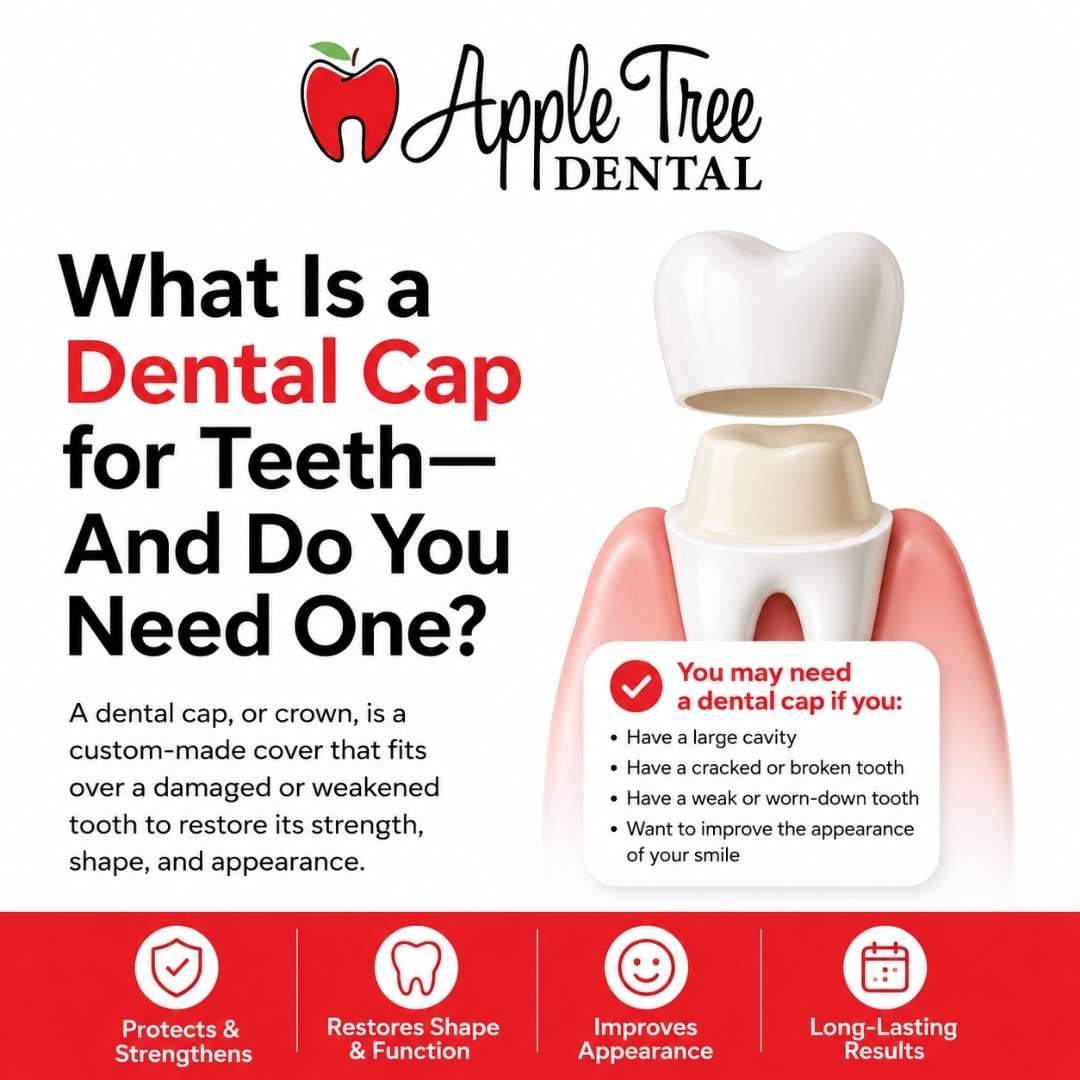
You bit into something hard and felt a crack. Or your dentist said your filling is too large to replace — your tooth needs a dental cap for teeth. Either way, you probably have questions. What exactly is a dental cap? How much does it cost in London, Ontario? Does the procedure hurt? At Apple Tree Dental, we answer these questions every day. This guide gives you everything you need to understand dental caps — before you ever sit in the chair.
What Is a Dental Cap? Understanding the Basics
The term “dental cap” and “dental crown” refer to the same restoration. Dentists use “crown” in clinical settings; patients often say “cap” — both are correct. A dental cap encases the entire visible portion of a tooth above the gum line. Think of it as a custom-fitted helmet that sits over a damaged tooth and holds everything together.
A crown becomes necessary when a tooth is too compromised for a filling alone. Large decay, a cracked cusp, a tooth weakened after a root canal, or a badly worn surface — these are situations where a dental cap for teeth is the clinically appropriate answer. Without a crown in these cases, the tooth risks fracturing further or failing entirely.
The Canadian Dental Association recognises dental crowns as one of the most common restorative procedures performed in Canada. They are well-documented, highly predictable, and designed to last a decade or more with proper care.
Dental Cap Types: Which Crown Material Is Right for You?
Not every crown is made from the same material. The right choice depends on which tooth is being crowned, how visible it is when you smile, what biting forces it must handle, and your budget. Here is a breakdown of the main dental cap types used at Apple Tree Dental in London, Ontario.
What Are All-Porcelain or All-Ceramic Crowns?
All-porcelain and all-ceramic crowns match the colour and translucency of natural teeth very closely. They are the most aesthetic option available and work especially well for front teeth. They contain no metal, which makes them an excellent choice for patients with metal sensitivities. The trade-off is that they are slightly less durable under heavy chewing forces compared to metal alternatives.
What Is a Zirconia Crown?
Zirconia is one of the most popular crown materials in modern dentistry. It is a type of ceramic that combines excellent aesthetics with exceptional strength. Zirconia crowns work on both front and back teeth. They are especially well-suited for a crown on a molar where bite forces are highest. They are biocompatible, long-lasting, and require minimal tooth reduction in some designs.
What Is a Porcelain-Fused-to-Metal Crown?
Porcelain-fused-to-metal (PFM) crowns have a metal substructure with a porcelain outer layer. They offer a reasonable balance of strength and aesthetics. One consideration is that the metal margin can sometimes show at the gum line as a dark line — particularly as gums recede with age. PFM crowns have been used reliably in dentistry for decades and remain a cost-effective option for many patients.
When Is a Gold or Metal Alloy Crown Used?
Gold and other metal alloys are among the most durable crown materials available. They rarely chip, fracture, or wear through. They require less tooth reduction than some other materials. Metal crowns are not tooth-coloured, which limits their use primarily to back molars where they are not visible. For patients who grind their teeth heavily, a metal crown on a back molar is often the most practical long-term choice.
| Crown Type | Best For | Key Advantage | Key Consideration |
|---|---|---|---|
| All-Porcelain / Ceramic | Front teeth, visible areas | Most natural appearance | Less impact-resistant than metal |
| Zirconia | Front and back teeth | Strong + aesthetic combination | Higher cost than PFM |
| Porcelain-Fused-to-Metal | Back teeth, general use | Balance of strength and aesthetics | Metal margin may show over time |
| Gold / Metal Alloy | Molars, heavy grinders | Exceptional durability | Not tooth-coloured |
Did You Know?
Zirconia crowns have become the standard for molar restorations in many Canadian dental practices. Their flexural strength — measured in megapascals — is significantly higher than that of traditional porcelain, making them highly resistant to the crushing forces generated by back teeth during chewing.
The Dental Cap Procedure: What Happens at Each Appointment?
Understanding the dental cap procedure step by step removes much of the uncertainty patients feel going in. Most crown placements involve two appointments spaced one to two weeks apart.
What Happens at the First Dental Crown Appointment?
At your first visit, your dentist examines the tooth and takes X-rays to assess the root and surrounding bone. If decay is extensive or the tooth has had a previous large filling, a core build-up may be placed first to give the crown a solid foundation. The tooth is then shaped — a small amount of enamel is removed from all sides to create room for the crown to fit without altering your bite.
Once the tooth is shaped, impressions or digital scans are taken. These go to a dental laboratory where your permanent crown is custom-fabricated. Before you leave, your dentist places a temporary dental cap over the prepared tooth. This temporary protects the tooth and maintains your appearance and function while you wait for the permanent crown.
What Happens at the Second Dental Crown Appointment?
When your permanent crown returns from the lab, you come in for the second appointment. Your dentist removes the temporary cap, checks the fit and colour of the permanent crown, and makes any minor adjustments. Once the fit is confirmed, the crown is permanently cemented into place. The entire second appointment typically takes under an hour.
Is Getting a Dental Cap Painful?
This is one of the most common questions patients ask about dental cap pain. The honest answer: the procedure itself is not painful. Local anaesthetic is administered before any tooth preparation begins. You may feel pressure during shaping, but no sharp pain. After the appointment, some patients experience mild sensitivity around the prepared tooth and gum area for a few days. Over-the-counter pain relief and avoiding very hot or cold foods manages this comfortably. If sensitivity is pronounced or persists beyond a week, contact your dental team.
Pro Tip — From the Clinical Team
Treat your temporary dental cap with care. Avoid sticky or hard foods — caramel, ice, raw carrots — until your permanent crown is in place. Temporary crowns are secured with short-term cement. They can dislodge if placed under excessive force. If your temporary does come off, store it safely and call us right away. Leaving the prepared tooth exposed causes sensitivity and can shift the surrounding teeth.
Who Needs a Dental Cap? Signs You May Be a Candidate
Not every damaged tooth needs a crown — but certain clinical situations make a dental cap the most appropriate and reliable solution. Your dentist at Apple Tree Dental in London, Ontario evaluates your specific situation and recommends a crown only when it is genuinely the right call.
Common reasons a tooth crown is recommended include: a tooth with a crack that extends toward the root; a large cavity that has destroyed too much natural tooth structure for a filling; a tooth that has just completed root canal treatment (which leaves it more brittle); a broken cusp; or a severely worn tooth from grinding. Crowns are also used to anchor a dental bridge, to cover a dental implant, and to improve the appearance of a severely discoloured or misshapen tooth. Patients exploring cosmetic options may want to review our cosmetic dentistry services to understand where crowns fit alongside other treatments.
Did You Know?
According to data compiled across Canadian dental practices, root-canal-treated teeth that are not crowned within a reasonable timeframe have a significantly higher long-term failure rate than those that receive a crown. A dental cap after root canal therapy is not optional in most cases — it is essential to protecting the investment already made in saving that tooth.
Dental Cap Cost in London, Ontario: What Affects Your Price?
Patients searching for dental cap cost information want a real answer — not vague ranges. The honest position is that crown costs vary, and there are specific reasons why. Understanding what drives the cost helps you plan accurately before your consultation.
The material is the largest cost variable. A gold alloy crown, a full-porcelain crown, and a zirconia crown are fabricated differently and carry different laboratory fees. The location of the tooth matters too — front teeth require more aesthetic precision; a crown on a molar demands different material properties. Any preparatory work required also affects the total: a core build-up if the tooth structure is insufficient, or a root canal if the pulp is involved, each adds to the treatment plan. In London, Ontario, most dental offices follow the Ontario Dental Association (ODA) fee guide as a baseline reference.
Most private dental insurance plans in Canada cover a portion of crown costs — typically 50% of the fee up to an annual maximum, after any deductible. The Canadian Dental Care Plan (CDCP) may provide additional support for eligible Canadians. Our team at Apple Tree Dental reviews your coverage before treatment and provides a fully itemised estimate so there are no surprises.
Dental Caps vs Veneers: How Do They Differ?
Patients comparing dental caps vs veneers are often surprised by how different these two restorations actually are — despite both involving a tooth-coloured shell placed over a tooth.
A dental cap (crown) encases the entire tooth — all surfaces above the gum line. It is chosen when structural integrity is at stake: significant decay, a cracked tooth, post-root-canal protection. A veneer covers only the front-facing surface of a tooth. It is a cosmetic restoration designed to improve appearance — colour, shape, minor alignment — on a tooth that is structurally healthy. Veneers require less tooth reduction than crowns, but they are not a substitute for a crown when structural damage is present. If your tooth is cracked or heavily decayed, a veneer will not solve the underlying problem. Our team can explain which option is appropriate at a consultation appointment.
| Feature | Dental Cap (Crown) | Veneer |
|---|---|---|
| Coverage | Entire tooth (360°) | Front surface only |
| Primary Use | Structural restoration | Cosmetic improvement |
| Tooth Reduction | More extensive | Minimal (0.3–0.7 mm) |
| Suitable For | Cracked, decayed, post-RCT teeth | Discolouration, chips, minor shape issues |
| Lifespan | 10–15+ years | 10–15 years with good care |
How Long Do Dental Caps Last — and How Do You Care for Them?
A well-placed dental cap for teeth lasts 10 to 15 years on average. Many last considerably longer with consistent care. Zirconia and metal crowns tend to outlast porcelain options when placed on high-force molars. The lifespan of a crown depends heavily on what happens at the gum line and in the underlying tooth — not just the crown itself.
Daily care for a crowned tooth is essentially the same as for any natural tooth. Brush twice daily with a soft-bristle brush. Floss carefully at the margin where the crown meets the gum — this junction is where decay can develop on the remaining natural tooth structure beneath. Avoid chewing ice, hard candy, or using teeth to open packaging. If you grind at night, ask your dentist about a custom night guard — grinding accelerates crown wear significantly. Regular checkups allow your dentist to monitor the crown margin and catch any issues early. Our general dentistry team includes crown monitoring in every routine exam.
Dental Crown Use in Canada: The Numbers
Frequently Asked Questions About Dental Caps in London, Ontario
What is a dental cap and how is it different from a crown?
Q: What is a dental cap, and is it the same as a crown?
A: A dental cap and a dental crown are exactly the same restoration. “Cap” is the everyday term patients use; “crown” is the clinical term dentists use. Both refer to a custom-made covering that fits completely over a prepared tooth above the gum line. The restoration restores the tooth’s shape, size, strength, and appearance. The terminology differs — the procedure and result do not.
How much does a dental cap cost in London, Ontario?
Q: What is the typical dental cap cost in London, Ontario?
A: Dental cap cost in London, Ontario varies depending on the material chosen (porcelain, zirconia, metal), the location of the tooth, and whether any preparatory work is needed — such as a core build-up or root canal treatment. Most private dental insurance plans cover a portion of crown fees. The Canadian Dental Care Plan (CDCP) may also assist eligible patients. At Apple Tree Dental, every consultation includes a transparent, itemised cost estimate before any treatment begins.
Is getting a dental cap painful?
Q: Does getting a dental cap hurt?
A: Dental cap pain during the procedure itself is minimal. Local anaesthetic is used throughout the tooth preparation appointment. Patients feel pressure but not sharp pain. After the anaesthetic wears off, mild sensitivity around the tooth and gum line for two to four days is normal. This is managed easily with over-the-counter pain relief. If discomfort is significant or lasts more than a week, contact your dentist — it may indicate the bite needs a small adjustment or that the underlying tooth requires further assessment.
What is the difference between dental caps vs veneers?
Q: When should I choose a dental cap versus a veneer?
A: Dental caps and veneers serve different purposes. A dental cap covers the entire tooth and is used when there is structural damage — a crack, large decay, or a tooth needing protection after a root canal. A veneer covers only the front surface of a tooth and is a cosmetic treatment for discolouration, chips, or minor shape irregularities on otherwise healthy teeth. If your tooth is structurally compromised, a crown is the correct treatment. A veneer on a damaged tooth will not resolve the underlying problem and may fail prematurely.
Can I get a dental cap for a molar?
Q: What type of crown is used on a molar?
A: Yes — a crown on a molar is very common, particularly after root canal treatment or when a molar has lost significant tooth structure to decay. Molars are high-force teeth, so the material recommendation differs from front teeth. Zirconia crowns are currently the most popular choice for molars because they combine excellent strength with an acceptable aesthetic result. Gold alloy crowns remain an outstanding option for back molars where appearance is not a priority — they are exceptionally durable and require minimal tooth adjustment in some designs.
What does a temporary dental cap do?
Q: Why do I need a temporary dental cap between appointments?
A: A temporary dental cap serves several important functions while your permanent crown is being fabricated. It protects the prepared tooth from temperature sensitivity, bacterial exposure, and physical damage. It also maintains the shape of the space so that surrounding teeth do not shift before the permanent crown is placed. Temporary caps are secured with short-term cement — they are not as strong as permanent crowns. Your dentist will advise you to avoid hard, sticky, or chewy foods on that side until your permanent cap is in place.
How do I find dental caps near me in London, Ontario?
Q: Where can I get a dental cap near me in London, Ontario?
A: Apple Tree Dental provides complete dental cap and crown services in London, Ontario — from initial assessment and tooth preparation through to permanent placement. Our team serves patients across London and surrounding communities. You can book a consultation online to have your tooth assessed and receive a personalised treatment plan. We keep our process transparent, and we answer every question before any procedure begins.
Ready to Restore Your Tooth? Book a Dental Cap Consultation in London, Ontario
A damaged tooth is not something to ignore. What starts as a manageable crack or large cavity can progress quickly — and a dental cap for teeth placed at the right time protects the tooth and saves you from more complex treatment later. At Apple Tree Dental in London, Ontario, our team makes the process straightforward, transparent, and genuinely comfortable from start to finish. We take time to explain your options, match the right crown material to your tooth and lifestyle, and work within your coverage and budget. Our restorative dentistry services cover every stage of the process — from diagnosis through final placement. Patients who also need adjacent teeth assessed or replaced can explore dental implant options alongside crown treatment.