
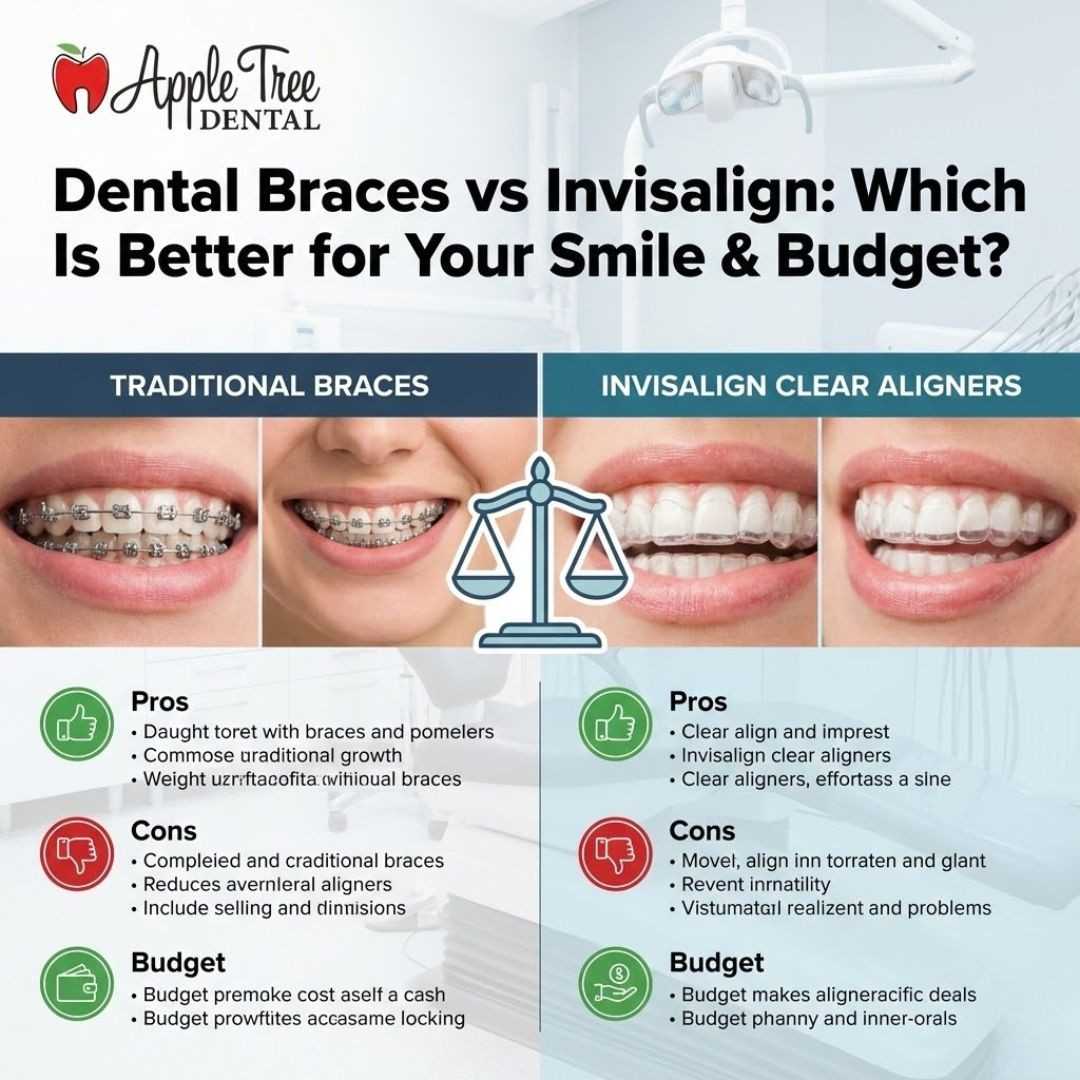
Choosing between dental braces vs Invisalign is a common decision for people looking to straighten their teeth and improve oral health. Both treatments are effective, but they differ in appearance, comfort, cost, and suitability for different dental conditions.
If you’re considering orthodontic treatment in London, Ontario, this guide will help you understand which option is right for your smile, lifestyle, and budget.
Quick Summary
When comparing dental braces vs Invisalign, braces are more effective for complex tooth and bite alignment, while Invisalign is ideal for mild to moderate correction and offers a discreet appearance. Costs vary depending on treatment complexity, and a professional dental evaluation is the best way to choose the right option.
What Are Dental Braces?
Dental braces use brackets and wires that stay fixed on the teeth. They apply controlled pressure over time to move teeth into proper alignment.
Types of Dental Braces
- Metal braces
- Ceramic (tooth-coloured) braces
- Self-ligating braces
Dental braces remain one of the most precise and reliable orthodontic treatments, especially for complex cases.
Dental Braces Are Commonly Used For:
- Crowded or overlapping teeth
- Large gaps between teeth
- Overbite, underbite, or crossbite
- Jaw alignment concerns
- Children and teens needing guided correction
What Is Invisalign?
Invisalign uses a series of clear, removable aligners custom-made to fit your teeth. Each aligner gradually shifts teeth into place.
Because aligners are nearly invisible, Invisalign is popular with adults and teens who want a less noticeable orthodontic option.
Invisalign Works Best For:
- Mild to moderate misalignment
- Small gaps or spacing issues
- Minor bite concerns
- Patients who prefer removable treatment
Dental Braces vs Invisalign: Key Differences
Appearance
- Dental Braces: Visible, though ceramic options blend better
- Invisalign: Clear and discreet
Comfort
- Dental Braces: Some soreness after adjustments
- Invisalign: Smooth aligners with less irritation
Effectiveness
- Dental Braces: Ideal for complex orthodontic issues
- Invisalign: Best for simpler alignment cases
Daily Use
- Dental Braces: Fixed and always working
- Invisalign: Must be worn 20–22 hours daily
Eating and Oral Hygiene
- Dental Braces: Certain foods should be avoided
- Invisalign: Aligners are removed for eating and brushing
Which Option Is Better for Your Budget?
For complex alignment problems, dental braces may offer better value, as they provide consistent results without relying on patient compliance.
Invisalign may cost more, but many patients find the benefits—such as comfort, appearance, and flexibility—worth the investment.
A personalized dental consultation is the most accurate way to compare value, not just cost.
Not Sure Which Option Is Right for You?
Choosing between braces and Invisalign depends on your teeth, bite, and long-term goals. Starting the right treatment early can reduce treatment time and overall cost.
Book an orthodontic consultation at Apple Tree dental to receive a customized treatment plan designed around your smile.
Why Professional Experience Matters
Orthodontic outcomes depend not only on the system used, but also on the experience of the dentist.
At Apple Tree Dental, orthodontic care is guided by Dr. Nagham Altalib, whose background includes:
- International dental education
- Experience in orthodontics and prosthodontics
- A strong focus on family and child dental care
Her approach emphasizes accurate diagnosis, patient comfort, and long-term oral health.
Braces or Invisalign for Children and Teens?
- Dental braces are often recommended for children because they do not rely on remembering to wear aligners.
- Invisalign Teen may be suitable for responsible teens with mild alignment concerns.
Parents in London, Ontario frequently choose braces for younger patients due to predictable results.
Braces or Invisalign for Adults?
Adults often prefer Invisalign for its discreet appearance and convenience. However, adults with complex bite or spacing issues may still benefit more from dental braces.
Safety and Dental Standards in Canada
Orthodontic care in Canada follows strict clinical and safety guidelines. According to the Canadian Dental Association, proper diagnosis, treatment planning, and follow-up care are essential for safe and effective orthodontic treatment.
Clinical Review & Accuracy
This content has been clinically reviewed for accuracy and relevance by Dr. Nagham Altalib, ensuring alignment with current Canadian dental standards and patient care best practices.
Frequently Asked Questions
What is the difference between dental braces and Invisalign?
Dental braces use fixed brackets and wires.
Invisalign uses removable clear aligners.
Which is better, dental braces or Invisalign?
Dental braces are better for complex alignment.
Invisalign is better for mild to moderate cases.
Is Invisalign more expensive than braces?
Invisalign usually costs slightly more.
Exact pricing depends on treatment complexity.
How long does orthodontic treatment take?
Most treatments take 12 to 24 months.
Do braces hurt more than Invisalign?
Braces may cause more initial soreness.
Invisalign is generally more comfortable.
Are dental braces better for children?
Yes. Braces are often better for children because they do not rely on wearing aligners consistently.
Can adults choose Invisalign instead of braces?
Yes. Many adults choose Invisalign for its discreet appearance.
How do I choose between braces and Invisalign?
A dental exam is the best way to decide.
Your dentist will recommend the right option.
Final Verdict: Dental Braces vs Invisalign
There is no single best choice for everyone.
- Choose dental braces for complex correction and precise control
- Choose Invisalign for comfort, discretion, and flexibility
The right treatment starts with the right evaluation.
Schedule your orthodontic consultation at Apple Tree Dental in London, Ontario, and take the next step toward a healthier, straighter smile.