
Dental Care · London, Ontario
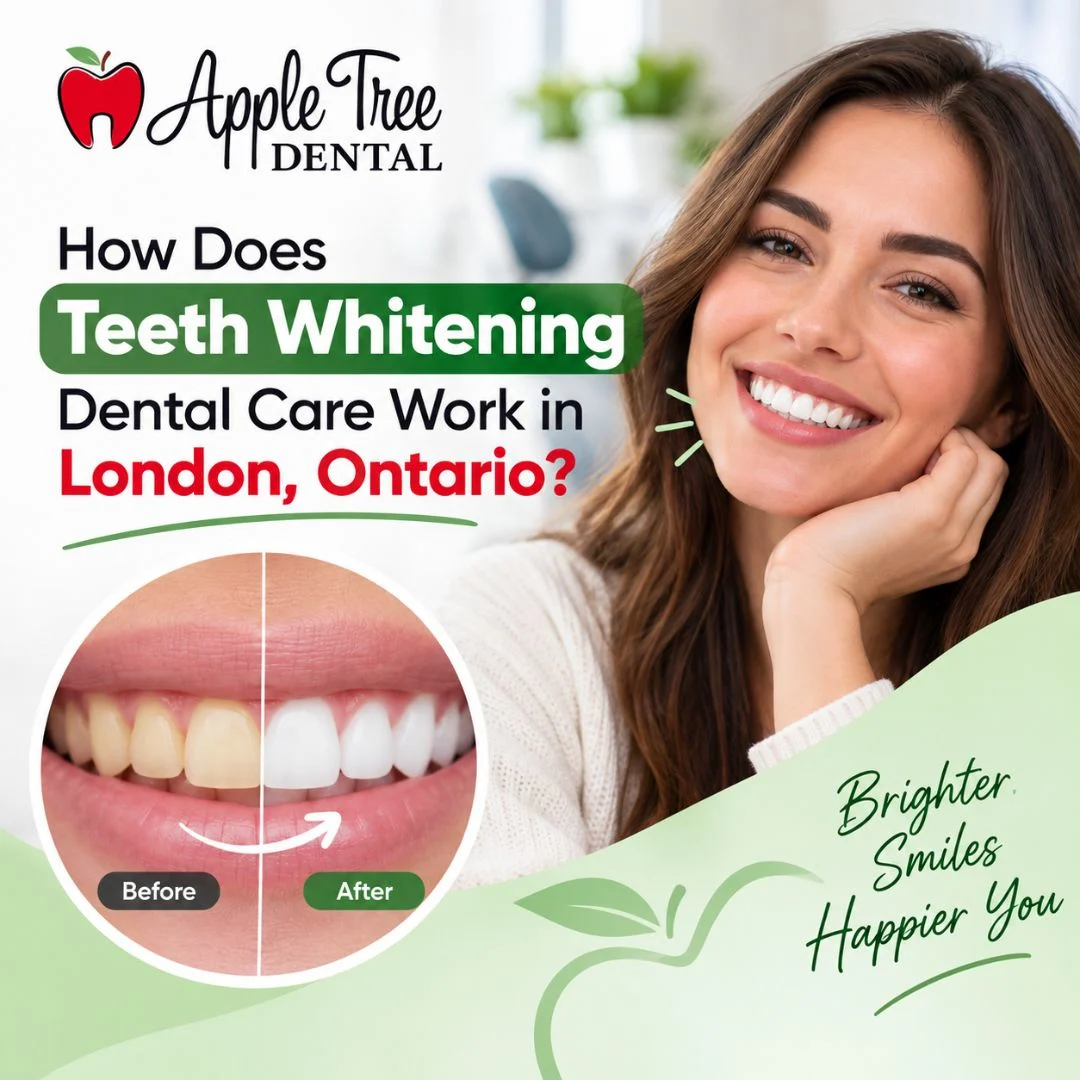
Teeth whitening dental care at a clinic lightens teeth by several shades in one visit or over two to three weeks, depending on the method. A dentist checks your gums, fillings and enamel first, which store-bought kits skip entirely.
Apple Tree Dental offers whitening consultations at its Beaverbrook Avenue North and Wonderland Road South clinics in London.
You’ve got a wedding in June, a job interview Monday, or a photo you’d rather not look at. So you search for teeth whitening dental care that works, and end up staring at forty different boxes of strips.
Here’s the honest version. Some whitening methods are worth it, some are a waste of $40, and a few can leave your gums sore for a week. This guide sorts out which is which, what dental teeth whitening costs you in time and money, and how to decide.
1. What professional teeth whitening actually does
2. Dentist whitening vs. store-bought kits
3. In-office vs. take-home options
4. Who shouldn’t whiten yet
5. Cost, insurance and time
6. How to make results last
7. Whitening in London, Ontario
8. FAQs
1What Does Professional Teeth Whitening Actually Do?
Coffee, tea, red wine and tobacco leave pigment in the tiny pores of your enamel. Age darkens the dentin underneath too. Whitening gel releases oxygen that breaks those pigments into smaller, lighter pieces.
That’s why a cleaning comes first. Scaling removes surface buildup so the gel can reach the enamel evenly. Skip it and you’ll get patchy results.
Most people go two to eight shades lighter. Your starting colour, the type of staining, and the method you pick all change that number. Yellow stains respond best. Grey or blue-toned stains from certain medications respond slowly and sometimes need veneers instead.
2Is Dentist Teeth Whitening Better Than Over-the-Counter Kits?
Drugstore strips work on the front six teeth and often miss the sides. One-size trays leak gel onto your gums. Health Canada regulates tooth whitening products and limits peroxide strength for products sold to the public, which is why the strongest gels stay in the dental office. You can read the federal guidance on tooth whitening products from Health Canada.
| Store-bought kits • Lower peroxide strength • Generic trays or strips • No exam beforehand • Uneven shade is common |
Dentist-supervised • Higher, controlled strength • Custom trays or gum barrier • Exam and cleaning first • Even, predictable results |
There’s a safety angle too. Whitening gel can’t tell the difference between a natural tooth and a cavity. A dentist spots decay, cracks and receding gums before the gel does the damage.
3Which Is Better: In-Office or Take-Home Whitening?
In-office whitening
Your dental team isolates your gums, applies a professional-strength gel, and activates it in short cycles. You leave visibly brighter the same day. It suits deadlines like weddings, graduations and headshots.
Custom take-home trays
Your dentist takes impressions and makes trays that fit your bite. You wear them 30 to 60 minutes a day with a lower-strength professional gel. The slower pace tends to be gentler on sensitive teeth.
Combining both
Many patients start in the chair, then keep the trays for touch-ups every six to twelve months. It’s a practical way to protect your investment.
| Factor | In-office | Take-home trays |
|---|---|---|
| Time to results | 1 visit (about 60 to 90 min) | 10 to 14 days |
| Best for | Events, fast turnaround | Sensitive teeth, budgets |
| Sensitivity risk | Moderate, short-term | Lower, adjustable |
| Touch-ups | Book a visit | Reuse trays at home |
4Who Shouldn’t Whiten Their Teeth Yet?
This is the gap most clinic pages leave out, and it’s where people get burned. Whitening only works on natural enamel. If you have a front crown or bonded filling, it stays the shade it is, so your teeth can end up mismatched.
- Gum recession or worn enamel: Gel reaches sensitive areas and causes sharp zings.
- Old restorations: They may need replacing after whitening to match.
- Pregnancy: Most dentists advise waiting as a precaution.
- Deep grey or banded stains: Better handled with cosmetic dentistry options like veneers or bonding.
Straightening first is often smarter too. Patients finishing treatment with Invisalign clear aligners commonly whiten right after, since the trays can double as a whitening guide under your dentist’s direction.
5How Much Does Teeth Whitening Cost in London, Ontario?
Three things move the price: the method, how deep your staining runs, and whether you need a cleaning first. Anyone quoting you a flat number over the phone without seeing your teeth is guessing.
Insurance is the other question. Most Ontario dental plans classify whitening as cosmetic and don’t cover it, though the cleaning and exam beforehand usually are. The Canadian Dental Association’s procedure guide explains how dental treatments are typically categorized.
Think in cost per year, not per visit. A whitening that lasts one to two years with occasional touch-ups is cheaper than replacing strips every month.
6How Do I Keep My Teeth White After Whitening?
- First 48 hours: Stick to a “white diet” of chicken, rice, pasta, milk and water. Enamel is extra porous right after treatment.
- Coffee and wine: Use a straw and rinse with water afterwards.
- Toothpaste: Choose a low-abrasion, fluoride formula. Charcoal powders scratch enamel.
- Regular cleanings: Surface stain returns faster when tartar builds up.
If you’re missing a tooth and planning a smile makeover, sequence matters. Whiten first, then match your new restoration. Dental implants are shade-matched to your teeth, so whitening beforehand avoids a mismatch.
7Where Can I Get Professional Teeth Whitening in London, Ontario?
Apple Tree Dental is a family practice with RCDSO-registered dentists. You can confirm any Ontario dentist’s registration through the RCDSO public register, and you should before booking anywhere.
The team starts every whitening plan with an exam, so your gums, fillings and enamel are checked before any gel goes on. If you live near Wonderland Road, the South London clinic page has directions and hours.
Patients from Masonville, Byron, Westmount and Oakridge usually pick whichever location is closer to home or work. Both offer the same consultation.
Ready for a brighter smile?
Get a personalized whitening plan and an exact quote after a quick exam.
Frequently Asked Questions
How do I get teeth whitening that lasts?
Start with a professional cleaning, then choose in-office or custom take-home whitening. Avoid staining foods for 48 hours afterwards and book touch-ups every 6 to 12 months. Consistent brushing and regular cleanings protect the results.
Is professional teeth whitening safe for enamel?
Yes, when a dentist supervises it. Professional gels are used at controlled strengths with gum protection, and your teeth are checked first. Temporary sensitivity is common, but it typically fades within a day or two.
How long does dental teeth whitening take?
In-office whitening takes about an hour to 90 minutes in one visit. Take-home trays take roughly 10 to 14 days at 30 to 60 minutes daily. Your dentist recommends one based on your timeline and sensitivity.
Does teeth whitening hurt?
It shouldn’t hurt, but many people feel mild sensitivity or gum tingling for 24 to 48 hours. Tell your dentist if you already have sensitive teeth. They can adjust gel strength or switch to take-home trays.
How many shades whiter can I go?
Most people lighten two to eight shades, depending on staining type and starting colour. Yellow stains respond best, while grey stains and restorations respond less. Your dentist can estimate your result at the consultation.
Is whitening covered by insurance in Ontario?
Usually not. Most plans treat whitening as cosmetic, though your exam and cleaning may be covered. Ask your insurer directly, and request a written estimate from the clinic so you know your out-of-pocket cost.
How do I whiten the teeth I have with crowns or fillings?
Whitening won’t change crowns, veneers or fillings. Your dentist whitens the natural teeth first, then replaces visible restorations to match the new shade. This avoids a patchy look, so plan the order with your dentist.