
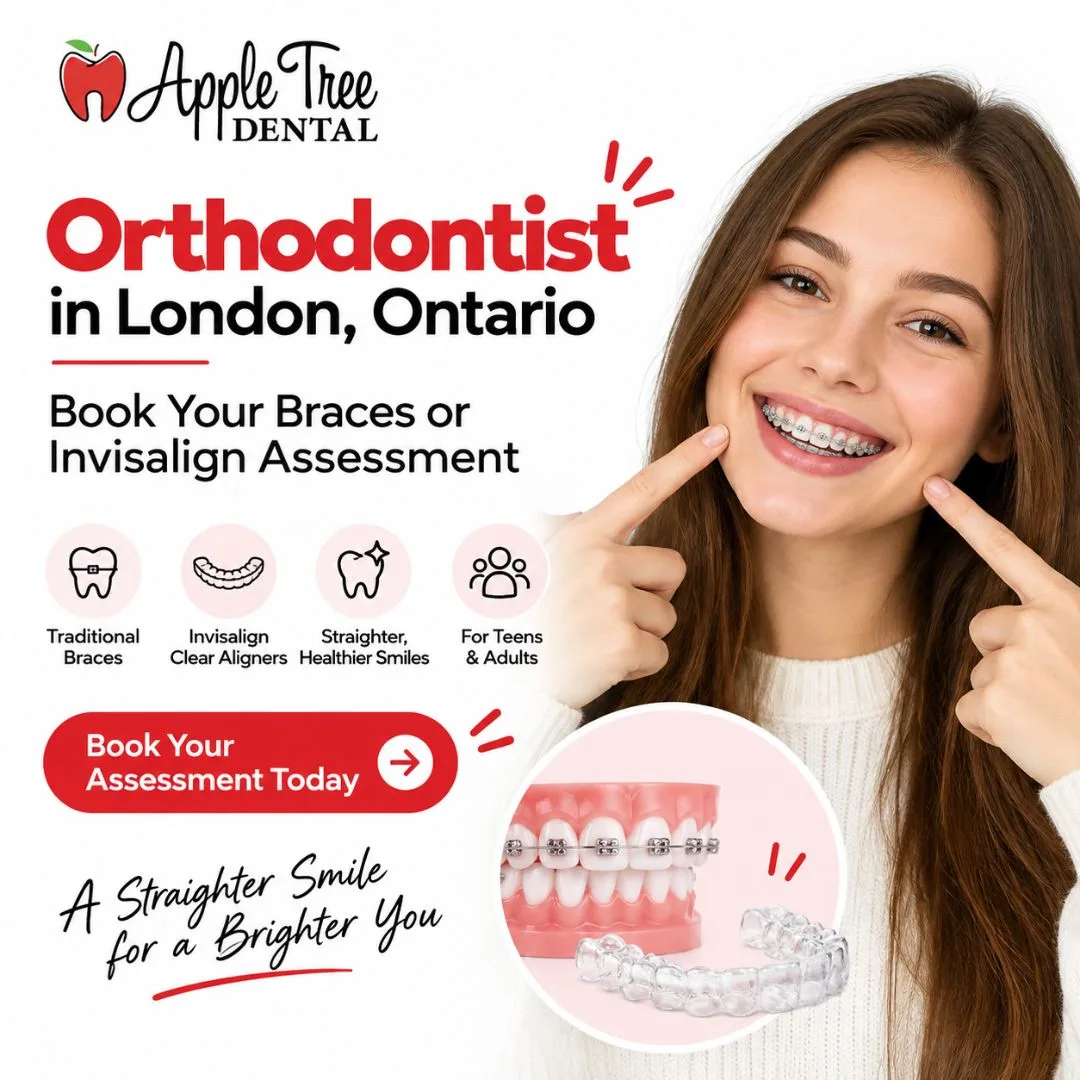
Quick answer: If you’re ready to book a London orthodontist, confirm four things first: whether your case needs a general dentist or a registered specialist, what’s actually included in the treatment plan, whether CDCP applies to your situation, and whether the clinic treats you in-house alongside your regular dental care. Apple Tree Dental takes orthodontic assessments now at both its Beaverbrook Avenue North and Wonderland Road South locations in London — book online or call ahead.
You’ve decided it’s time — braces or Invisalign, for you or your teenager. You’re ready to book with a London orthodontist rather than keep researching. Good. The fastest way to get there without a bad surprise mid-treatment is to confirm a few things first. Before your first appointment, find out who’s actually treating you, what the plan covers, and where CDCP fits. This page walks through exactly that, then gets you to a booking link.
📋 Table of Contents
→ What Most London Orthodontist Pages Don’t Tell You
→ Who Should Treat Your Case: Specialist or General Dentist?
→ 5 Things to Confirm Before You Book
→ Braces or Invisalign: Which Fits Your Case
→ CDCP Reality for Orthodontics in Ontario
→ When to Book Your Child’s First Orthodontic Visit
✅ Key Takeaways
- “Orthodontist” and “dentist who does orthodontics” are not the same credential — a general dentist can treat straightforward cases, but a registered specialist has two to three years of extra training for complex bites.
- Most London clinics don’t clarify their treatment plan until the consultation. Ask for a written breakdown of what’s included before you compare two clinics.
- CDCP generally does not cover orthodontic treatment for adults. Coverage for children and youth stays limited and case-specific. Confirm eligibility in writing, not from a homepage banner.
- Staying in-house, at the same clinic as your regular dentist, avoids a second file and a second set of X-rays. Referrals out add weeks to the timeline before treatment even starts.
- Apple Tree Dental provides Invisalign and orthodontic assessments at both London locations — North on Beaverbrook Avenue and South on Wonderland Road. Imaging happens on-site. Book your assessment at either location.
What Most London Orthodontist Pages Don’t Tell You
Search “orthodontist London Ontario” and the first page reads almost identically across every result. You’ll see a hero photo of a smiling patient, a line about a “revolutionary” clear aligner, and a contact form. None of it tells you what you actually came for.
We reviewed how the top-ranking London orthodontic pages handle this decision. The pattern is consistent. Most pages describe treatment options in general terms. Few spell out what’s actually included in a plan. Several sites blur the line between a general dentist offering Invisalign and a specialist orthodontist, without saying which one you’d see. Almost none explain what happens to your coverage once CDCP enters the picture, even though that’s the first thing most patients ask about in 2026. This guide closes those three gaps directly, using our own process as the working example, because it’s the one we can answer for with certainty.
💡 Front-Desk Insight: The question we hear most at the consultation stage isn’t “does this work” — it’s “why does the plan I got somewhere else sound so different from this one.” Usually the difference comes down to whether the original explanation included retainers, follow-up adjustments, and refinement aligners. Ask for a written breakdown of what’s covered before you commit to anything.
Who Should Treat Your Case: Specialist or General Dentist?
A registered orthodontic specialist has completed dental school plus a further two to three years focused only on tooth movement and jaw alignment. A general dentist offering Invisalign or braces has typically taken shorter continuing-education courses on top of a general practice.
For mild to moderate crowding, spacing, or a simple bite correction, a general dentist with orthodontic training often handles the case well. A specialist’s extra training becomes worth the referral for a significant overbite, jaw discrepancy, or a case where a previous attempt failed. The honest answer from any clinic should tell you which category your case falls into during the first visit, not after you’ve already ordered aligners.
At Apple Tree Dental, orthodontic assessments start with a scan and a straight answer about which category applies to you. We refer out only when the case genuinely calls for specialist-level care.
5 Things to Confirm Before You Book
Run any London clinic through these five filters at the consultation. It takes one phone call, and it prevents the mid-treatment surprise that turns patients off orthodontics for good.
1
A full written treatment plan, not just a verbal summary. Get the scope of treatment, the estimated timeline, and what’s included in writing before comparing two clinics.
2
Whether the plan includes retainers. Some clinics bill post-treatment retainers separately, and skipping them undoes months of movement within a year.
3
In-house treatment or a referral. Ask if the dentist doing your regular cleanings is the same person planning your orthodontic case. If not, you may be sent elsewhere for a second intake.
4
Real appointment frequency. Traditional braces need adjustments roughly every 4 to 8 weeks; Invisalign check-ins are usually longer apart. Confirm what that means for your schedule over the next year.
5
CDCP eligibility, confirmed for your case specifically. Don’t rely on a general statement about the federal plan — ask what it means for orthodontic treatment at your age and income bracket.
Confirmed which category you’re in and ready to move forward?
Braces or Invisalign: Which Fits Your Case
Both move teeth into the same end position. The difference that matters day to day is visibility, diet restrictions, and how much discipline the treatment demands from you.
| Factor | Traditional Braces | Invisalign |
|---|---|---|
| Visibility | Visible metal or ceramic brackets | Clear, removable trays |
| Diet restrictions | Sticky and hard foods off-limits | None — trays come out to eat |
| Best for | Complex bite issues, younger patients | Mild to moderate cases, working adults |
| Requires patient discipline | Low — brackets stay on regardless | High — needs 20–22 hours a day worn |
If you’ve lost or forgotten to wear a retainer before, or you know you’d forget to put trays back in after lunch, that history should factor into which option you choose. Once you’ve picked a direction, the next step is a consultation to confirm it fits your bite.
CDCP Reality for Orthodontics in Ontario
The Canadian Dental Care Plan has genuinely changed the conversation for preventive and restorative work across London. Orthodontics sits outside most of that shift. CDCP limits coverage for braces or aligners mostly to specific medically necessary cases in children and youth. Adults shouldn’t expect to lean on it for a routine straightening case.
That makes how a clinic explains its treatment plan the bigger factor. Ask specifically what happens if treatment runs longer than the original estimate. Extended timelines happen often with more complex cases, and a clinic that discloses how it handles that upfront is being straight with you.
Ask any clinic for a full written treatment plan that lists what’s included. It should cover retainers, adjustments, and any refinement aligners, not just a general verbal summary. A clinic that can’t put that in writing before your first appointment is giving you a signal worth weighing.
When to Book Your Child’s First Orthodontic Visit
Most guidance points to around age 7 for a first orthodontic evaluation, even though visible treatment often doesn’t start for several more years. That early check catches jaw growth issues and crowding patterns while there’s still room to guide development. A simple appliance now can prevent a longer full-braces case later.
Not every child needs early intervention. A first evaluation is about ruling problems out as much as catching them. A clinic that recommends treatment at every early visit, regardless of what it finds, is worth a second opinion. If your child is around 7, or has already had crowding flagged at a check-up, book an evaluation now. Don’t wait for it to come up again next year.
Book at Apple Tree Dental: Two London Locations
Apple Tree Dental provides orthodontic assessments and Invisalign treatment at both London locations: North London on Beaverbrook Avenue and South London on Wonderland Road. Your file, scans, and progress notes carry between the two, so a schedule conflict at one location doesn’t mean starting over at the other.
📍 Two things worth knowing before your consultation:
- Assessments include on-site imaging to determine whether your case suits Invisalign, traditional braces, or a specialist referral, before we quote any treatment plan.
- Written treatment plans spell out what’s included — retainers, adjustments, and refinements — so nothing gets left out of the conversation once treatment starts.
We also provide cosmetic dentistry, dental implants, and general family care across both London clinics. An orthodontic case that surfaces a cavity or a cracked tooth along the way doesn’t mean a second clinic and a second file.
Frequently Asked Questions
What determines how much orthodontic treatment involves in London, Ontario?
Case complexity, treatment length, and whether you choose braces or Invisalign all factor in. Ask for a written plan that separates retainers and refinements from the base treatment so you know exactly what’s included.
Does CDCP cover braces or Invisalign in Ontario?
CDCP limits coverage mostly to specific medically necessary cases in children and youth. Adults shouldn’t expect it to cover routine orthodontic treatment — confirm your eligibility directly before booking.
Do I need a specialist orthodontist or can a general dentist do it?
A general dentist trained in orthodontics often handles mild to moderate crowding or spacing well. Complex bite or jaw issues benefit from a registered specialist’s additional two to three years of training.
How long does orthodontic treatment take?
Most cases run 6 to 24 months, depending on how much movement the teeth need and whether the patient wears aligners as instructed. Simple cases can finish faster; complex bite corrections take longer.
At what age should a child first see an orthodontist in London?
Around age 7 for an initial evaluation, even though visible treatment usually starts later. Early checks catch jaw growth patterns while there’s still room to guide development.
Does Apple Tree Dental offer Invisalign in London, Ontario?
Yes. Apple Tree Dental provides Invisalign and orthodontic assessments at both London locations — North on Beaverbrook Avenue and South on Wonderland Road — and does the imaging on-site.
How do I book an orthodontic consultation at Apple Tree Dental?
Book online or call your nearer London location and ask for an orthodontic assessment appointment.
You’ve done the research. The next step is a real assessment: imaging, a written plan, and a straight answer on whether Invisalign, braces, or a specialist referral fits your case.
Apple Tree Dental takes orthodontic assessments now at either London location, CDCP eligibility included.