
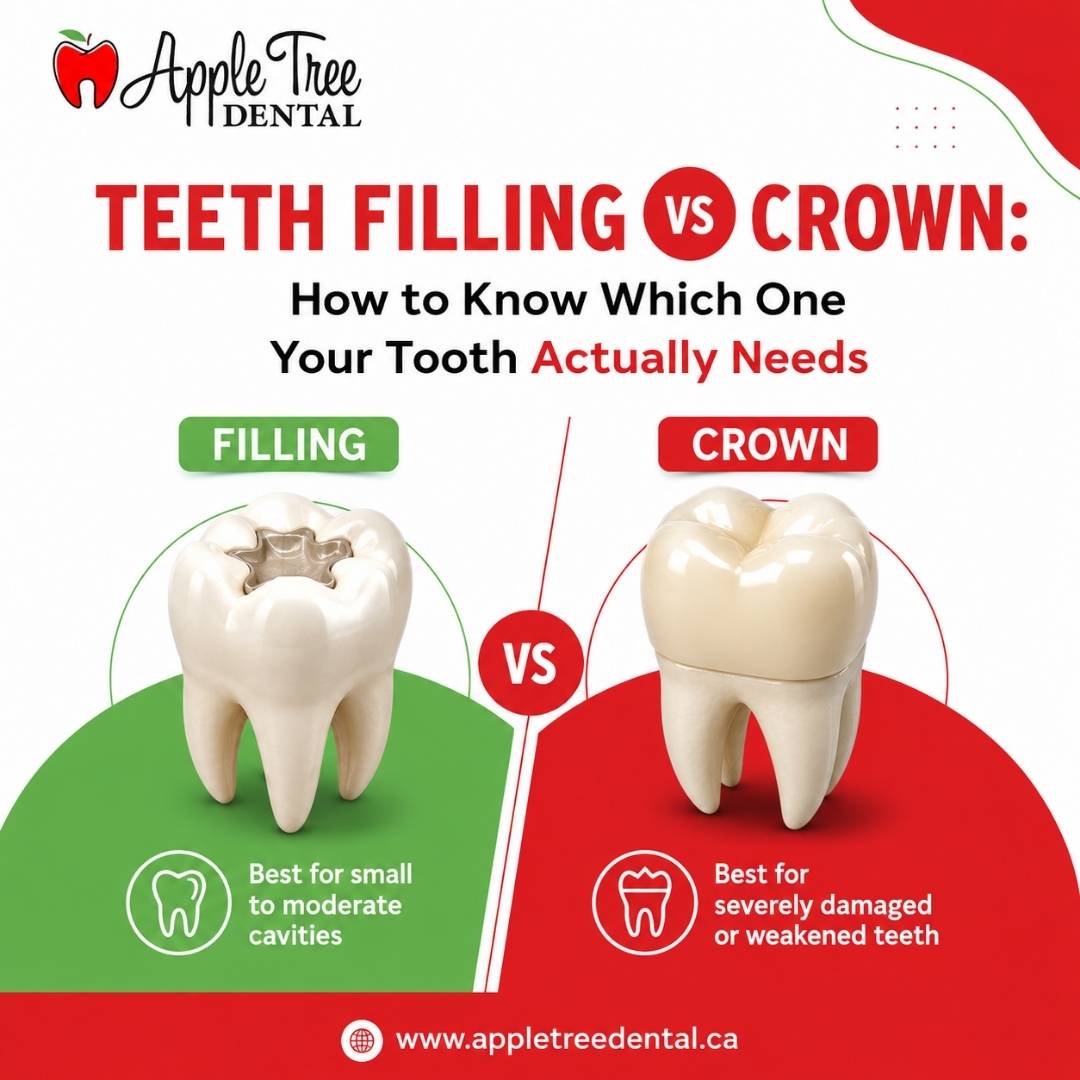
A cracked or decayed tooth leaves you with one big question: teeth filling vs crown — which one do you need? The answer depends almost entirely on how much healthy tooth structure remains. Small to moderate damage usually means a filling. Large damage, deep cracks, or a tooth weakened by a root canal usually means a crown. If you are unsure which side your tooth falls on, Apple Tree Dental in London, Ontario can examine it and give you a straight answer.
Teeth Filling vs Crown: How London, Ontario Dentists Decide Which One You Need
Your dentist looks at one thing above everything else: how much healthy tooth is left. A tooth with a small cavity and strong walls can hold a filling for years. A tooth with a large cavity, thin walls, or a crack running through it cannot.
Put a filling in a tooth that really needs a crown, and the tooth often fractures later. That fracture can run below the gumline — and at that point, the tooth may not be saveable at all. This is why the crown vs filling decision matters more than most patients realise.
The Canadian Dental Association lists both fillings and crowns as standard restorative treatments. Neither is “better.” Each solves a different problem.
Teeth Filling vs Crown: The Key Differences Side by Side
Think of the teeth filling vs crown choice this way. A filling patches a pothole. A crown repaves the whole road surface. Both work — but only when matched to the right amount of damage.
One more term worth clearing up: “filler dental” searches usually mean dental fillings, not cosmetic facial filler. If your dentist mentions a filling, they mean the tooth repair described here.
What to Expect: Step-by-Step Process
Step 1: Exam and X-rays
Your dentist examines the tooth and takes X-rays to see how deep the decay or crack runs. This is where the filling-or-crown decision gets made. You will know your options before any drilling starts.
Step 2: Numbing the area
Local anaesthetic keeps the procedure pain-free for both treatments. Nervous about needles or dental work in general? Say so. Your provider can adjust the pace and explain each step as it happens.
Step 3 (Filling): Removing decay and filling the tooth
For a filling, the dentist removes the decayed portion, cleans the space, and places composite resin in layers. Each layer hardens under a curing light. The dentist then shapes and polishes it to match your bite. You are done in one visit.
Step 3 (Crown): Shaping the tooth and taking impressions
For a crown, the dentist reshapes the tooth so the cap fits over it. Impressions or a digital scan go to a lab where your custom crown gets made. A temporary crown protects the tooth in the meantime.
Step 4 (Crown): Fitting the permanent crown
Two to three weeks later, you return. The dentist removes the temporary, checks the fit and colour of the permanent crown, and cements it in place. A quick bite check, minor adjustments, and you leave with a fully restored tooth.
Step 5: Aftercare for both
Mild sensitivity for a few days is normal after either procedure. Brush twice daily, floss around the restoration, and keep regular checkups. Fillings and crowns both fail early when the tooth around them gets neglected.
Cost of Fillings and Crowns in London, Ontario — What You’ll Actually Pay
Here is the honest picture. A filling costs a fraction of what a crown does — a crown involves lab work, custom fabrication, and two appointments. That gap tempts some patients to push for a filling when their tooth needs a crown. It rarely ends well. A fractured tooth later can mean extraction and an implant, which costs far more than the crown would have.
Contact Apple Tree Dental directly for a personalised estimate based on your exam and X-rays. You get real numbers before committing to anything.
When a Filling Fails: Why Dentists Sometimes Upgrade You to a Crown
Fillings have a size limit. Composite resin bonds to tooth structure — but it needs enough of that structure to bond to. Once decay eats away more than about half the tooth, the remaining walls become thin and brittle.
A large filling in a thin-walled tooth acts like a wedge. Every bite pushes outward on those weak walls. Over months or years, the walls crack. This is the most common reason a dentist recommends replacing an old, oversized filling with a crown before anything breaks.
Root canal treatment is the other big trigger. A tooth loses moisture and strength after a root canal, especially molars that take heavy chewing force. The Royal College of Dental Surgeons of Ontario (RCDSO) holds Ontario dentists to evidence-based standards — and the evidence strongly supports crowning back teeth after root canal treatment to prevent fracture.
Teeth Filling vs Crown: Which One Is Right for You? (Signs + Candidacy)
Some teeth sit in the grey zone between the two. In those cases, your dentist may suggest an inlay or onlay — a lab-made restoration that covers part of the tooth without a full crown. An exam and X-ray at Apple Tree Dental in London, Ontario will tell you exactly where your tooth stands.
Frequently Asked Questions: Teeth Filling vs Crown
Which is better, a filling or a crown?
Neither is universally better. A filling is better for small damage because it preserves natural tooth. A crown is better for large damage because it protects the whole tooth from fracture. The right choice depends on how much healthy tooth structure remains — which only an exam can confirm.
Does a crown hurt more than a filling?
No. Both procedures happen under local anaesthetic, so you feel pressure but not pain. A crown appointment runs longer, and some patients notice more sensitivity for a few days afterward. Over-the-counter pain relief handles it in almost every case.
How long do fillings and crowns last?
Composite fillings typically last 5 to 10 years. Crowns typically last 10 to 15 years, and many last 20 or more. Daily habits decide the outcome — brushing, flossing, avoiding ice chewing, and wearing a night guard if you grind your teeth all extend the life of either restoration.
Can a tooth with a large filling be crowned later?
Yes — and it happens often. Many crowns go on teeth that carried large fillings for years. The dentist removes the old filling, builds up the core if needed, and shapes the tooth for the crown. Doing this before the tooth cracks gives a far better outcome than waiting for a fracture.
Do I always need a crown after a root canal?
Back teeth — molars and premolars — almost always need a crown after a root canal because they take heavy chewing force and become brittle. Front teeth sometimes manage with a filling alone if enough structure remains. Your dentist will assess the specific tooth and tell you which applies.
What happens if I delay getting a crown my dentist recommended?
The tooth stays at risk of cracking. If the crack stays above the gumline, a crown can still save the tooth. If it runs below the gumline or splits the root, extraction often becomes the only option — followed by a bridge or implant at much higher cost. Delaying rarely saves money in the end.
Get a Clear Answer on Filling vs Crown in London, Ontario
The teeth filling vs crown decision comes down to your tooth — not a general rule. A short exam with X-rays at Apple Tree Dental gives you a clear recommendation and real cost numbers before anything starts. Book your appointment in London, Ontario today and stop guessing.