
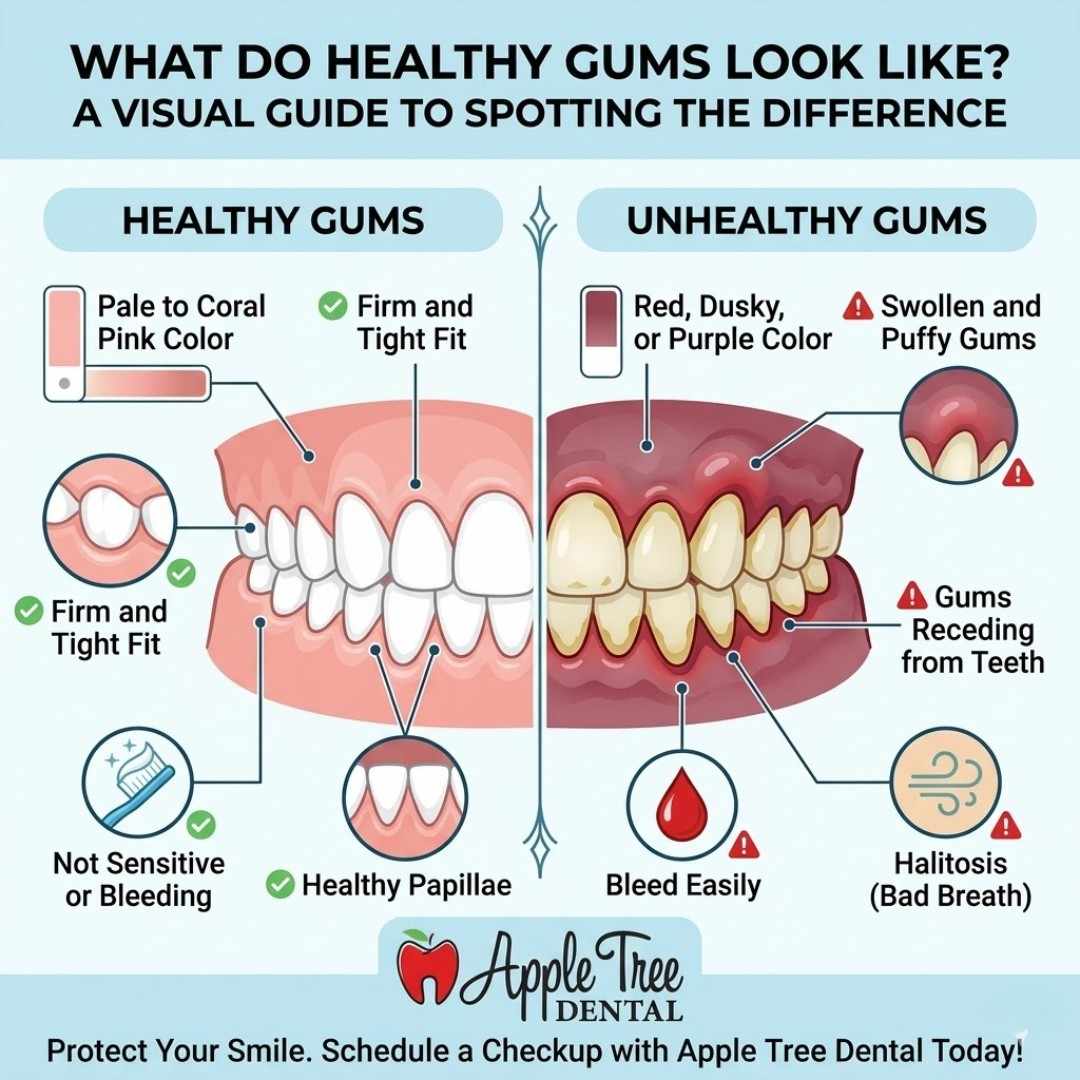
Healthy gums have a very specific look — and once you know what to look for, checking your own is simple. Pink, firm, and fitted snugly around each tooth — that is the baseline. If your gums look different from that description, it is worth paying attention. This guide explains exactly what healthy gums look like, what warning signs mean, and when to book an appointment at Apple Tree Dental in London, Ontario.
What Does Healthy Gums Look Like? A Clear Guide for Canadian Adults
Most people only think about their gums when something hurts. But gum problems rarely hurt in the early stages. They show up visually first — in colour, texture, and shape. Learning to read those signs gives you a real advantage. You can catch issues months before they become painful or expensive to treat.
Signs of Healthy Gums: Colour, Texture, and Shape
Colour
The standard reference point is coral pink. That said, gum colour naturally varies. People with darker skin tones often have gums with brown or blue-black pigmentation — this is completely normal and healthy. What matters is consistency. Your gums should look the same shade throughout, with no sudden red patches, white spots, or pale areas.
Texture
Run your tongue across your gums. Healthy gum tissue feels firm and slightly textured — dentists describe it as having a stippled surface, similar to orange peel. Puffy, soft, or smooth gum tissue that feels spongy under pressure is a warning sign. That texture change often means inflammation has already started.
Shape and fit
Healthy gums form a tight, scalloped edge around each tooth. They do not gap away from the tooth surface. They do not sit so high that the tooth root is exposed. The margin — the point where gum meets tooth — should look like a neat cuff, not a loose collar. If you can see more of your teeth than you used to, your gums may be receding.
No bleeding
This one is simple. Healthy gums do not bleed. Not when you brush, not when you floss, not after eating something firm. Bleeding is your immune system responding to bacteria in the gum tissue. It is a signal — not something to rinse away and forget about.
Healthy Gums vs. Unhealthy Gums: What the Difference Looks Like
The Canadian Dental Association identifies gum disease as one of the most common oral health conditions in Canada — and most people with early-stage gum disease have no idea. That is precisely why knowing what to look for matters.
Early Gingivitis Symptoms: What to Watch For
Gingivitis is the earliest and most treatable stage of gum disease. The Royal College of Dental Surgeons of Ontario (RCDSO) recognises it as a reversible condition — meaning with the right care, your gums can return fully to normal.
Early gingivitis signs include gums that look slightly redder than usual, a small amount of bleeding when you floss, and mild puffiness at the gum line. These symptoms often appear gradually. Many people brush it off, assuming they flossed too hard. But when the bleeding is consistent — happening every time — it is your body flagging a bacterial buildup that your brush and floss alone cannot fully clear.
Left untreated, gingivitis progresses to periodontitis — a more serious infection that damages the bone supporting your teeth. That stage is not reversible. It can only be managed. Catching it at the gingivitis stage saves your teeth and saves you money.
What to Expect: How a Gum Health Assessment Works
Step 1: Visual examination
Your dentist looks at the colour, shape, and texture of your gums. This takes only a few minutes. They check for recession, swelling, and any changes since your last visit. If you have never had a gum assessment, there is no previous baseline — so this first look becomes the starting point for all future comparisons.
Step 2: Probing
A small, blunt instrument called a periodontal probe measures the depth of the pocket between your gum and each tooth. Healthy pockets measure 1 to 3 millimetres. Deeper pockets signal that the gum has pulled away from the tooth — a sign of disease progression. This process is painless in healthy gums. Tenderness during probing is itself a diagnostic signal.
Step 3: X-rays (if needed)
If the visual exam or probing raises concerns, X-rays help assess bone levels beneath the gum line. Bone loss is invisible to the naked eye. X-rays reveal how far a problem has progressed and guide your treatment plan.
Step 4: Professional cleaning
Most gum health issues start with plaque and tartar buildup below the gum line. A professional cleaning — scaling — removes what your toothbrush cannot reach. For more advanced cases, a deeper procedure called scaling and root planing cleans below the gum line and smooths the root surface to discourage bacteria from reattaching.
Step 5: Home care plan
Your provider reviews your brushing and flossing technique and may recommend specific tools — an electric toothbrush, a water flosser, or an antibacterial rinse. This step is often underestimated. Clinic visits fix what has already happened. Your daily routine determines whether it comes back.
Gum Treatment Cost in Canada — What You Will Actually Pay
What affects the price?
Routine preventive cleanings are the most affordable option and the most effective way to avoid larger costs later. If gum disease has progressed, scaling and root planing involves more time and skill — and the cost reflects that. The Canadian Dental Association does not set fixed national fees, so prices vary between clinics. Contact Apple Tree Dental directly for a personalised estimate based on your specific needs.
Gum Recession and Gingival Problems: What They Mean for Your Health
Gum recession is when the gum tissue pulls back, exposing more of the tooth or even the root. It happens slowly — often so gradually that people notice their teeth look longer before they notice the gum line has moved.
Recession creates pockets where bacteria collect. It also exposes the root surface, which is not protected by enamel. That makes affected teeth more sensitive to temperature and more vulnerable to decay. Recession does not reverse on its own. But it can be stopped — and in some cases, treated with a gum graft procedure.
Gingival problems like recession, persistent redness, and swelling are not just cosmetic. They signal that the foundation supporting your teeth is under stress. Addressing them early is always easier — and less expensive — than waiting.
Is a Gum Health Check Right for You? Signs to Act On
You do not need to have multiple symptoms to book an appointment. One consistent sign — especially bleeding or recession — is enough reason to get checked. Catching gum problems early is always the better outcome.
Frequently Asked Questions About Gum Health
What does a healthy gums look like compared to gingivitis?
Healthy gums are pink, firm, and do not bleed. Gums with gingivitis look redder, feel softer, and bleed easily when brushed or flossed. Gingivitis is the earliest stage of gum disease — and the only stage that is fully reversible. With a professional cleaning and improved home care, gums can return to a healthy state.
Is it normal for gums to bleed when flossing?
No. Occasional minor irritation when you first start flossing is normal. But consistent bleeding every time you floss is not. It means your gums are inflamed. The solution is not to floss less — it is to see a dentist, have the inflammation treated, and establish a consistent flossing routine. Bleeding usually stops within one to two weeks of regular flossing once the underlying issue is addressed.
Can gum disease affect my overall health?
Yes. Research from Heart & Stroke Canada and other health organisations has linked periodontitis to increased risk of cardiovascular disease, diabetes complications, and premature birth. The mouth is not separate from the rest of your body. Bacteria from infected gum tissue enter the bloodstream. Treating gum disease is not just about your teeth.
What colour should healthy bottom gums be?
The same as your upper gums — coral pink, consistent in colour, and without patches of red, white, or dark purple. Natural pigmentation — especially in people with darker skin tones — can make gums appear darker, and that is completely normal. What matters is that your gum colour looks consistent and has not changed suddenly.
How often should I have my gums checked by a dentist?
For most adults, twice per year is the standard recommendation. If you have a history of gum disease, your dentist may recommend more frequent visits — every three to four months — to keep the condition stable. Regular checkups are your best defence. They catch problems before symptoms become obvious.
Does the Canadian Dental Care Plan cover gum treatment?
The Canadian Dental Care Plan (CDCP) covers certain preventive and gum-related services for eligible Canadians who do not have access to private dental insurance. Coverage specifics depend on your eligibility category. Apple Tree Dental accepts CDCP and will confirm what is covered at your appointment — so there are no surprises when you arrive.
Ready to Check Your Gum Health in London, Ontario?
Apple Tree Dental in London, Ontario offers gum health assessments for adults and families, with flexible payment options and acceptance of the Canadian Dental Care Plan. If something about your gums looks or feels different — even slightly — a professional check-up gives you a clear answer. Book your appointment today and know exactly where your gum health stands.