
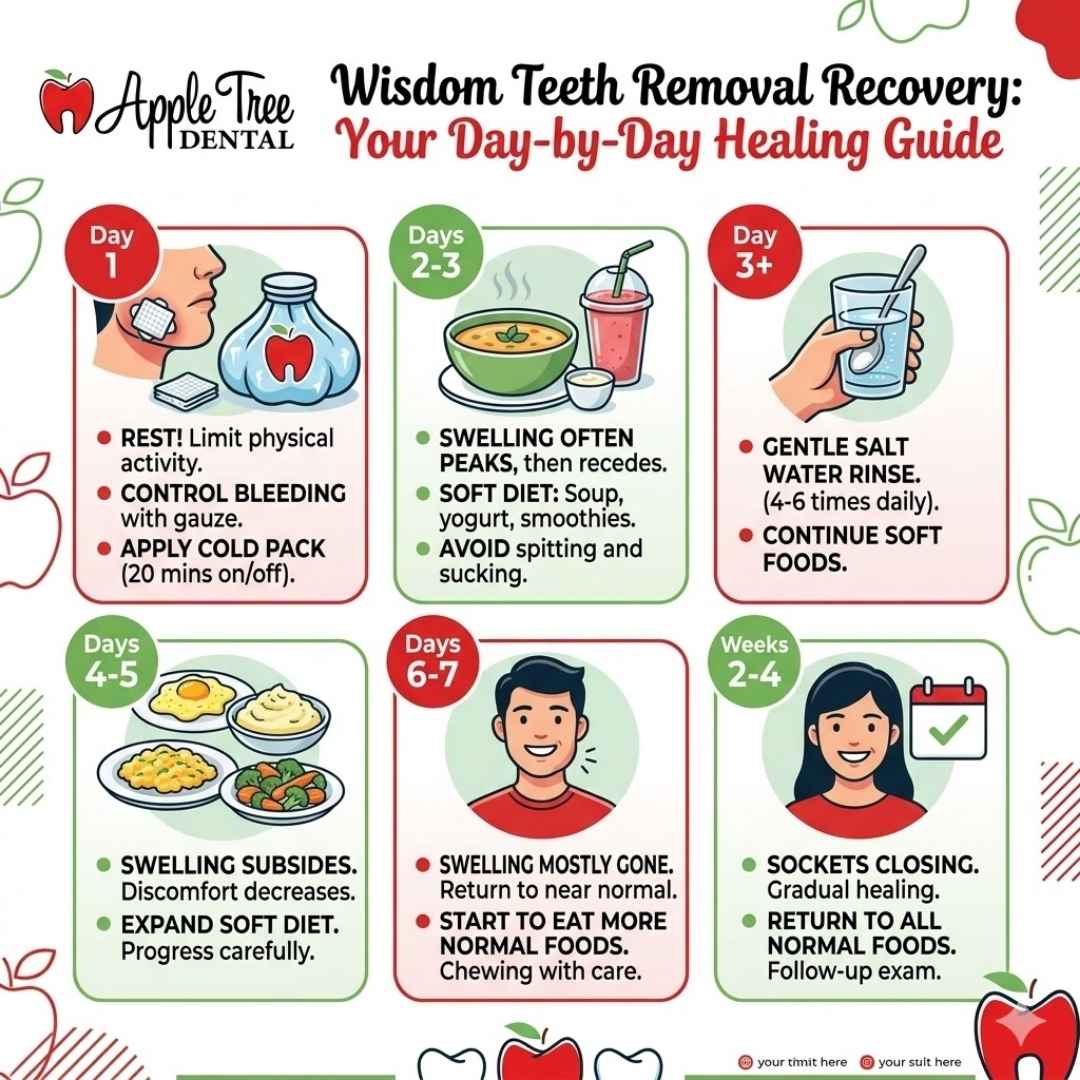
Wisdom teeth removal recovery usually takes seven to fourteen days, though most people feel ready to return to work or school within three to five days. Swelling peaks around day two, then fades. The first 48 hours matter most, because that is when the blood clot forms and protects the socket. Careful aftercare keeps healing on track and lowers your risk of complications.
Wisdom Teeth Removal Recovery: Your Day-by-Day Healing Guide
Nobody books wisdom tooth surgery for fun. The good news? Recovery is far more predictable than most people fear, and the internet horror stories rarely match reality. At Apple Tree Dental in London, Ontario, the question we hear most is simple: “How long until I feel normal again?” This guide walks you through the entire wisdom teeth removal recovery process — day by day, food by food, and warning sign by warning sign — so you can heal with confidence instead of guesswork.
How Long Does Wisdom Teeth Recovery Take?
What is the typical wisdom teeth recovery timeline?
Here is the honest answer: it depends on the tooth. According to the Cleveland Clinic, wisdom teeth removal recovery time averages one to two weeks, and most people resume work, school, and normal routines in about three to five days. A simple extraction of a fully erupted tooth often heals faster than that. An impacted tooth buried in the jawbone, however, usually needs the longer end of that range.
So when patients ask how long recovery from wisdom teeth removal really lasts, the realistic snapshot looks like this: a few rough days, a noticeably better first week, and a fully comfortable mouth within two weeks. Beneath the surface, though, your body keeps working.
Why does the bone keep healing after you feel fine?
Even after the gum looks closed, the empty socket continues filling with new bone underneath. This deeper remodelling takes several months to finish, which is completely normal and nothing you will feel. In other words, surface healing and bone healing run on two different clocks. Your daily life follows the fast one.
Age plays a role too. Younger patients tend to bounce back quicker because their tooth roots are less developed and the bone is more forgiving. Patients in their thirties, forties, and beyond should plan for a slightly longer, gentler recovery.
Wisdom Teeth Recovery Timeline: What to Expect Each Day
Day 1: the rest day
A blood clot forms in the socket within the first hour, and protecting it is your only real job today. Expect some oozing, numbness from the anaesthetic, and tenderness as the freezing wears off. Bite gently on gauze, keep your head elevated, and take it easy. Honestly, the couch is your friend here.
Days 2 to 3: peak swelling
Swelling typically peaks around 48 hours after surgery and then begins to subside, which surprises many patients who assume “getting puffier” means “getting worse.” It usually does not. Bruising and stiff jaw muscles can also appear now. Cold packs and steady pain relief make these the most manageable of the rough days.
Days 4 to 7: the turnaround
This is when most people feel human again. Swelling drops noticeably, pain fades, and the gum tissue starts closing over the socket. Many patients return to desk work or class around now and gradually reintroduce more normal foods, while still chewing away from the surgical sites. If you received non-dissolvable stitches, your dentist usually removes them around the one-week mark.
Week 2 and beyond: nearly there
By the end of the second week, the visible wound is generally comfortable and well on its way to closed. Some tightness may linger, especially after impacted extractions, but daily life feels normal again. Meanwhile, the jawbone quietly continues its months-long remodelling beneath the surface.
How to Speed Up Wisdom Teeth Recovery
What actually helps you heal faster?
There is no magic shortcut, but smart habits genuinely move the needle. The single biggest factor is how closely you follow your aftercare instructions — that matters more than most people expect. Beyond that, a few simple moves protect the clot and keep inflammation down.
Notice a theme? Nearly every “speed up recovery” tip is really a “protect the blood clot” tip. Guard that clot, and your body handles the rest.
Managing Pain and Swelling During Recovery
How much discomfort is normal?
Discomfort usually peaks on the first or second day, then steadily eases. Most patients control it well with over-the-counter options such as ibuprofen and acetaminophen, sometimes alternated on a schedule your dentist recommends. For more complex surgical extractions, your provider may prescribe something stronger.
Here is the key pattern to remember: pain should trend down after day three. Mild soreness lingering into the first week is expected. Pain that suddenly intensifies several days out is not — and that brings us to the one complication worth understanding.
Clinical Note — Dry Socket
Dry socket (alveolar osteitis) develops when the protective blood clot dislodges before healing finishes, leaving bone exposed. It affects roughly 2–5% of routine extractions but climbs to about 25–30% of impacted lower wisdom tooth cases, per research summarised by the Cleveland Clinic. The hallmark sign is a dull, radiating pain that starts two to four days after surgery and does not ease with normal pain relief. It is treatable — call Apple Tree Dental promptly and we can medicate and dress the socket for fast relief.
What to Eat While You Recover
Which foods are safe in the first few days?
For the first three to five days, soft is the rule. Reach for yogurt, smooth soups, scrambled eggs, mashed potatoes, applesauce, oatmeal, and soft pasta. Lukewarm beats hot, and a spoon beats a straw every time. As tenderness fades, you can gradually bring firmer foods back — just keep chewing away from the surgical sites until things feel solid.
One more tip patients appreciate: prep your soft-food menu before surgery. Hungry, sore, and freezer-diving at 9 p.m. is nobody’s idea of a smooth recovery. A little planning goes a long way.
Warning Signs: When to Call Your Dentist
What signals a problem rather than normal healing?
Most recoveries proceed without a hitch. Still, a few signs deserve a prompt call to our team. Reach out to Apple Tree Dental if you notice pain that climbs after day three, a foul taste or odour developing after the first day or two, a fever, swelling that worsens past day two, heavy bleeding that firm gauze pressure will not slow, or difficulty opening your jaw that keeps getting tighter.
None of these means panic. Each simply means “let’s take a look.” Catching an issue early almost always makes it easier to fix. When in doubt, call — we would rather reassure you than have you wonder.
Why London, Ontario Patients Choose Apple Tree Dental
What makes our wisdom tooth care different?
Apple Tree Dental in London, Ontario performs simple and surgical wisdom teeth removal with modern techniques and a genuine focus on comfort. Every case begins with a thorough clinical and radiographic assessment, and the clinic follows the standards set by the Royal College of Dental Surgeons of Ontario (RCDSO) and guidance from the Canadian Dental Association.
We also know surgery makes people nervous, so we take the time to explain each step in plain language. You leave with clear written aftercare instructions and direct access to our clinical team throughout recovery. Our general dentistry services include post-extraction checks to confirm the socket is healing the way it should.
Frequently Asked Questions About Wisdom Teeth Removal Recovery
How long is the recovery from wisdom teeth?
Recovery from wisdom teeth typically takes seven to fourteen days for surface healing, and most people return to normal routines within three to five days. Simple extractions of erupted teeth often heal faster, while impacted teeth take the longer end of that range. The jawbone underneath keeps remodelling for several months, but you will not feel that part.
When can I go back to work or school?
Many patients head back to desk work or class three to four days after surgery, once swelling and discomfort settle. Plan for at least two to three rest days, especially the first 48 hours. Jobs involving heavy lifting or intense physical activity may need about a week, since exertion can disturb the clot.
How can I speed up wisdom teeth recovery?
Rest, ice the area early, stick to soft foods, take pain relief as directed, and protect the blood clot. That means no smoking, no straws, and no forceful rinsing in the early days. Following your aftercare instructions closely is the most reliable way to recover quickly — it matters more than any single trick.
Is the swelling on day two a bad sign?
No — swelling that peaks around 48 hours is a normal part of healing, not a setback. It should begin improving after that. Cold packs in the first day or two help keep it down. Swelling that suddenly worsens after day two, however, is worth a call to your dentist.
What does dry socket feel like, and how common is it?
Dry socket causes a dull, throbbing pain that radiates through the jaw and ear, usually starting two to four days after surgery and not responding to normal pain relief. It affects only about 2–5% of routine extractions, but up to roughly a quarter to a third of impacted lower wisdom tooth cases. It is treatable, so contact Apple Tree Dental promptly if pain rises instead of fading.
Does the Canadian Dental Care Plan cover wisdom tooth removal?
The Canadian Dental Care Plan (CDCP) covers eligible Canadians who lack private dental insurance and meet household income thresholds, and extractions qualify as a covered benefit. Most private plans also cover a share of the fee. Apple Tree Dental accepts the CDCP and confirms your eligibility at booking — contact our team for a personalised estimate.
Facing Wisdom Tooth Surgery in London, Ontario? We’ve Got You
A smooth recovery starts with the right care team. Whether your wisdom tooth is causing pain, crowding, or repeated infections, Apple Tree Dental in London, Ontario handles the full range of cases in a calm, well-equipped setting. We explain every step before we begin, offer same-day appointments for urgent situations, and stay available through every stage of healing. Our team accepts the Canadian Dental Care Plan and works with most private insurance. Patients planning ahead can also explore dental implant options and restorative dentistry at the same consultation.