
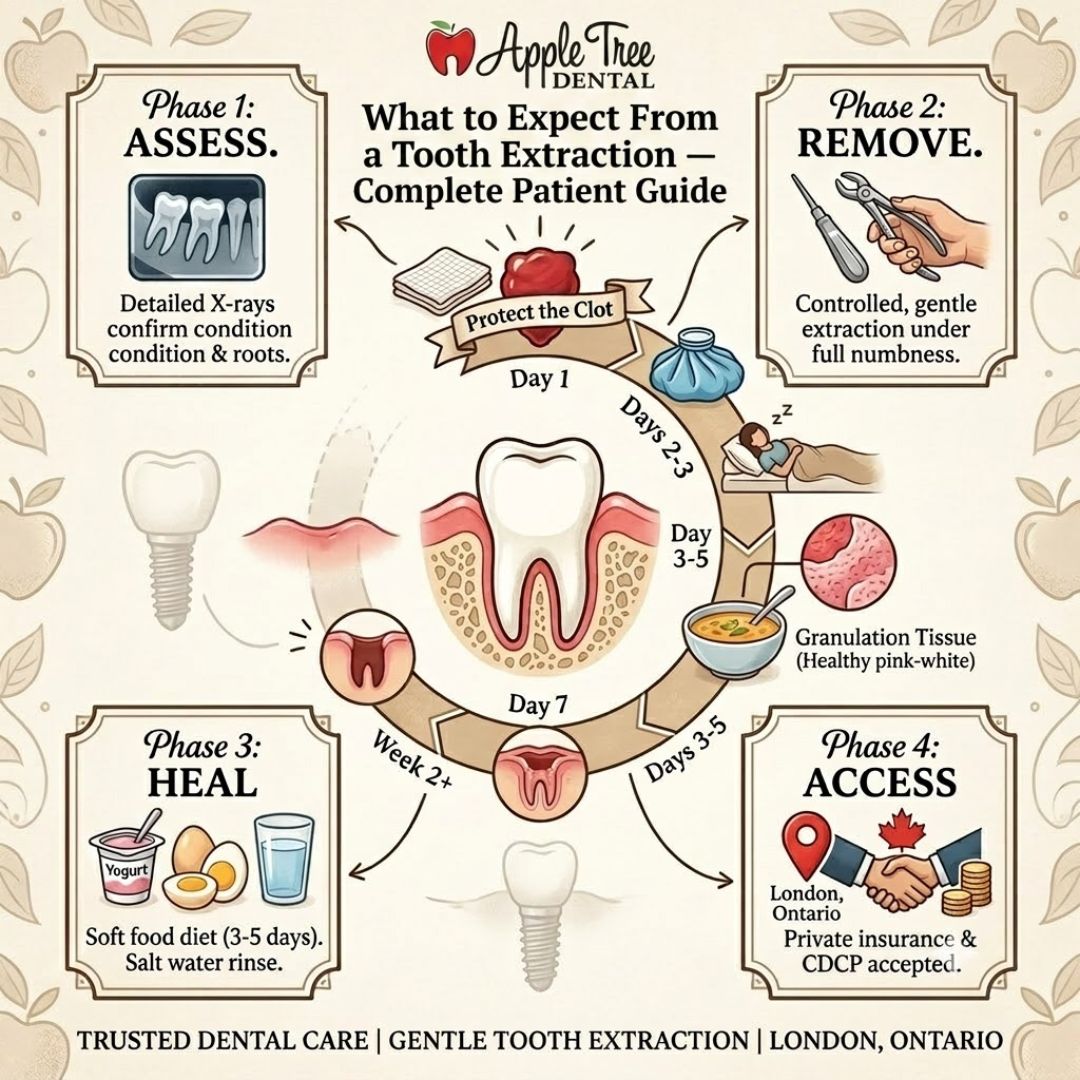
A tooth extraction removes a tooth from its socket in the jawbone. Dentists perform this procedure when a tooth suffers too much damage, decay, or crowding to save. Most extractions in London, Ontario take a single appointment under local anaesthetic, and patients follow a predictable healing process lasting one to two weeks.
What to Expect From a Tooth Extraction — A Complete Patient Guide
Your dentist just told you that you need a tooth extraction, and your mind immediately goes to worry. What will it feel like? How long will healing take? Will it hurt afterward? These are the questions patients at Apple Tree Dental in London, Ontario ask most often — and every one of them has a clear, honest answer. This guide covers every stage of the process: what extraction involves, what healing looks like day by day, what to eat afterward, and when to call your dentist if something feels off.
What Is a Tooth Extraction?
How does modern dentistry define a tooth extraction?
A tooth extraction removes a tooth completely from the alveolar socket — the cavity in the jawbone that holds the tooth root. In clinical practice, extractions fall into two categories: simple extractions and surgical extractions. A simple extraction involves a tooth visible in the mouth that a dentist can loosen and remove with forceps. A surgical extraction is necessary when a tooth is impacted, partially erupted, or has broken off at the gum line — as often happens with wisdom tooth removal.
From a patient’s perspective, a tooth extraction removes a tooth that no longer responds to repair or that creates problems a dentist cannot solve any other way. The Canadian Dental Association identifies extraction as the appropriate choice when decay, fracture, infection, or crowding makes keeping the tooth clinically inadvisable. Saving a natural tooth always comes first, but extraction is sometimes the most responsible decision for a patient’s long-term oral health.
What are the most common reasons for a tooth extraction?
According to Apple Tree Dental in London, Ontario, the most common reasons patients need a tooth extraction include advanced decay that destroys too much tooth structure to support a crown, a vertical root fracture that a dentist cannot restore, severe periodontal (gum) disease that has weakened the supporting bone, a tooth causing crowding before orthodontic treatment, and an impacted wisdom tooth that puts adjacent teeth at risk.
How Does a Tooth Extraction Work?
What happens at your appointment at Apple Tree Dental?
Knowing each step of the process makes the appointment far less stressful. Here is exactly what happens from the moment you sit in the chair to the moment you leave.
- Assessment and X-rays. Your dentist takes a periapical X-ray to assess root shape, bone levels, and surrounding anatomy before touching any instruments.
- Local anaesthetic. Your dentist applies a topical numbing gel to the gum tissue first, then delivers the local anaesthetic injection. You will feel pressure during the procedure, but not pain. Full numbness sets in within two to three minutes.
- Loosening the tooth. For a simple extraction, your dentist uses a dental elevator to gently loosen the tooth within the socket. This expands the surrounding bone and releases the fibres that hold the tooth in place.
- Removal. Dental forceps grasp the tooth and remove it with controlled rocking and rotational movements. Once the tooth is adequately loosened, this step often takes under a minute.
- Surgical steps (if required). For an impacted or broken tooth, your dentist makes a small incision in the gum and may section the tooth — dividing it into smaller pieces — to allow removal with minimal force and less bone disturbance.
- Socket care. Your dentist inspects and cleans the socket, then places a gauze pad over the site. You bite down firmly for 30 to 45 minutes to help the blood clot form.
- Aftercare instructions. Before you leave, your dental team hands you written aftercare instructions and answers all questions about recovery, diet, and warning signs.
Most simple extractions wrap up within 20 to 40 minutes from start to finish. Surgical extractions of impacted wisdom teeth may take 45 to 90 minutes, depending on complexity. You stay awake throughout and remain in full control of the process at all times.
Who Is a Good Candidate for Tooth Extraction?
Who typically needs a tooth removed?
Most adults and older adolescents qualify for tooth extraction when clinical indications exist. Your dentist at Apple Tree Dental reviews your specific situation — including your medical history, medications, and the condition of surrounding bone and teeth — before recommending extraction.
Good candidates include patients with a tooth their dentist has assessed as beyond repair, patients with an impacted wisdom tooth causing pain, infection, or damage to neighbouring teeth, patients preparing for orthodontic treatment that requires more space, and patients whose tooth keeps triggering a chronic infection despite antibiotic treatment.
Are there any medical conditions your dentist needs to know about?
Yes. Certain health conditions call for extra steps before your dentist proceeds with an extraction. If you take blood thinners, bisphosphonate medications for bone density, or immunosuppressants, tell your dentist before your appointment. Patients with a history of heart conditions, diabetes, or a weakened immune system may need their physician involved in pre-treatment planning. The Royal College of Dental Surgeons of Ontario (RCDSO) sets clear standards for managing medically complex dental patients, and Apple Tree Dental follows those guidelines for every patient.
If you are unsure whether extraction is the right choice for your tooth, a consultation gives you the clearest picture. In some cases, root canal treatment, a crown, or periodontal therapy offers a viable path before extraction enters the conversation.
How Much Does a Tooth Extraction Cost in London, Ontario?
Does the Canadian Dental Care Plan (CDCP) cover it?
Treatment costs vary based on individual clinical needs. A simple extraction of a single-rooted tooth carries a different fee than a surgical extraction of a deeply impacted wisdom tooth that requires sectioning and sutures. Key cost factors include the complexity of the extraction, whether you need sedation, the number of teeth involved, and whether imaging beyond a standard X-ray is necessary.
Dental offices in London, Ontario typically use the Ontario Dental Association (ODA) fee guide as a pricing reference. Most private dental insurance plans in Canada cover a share of extraction fees — commonly 70% to 80% of the ODA rate, subject to your annual maximum and deductible. Confirm your specific coverage with your insurer before treatment.
The Canadian Dental Care Plan (CDCP), run by the Government of Canada and Sun Life, covers eligible Canadians who have no private dental insurance and meet household income thresholds. Tooth extractions qualify as a covered benefit under the CDCP. Apple Tree Dental accepts the Canadian Dental Care Plan and confirms your eligibility at the time of your appointment. Contact our team directly for a personalised cost estimate — we provide a fully itemised treatment plan before any procedure begins.
Tooth Extraction vs Alternatives: Which Option Suits Your Situation?
What other treatments should you consider first?
Extraction is not always the only path. When a tooth carries damage but the root and surrounding bone remain intact, alternatives are often worth exploring before permanently removing the tooth. Your dentist outlines which options make clinical sense for your specific case.
| Option | Best For | Key Advantage | Key Consideration |
|---|---|---|---|
| Tooth Extraction | Non-restorable teeth, impacted wisdom teeth, severe infection | Resolves the problem completely; no ongoing maintenance of the affected tooth | Replacing the tooth (implant, bridge) prevents bone loss afterward |
| Root Canal Treatment | Infected or dead pulp with enough tooth structure remaining | Saves the natural tooth and preserves surrounding bone | A crown is typically needed afterward; not an option if the tooth has too little structure left |
| Dental Crown | Cracked or heavily decayed teeth with healthy roots | Restores full function and appearance without removing the tooth | Requires enough natural tooth structure to support the crown |
According to Apple Tree Dental in London, Ontario, keeping the natural tooth is always the preferred clinical outcome when root structure and surrounding bone can support it. Your dentist recommends extraction only when the tooth cannot be restored predictably, or when keeping it creates more risk than removing it. Patients who proceed with extraction and want to replace the missing tooth can review dental implant options as part of their treatment plan.
Recovery and Aftercare: What Happens After Your Tooth Extraction
What does the healing timeline look like day by day?
Healing after a tooth extraction follows a predictable sequence. Understanding what a healthy tooth socket after extraction looks like — and how the site changes from one day to the next — helps you tell normal healing from something that needs attention.
Day 1: A blood clot forms in the socket within the first hour. This clot forms the foundation of the entire healing process — protecting it is the single most important action you can take on day one. Expect mild to moderate swelling, some oozing, and tenderness that over-the-counter pain relief manages comfortably.
Days 2 to 3: Swelling often peaks around the second day. The socket looks dark red at the edges. Tooth extraction healing pictures day by day at this stage show a socket partially filled with the blood clot and surrounded by slightly inflamed gum tissue. This is normal.
Days 3 to 5 — granulation tissue appears: The blood clot starts giving way to granulation tissue — a soft, pink-white or slightly yellowish material your body produces as it builds new cells in the wound. Pictures of granulation tissue after tooth extraction show a socket lighter in colour than the surrounding gum, with a soft, slightly uneven surface. This is a healthy sign, not a sign of infection. Granulation tissue is how your body fills and closes the socket from the inside out.
Days 5 to 7: Tenderness drops significantly for most patients. The gum tissue at the socket margins begins closing inward. What does a tooth extraction look like after 3 days and into days four and five is a progressively lighter socket with visible new tissue and minimal bleeding. Any swelling or bruising starts to clear.
Week 2 and beyond: The socket keeps filling with granulation tissue and eventually new bone. Full bone remodelling takes several months, but the visible wound typically closes and feels comfortable within two to four weeks.
What should you do — and avoid — after an extraction?
Clinical Note — Dry Socket
Dry socket (alveolar osteitis) develops when the blood clot leaves the socket before healing completes. It produces a dull, radiating pain that typically starts two to four days after extraction and does not improve with standard pain relief. Dry socket is not an infection, but it needs treatment. Contact Apple Tree Dental promptly if pain increases rather than fades after day three — we can medicate and dress the socket for rapid relief.
Why Patients in London, Ontario Choose Apple Tree Dental
What makes Apple Tree Dental the right choice for your extraction?
Apple Tree Dental in London, Ontario handles tooth extractions — including surgical wisdom tooth removal — with current techniques, modern equipment, and a genuine focus on patient comfort and clear communication. The clinic meets the full standards of the Royal College of Dental Surgeons of Ontario (RCDSO) and follows the guidance of the Canadian Dental Association (CDA). Every extraction begins with a thorough clinical and radiographic assessment to confirm the diagnosis and deliver the procedure safely.
What support do patients receive after treatment?
Patients leave every appointment with detailed written aftercare instructions and direct access to the clinical team for questions or concerns throughout recovery. The Apple Tree Dental team has extensive experience with anxious patients and dedicates the time needed to make sure every person fully understands their treatment plan before consenting to any procedure. Our general dentistry services include post-extraction monitoring to confirm healthy socket healing and support tooth replacement planning when the time comes.
Frequently Asked Questions About Tooth Extraction in London, Ontario
Is a tooth extraction painful?
A: The extraction procedure does not hurt. Your dentist administers local anaesthetic before using any instruments and waits for full numbness before proceeding. You will feel pressure and movement throughout, but not sharp pain. After the anaesthetic wears off, mild to moderate soreness at the site is normal for two to four days. Over-the-counter pain relief such as ibuprofen or acetaminophen manages this well. If pain increases after day three rather than fading, call your dental team — this may signal dry socket, which is treatable.
What is the recovery time for an extracted tooth?
A: Recovery time for an extracted tooth depends on the complexity of the procedure. Most patients feel comfortable within seven to ten days after a simple extraction. Surgical extractions — particularly impacted wisdom teeth — may bring tenderness and swelling for ten to fourteen days. The socket continues to heal beneath the gum surface for several weeks, and full bone remodelling takes two to six months. Most patients return to normal activities within 24 to 48 hours after a straightforward extraction.
What does a healthy tooth socket look like after extraction?
A: A healthy tooth socket changes progressively over the first two weeks. In the first 24 hours, it appears dark red as the blood clot forms. By days three to five, granulation tissue replaces the clot — a soft, pinkish-white material that looks slightly different from the surrounding gum. This is normal and healthy. By day seven, the gum edges start closing inward over the socket. A socket that heals well shows decreasing tenderness, no foul odour, and no sudden jump in pain after the first few days.
What should I eat after a tooth extraction?
A: Stick to soft foods for the first three to five days after extraction. Good options include yogurt, mashed potatoes, scrambled eggs, smooth soups, applesauce, oatmeal, and soft-cooked pasta. Avoid hard, crunchy, or spicy foods that can disturb the clot or push food particles into the socket. Skip alcohol for at least 24 hours. Do not use a straw for the first 72 hours — the suction creates negative pressure that can pull the blood clot out of the socket and lead to dry socket. Bring normal foods back gradually as tenderness fades.
Does dental insurance or the CDCP cover tooth extractions?
A: Most private dental insurance plans in Canada cover tooth extractions as a basic or preventive service, typically at 70% to 80% of the ODA fee guide rate. Surgical extractions, including wisdom tooth removal, usually fall under the major services or oral surgery benefit. The Canadian Dental Care Plan (CDCP) covers tooth extractions for eligible Canadians who lack private dental insurance and meet household income requirements. Apple Tree Dental accepts the CDCP and confirms your eligibility at booking. Contact our team for a personalised estimate.
What does granulation tissue look like after a tooth extraction?
A: Yes — granulation tissue is a completely normal part of healing. Your body produces it around days three to five to replace the initial blood clot with new cellular tissue. Granulation tissue looks soft, pink-white or slightly creamy, and may appear somewhat uneven in texture. It is not pus and does not signal infection. Its presence is a positive sign that healing moves forward as it should. If the socket appears empty, looks very dark, or produces a foul smell alongside increasing pain, call your dentist — those signs point to dry socket, not normal granulation.
When should I contact my dentist after a tooth extraction?
A: Call Apple Tree Dental if you notice: pain that increases rather than decreases after day three, a socket that looks empty with an exposed bony surface, a foul taste or odour that develops after the first day or two, fever above 38 degrees Celsius, swelling that worsens after day two instead of improving, difficulty opening your jaw beyond what was present immediately after the procedure, or heavy bleeding that does not stop with firm gauze pressure held for 30 to 45 minutes. Any of these signs call for a same-day or next-day evaluation.
Need a Tooth Extraction in London, Ontario? Book at Apple Tree Dental
A tooth that needs to come out does not get easier to deal with by waiting. Whether you manage pain from an impacted wisdom tooth, carry a severely broken tooth, or have a referral for a surgical extraction, Apple Tree Dental in London, Ontario handles the full range of extraction cases in a calm, well-equipped environment. We walk through every step before we begin, offer same-day appointments for urgent cases, and support you through every stage of healing. Our team accepts the Canadian Dental Care Plan (CDCP) and works with most private dental insurance plans. Patients who want to discuss tooth replacement after extraction can explore dental implant options and restorative dentistry at the same consultation.