
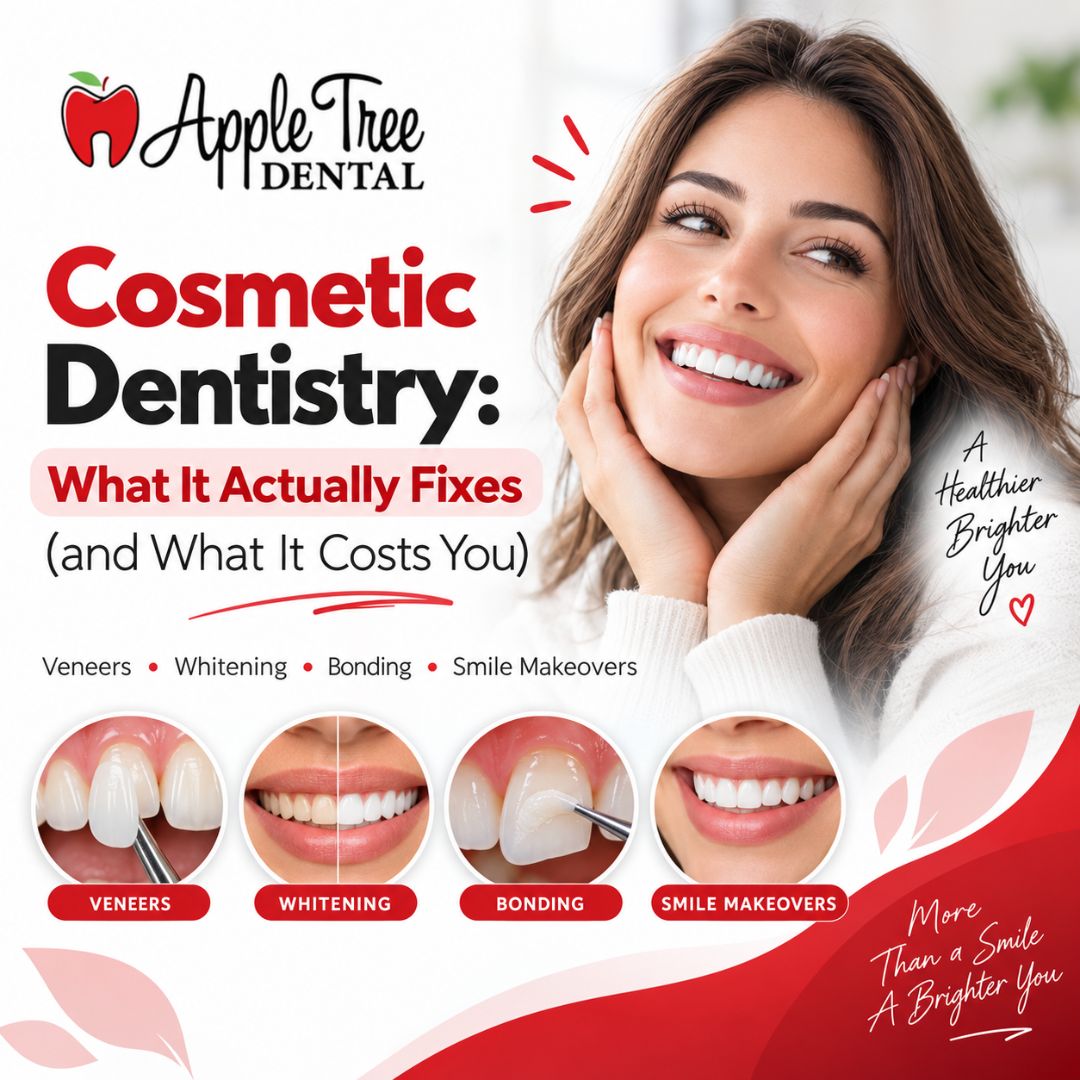
Quick answer: Cosmetic dentistry covers any dental treatment focused on improving how your smile looks rather than fixing a functional problem. That includes teeth whitening, veneers, bonding, crowns, and clear aligners. Most procedures run from under an hour to a few visits, and cost depends heavily on the treatment and material chosen.
You’ve probably typed “cosmetic dentistry” into Google wondering what it actually covers, and whether it’s the same thing as just “seeing a dentist about your smile.” It isn’t, exactly. At Apple Tree Dental in London, Ontario, this is one of the most common questions we get, right after “how much will this cost me.”
So this guide breaks down what cosmetic dentistry actually is, which treatments fall under it, what they cost, and how to tell if a fix is cosmetic or something your bite genuinely needs.
📋 Table of Contents
✅ Key Takeaways
- Cosmetic dentistry is elective and appearance-focused — it’s not a recognized ADA/RCDSO specialty, so it’s typically your general dentist doing the work.
- Over half of Americans say smile insecurity affects their confidence, and 65% believe a better smile would boost it further. [Source: SmileSet/Pollfish national survey, 2026]
- The cosmetic dental market is projected to top $5.6 billion in 2026, growing roughly 6.4% a year since 2020. [Source: American Academy of Cosmetic Dentistry, 2026]
- Cosmetic and restorative work often overlap — a crown can fix a broken tooth and its appearance at the same time.
- Insurance rarely covers purely cosmetic work, though Canadian patients can still use the CDCP for related restorative or preventive care.
What Cosmetic Dentistry Actually Means
Cosmetic dentistry is any dental treatment aimed at how your teeth, gums, and smile look, not at fixing decay, infection, or a bite problem. It covers changes to color, shape, size, and alignment.
Here’s the part most articles skip: cosmetic dentistry isn’t an official dental specialty. Any licensed general dentist can offer it, which is why training and case volume vary so much between practices. That’s worth knowing before you book anything.
💡 Expert Insight: Patients often come in asking for veneers when whitening or bonding would get them 80% of the result for a fraction of the cost and zero enamel removal. Our first job in any cosmetic consult isn’t picking a treatment — it’s figuring out what you’re actually unhappy with, because “my smile looks off” and “my teeth are yellow” call for completely different fixes.
Cosmetic vs. Restorative Dentistry: Where’s the Line?
Restorative dentistry repairs function — fillings, root canals, and crowns on damaged teeth all fall here. Cosmetic dentistry improves appearance on teeth that are otherwise healthy.
In practice, the line blurs constantly. A crown placed after a root canal is restorative. The same crown, shaped and shaded to also improve how the tooth looks, does double duty. This overlap matters for your wallet, since insurance is far more likely to help with the restorative half of a treatment than the cosmetic half.
1
Purely cosmetic: Whitening, most veneers, contouring, gum reshaping for aesthetics alone.
2
Dual-purpose: Crowns, bridges, and bonding that repair damage and improve looks at once.
3
Purely functional: Root canals, fillings, extractions — restorative dentistry with no cosmetic framing.
Treatment-by-Treatment Comparison
Here’s how the main cosmetic dental treatments stack up against each other, side by side:
| Treatment | Best For | Typical Lifespan | Chair Time |
|---|---|---|---|
| Teeth whitening | Stains, discoloration | 6 months–2 years | ~1 hour in-office |
| Composite bonding | Small chips, gaps | 5–7 years | Single visit |
| Porcelain veneers | Deep stains, shape, uneven teeth | 10–15 years | 2+ visits, lab-made |
| Dental crowns | Damaged or misshapen teeth | 10–15+ years | 2 visits, lab-made |
| Clear aligners (e.g. Invisalign) | Crowding, gaps, mild bite issues | Permanent (with retainer) | 6–24 months total |
Notice veneers and crowns sit at opposite goals but overlap in cost and process. If you’re weighing those two specifically, our team can walk you through which one fits your tooth structure during a cosmetic dentistry consultation.
What Cosmetic Dentistry Actually Costs
Cosmetic work is almost never covered by dental insurance, since plans are built around function, not appearance. That said, cost varies enormously by treatment:
- Teeth whitening: The lowest-cost entry point into cosmetic dentistry, and usually the first thing patients try.
- Bonding: Priced per tooth and noticeably cheaper than veneers, since it’s done chairside with no lab fabrication.
- Veneers: The bigger investment of the group — porcelain runs well above composite because of the lab work and material.
- Crowns: Priced similarly to veneers, but partly offset by insurance when the tooth also needed structural repair.
- Clear aligners: The highest total cost of the group, spread across the length of treatment rather than paid up front.
If you’re in Ontario and worried about cost, it’s worth asking your provider what’s covered under the Canadian Dental Care Plan before assuming a treatment is out of reach — restorative components of a case sometimes qualify even when the cosmetic portion doesn’t.
How to Choose the Right Cosmetic Treatment
Start with what’s actually bothering you, not the treatment name you’ve heard most. Match the problem to the fix:
1
Just discoloration? Start with whitening. It’s reversible, affordable, and solves the most common complaint on its own.
2
Chips or small gaps? Bonding fixes these in a single visit without touching the rest of the tooth.
3
Deep stains, uneven shape, or several teeth at once? Veneers give the most dramatic, long-lasting change.
4
Crowding or gaps between teeth? Clear aligners solve the actual position problem instead of covering it up.
Mistakes to Avoid
A few patterns come up again and again in cosmetic consults:
- Choosing veneers before trying whitening, when whitening alone often solves the complaint.
- Booking treatment abroad or at a discount clinic purely on price, without checking who’s actually doing the prep work.
- Skipping a consultation and assuming all cosmetic dentists have equal veneer or bonding experience — case volume varies widely.
- Ignoring an untreated bite or gum issue that will undermine cosmetic work later, regardless of how good it looks on day one.
Cosmetic Dentistry at Apple Tree Dental
Apple Tree Dental offers the full range of cosmetic dentistry covered above at both our London, Ontario locations — from Zoom teeth whitening and composite bonding through to porcelain and composite veneers, crowns, and Invisalign.
📍 Two things worth knowing:
- Free smile consultations. We start with an assessment of what’s actually causing the concern before recommending a specific cosmetic dentistry treatment, so you’re not sold the most expensive option by default.
- CDCP accepted at no extra fee. If part of your case overlaps with restorative work, we’ll confirm what’s covered under the Canadian Dental Care Plan before you commit to a start date.
Frequently Asked Questions
What is cosmetic dentistry, in simple terms?
Cosmetic dentistry is dental work focused on how your smile looks rather than fixing decay or a bite problem — whitening, veneers, bonding, and similar treatments.
Is cosmetic dentistry the same as restorative dentistry?
No. Restorative dentistry repairs function, like fillings and root canals. Cosmetic dentistry improves appearance, though the two often overlap in a single treatment like a crown.
Does insurance cover cosmetic dentistry?
Generally no, since most plans exclude elective procedures. Coverage is more likely on the restorative portion of a mixed treatment, such as a crown after damage.
What’s the cheapest cosmetic dental treatment?
Teeth whitening is typically the lowest-cost option, followed by composite bonding. Veneers, crowns, and aligners cost more due to lab work or treatment length.
Are veneers or bonding better?
Bonding suits small chips or gaps and costs less, but wears faster. Veneers last longer and handle deeper stains or shape changes, at a higher price point.
Can a general dentist do cosmetic dentistry?
Yes. Cosmetic dentistry isn’t a recognized dental specialty, so any licensed general dentist can offer it, though training and case experience vary between practices.
How long does cosmetic dental work last?
It depends on the treatment. Whitening fades in months, bonding lasts 5 to 7 years, and veneers or crowns typically last 10 to 15 years with proper care.
How do I know which cosmetic dentistry treatment I need?
A smile consultation is the most reliable way. Book a consultation to get a treatment plan matched to your specific concern.
Cosmetic dentistry isn’t one treatment — it’s a toolkit. The right pick depends on what’s actually bothering you about your smile, not what’s trending.
Our team at Apple Tree Dental can map out the simplest path to the smile you want, with real pricing, not guesswork.