
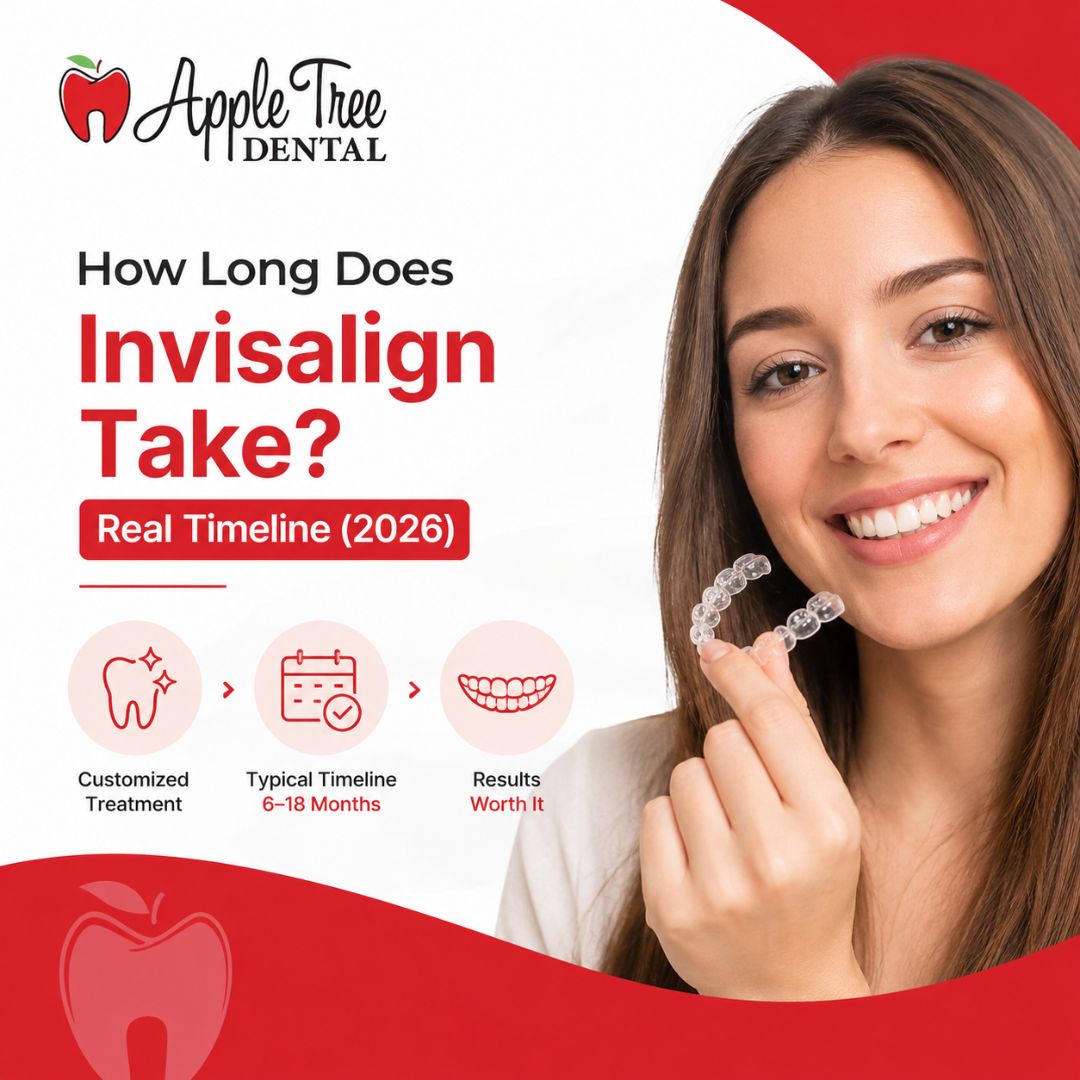
Quick answer: Invisalign typically takes 6 to 18 months for the average adult case, though mild crowding can finish in as little as 3 to 6 months and bite correction can run 12 to 24 months. Your exact timeline depends on how much your teeth need to move, your bite, and how consistently you wear your aligners.
You booked a consultation, or you’re about to, and the one question you actually want answered is how long you’ll be wearing these things. Not the marketing number. The real one. At Apple Tree Dental in London, Ontario, it’s the first thing almost every Invisalign patient asks us. After all, it’s a fair question — nobody wants an open-ended commitment on their face.
Overall, the honest answer is a range, not a single number. So this guide walks through why, what actually drives your personal timeline, and what the research says about how long treatment tends to run once refinements are counted.
📋 Table of Contents
✅ Key Takeaways
- Most adult cases run 6 to 18 months, with mild crowding closer to 3–6 months and bite correction closer to 12–24 months.
- A 2023 study of 500 patients found the average length, including refinements, was 22.8 months — nearly a year longer than the “as fast as 6 months” figure often quoted. [Source: Journal of Clinical Orthodontics, 2023]
- Refinement aligners are common, not rare — most patients need at least one extra round to finish precisely.
- Wear time is the single biggest lever you control — under 20–22 hours a day consistently adds weeks or months.
- Your real number comes from a scan, not a website — case complexity varies enough that any generic estimate is a starting point, not a promise.
What Actually Determines How Long Invisalign Takes
How long Invisalign takes comes down to how far your teeth need to travel, not how badly you want it to be fast. After all, a tooth can only move a fraction of a millimetre per aligner. Because of that, more distance means more trays, and more trays means more time.
Specifically, four factors shape your number:
1
Case complexity. Minor crowding or small gaps move fast. Rotated teeth, significant spacing, or a bite issue like an overbite, underbite, or crossbite take longer to correct.
2
Wear time. Invisalign is designed around 20 to 22 hours a day of wear. Fall short consistently, and your teeth simply aren’t getting the sustained pressure the plan assumes.
3
Age. Teen jawbones are still developing, so teeth tend to shift faster. Adult tooth movement is slower and more predictable, but not slow enough to matter much day to day.
4
Refinements. Almost every case needs at least one extra set of aligners near the end to fine-tune the result. That round typically adds one to three months.
💡 Expert Insight: The patients most surprised by their timeline aren’t the ones with complex cases — they’re the ones who assumed “12 months” meant 12 months flat, with no room for a refinement round. We build that expectation in from the first consultation so nobody feels like treatment is running long when it’s actually running normal.
Average Invisalign Timeline by Case Type
Here’s how long Invisalign treatment tends to run once you break it down by what’s actually being corrected:
| Case Type | Typical Timeline | What’s Involved |
|---|---|---|
| Mild crowding or small gaps | 3–6 months | Cosmetic-level movement, few aligner stages |
| Moderate crowding or spacing | 9–15 months | Full-arch alignment, standard attachment use |
| Complex crowding or rotations | 15–24 months | Heavier attachment use, higher refinement odds |
| Bite correction (over/underbite, crossbite) | 12–24 months | Elastics and attachments, closer monitoring |
Notice that “bite correction” and “complex crowding” overlap heavily with the high end of the range. That’s not a coincidence — bite problems are the single biggest reason a case runs long. If you’re weighing Invisalign specifically for a bite issue, our guide on whether Invisalign can fix an underbite breaks down that distinction in more depth.
Marketing vs. the Real-World Average
You’ll see “as fast as 6 months” on plenty of Invisalign pages, including Align Technology’s own marketing. That number is real — for a narrow slice of very mild cases with excellent compliance.
It’s not the typical outcome. In fact, a 2023 retrospective study tracking 500 Invisalign patients found the average total treatment length, once refinement rounds were included, was 22.8 months — about five months longer than the case’s original estimate. Only 6% of patients finished without needing a single refinement scan. [Source: American Journal of Orthodontics and Dentofacial Orthopedics, 2023]
That gap between the marketing number and the study average isn’t Invisalign underperforming. It’s what “average treatment time” actually includes once you count the fine-tuning most cases genuinely need to get a precise final bite.
What to Expect Month by Month
1
Weeks 1–3: Adjustment. Mild pressure, a short-lived lisp, and new habits around removing aligners to eat and drink anything but water.
2
Months 2–3: Visible movement. Most patients notice their first real change here — friends and family usually notice before you do.
3
Mid-treatment: Progress checks. Your dentist reviews fit every 6 to 8 weeks and confirms each tray is tracking as planned before moving you forward.
4
Final weeks: Original plan complete. The last planned aligner comes off, and your dentist then checks whether the bite meets the target or needs refinement.
5
Refinement, if needed, then retention. A short extra round of aligners, then a retainer to hold the result — retainers are ongoing, not optional.
Why Refinements Add Time — And Why That’s Normal
Refinements are a second, shorter set of aligners made after your original plan finishes, designed to close any small gap between the projected result and the actual one. Since teeth don’t always move in a perfectly straight line to their digital target, a refinement scan corrects the last few millimetres.
For example, the 2023 study cited above found patients averaged 2.5 refinement scans per case. That’s not a sign something went wrong — instead, it’s the normal shape of an Invisalign case. Consequently, each refinement round typically adds one to three months, which is where a lot of the gap between “estimated” and “actual” treatment time comes from.
How to Keep Your Timeline on Track
You can’t shrink case complexity, but you can control most of what makes treatment run longer than it needs to. Specifically:
- Wear your aligners 20–22 hours a day — take them out only to eat, drink anything but water, and brush
- Switch to each new tray on schedule, even if the previous one still feels fine
- Keep every progress check appointment so tracking issues get caught early, not months later
- Clean your aligners properly — buildup can affect fit and how well a tray seats
- Tell your dentist immediately if a tray feels loose or doesn’t seat fully; waiting lets the problem compound
Skipping even 30 to 60 minutes of daily wear time, consistently, is often enough to push your whole schedule back by weeks.
Invisalign vs. Braces: Which Is Faster?
Invisalign is usually the quicker route for mild to moderate cases, largely because you’re not waiting on wire adjustments every visit. In comparison, traditional braces commonly run 18 to 36 months, versus Invisalign’s typical 6 to 24 months depending on complexity.
That said, the gap narrows for complex bite correction, where both methods can take well over a year. For a full side-by-side on cost, comfort, and appearance, see our detailed breakdown of Invisalign vs braces in London, Ontario, and how both stack up against a faster cosmetic option in our Fastbraces and Invisalign comparison.
Getting Your Personalized Timeline in London, Ontario
Every range in this article is a starting point. Your real timeline comes from a 3D digital scan and a treatment simulation done by a certified provider like our team, not a generic web calculator.
📍 Two things worth knowing:
- In-house monitoring, not outsourced. Apple Tree Dental tracks every stage of your Invisalign case in-house, so progress checks and refinement decisions come from the dentist who scanned you originally.
- Insurance and Canadian Dental Care Plan eligibility checked upfront. We confirm what your plan covers before you commit to a start date, so your timeline and your budget line up from day one.
Frequently Asked Questions
How long does Invisalign take on average?
Most adult cases run 6 to 18 months. Including typical refinement rounds, a 2023 study of 500 patients found the real-world average was 22.8 months.
How long will Invisalign take for a mild case?
Mild crowding or small gaps often finish in 3 to 6 months, since fewer aligner stages are needed to reach the target position.
Why is Invisalign taking longer than my original estimate?
Refinement aligners are the most common reason. Roughly 94% of patients need at least one extra round to fine-tune the final result, which adds one to three months.
Can I speed up my Invisalign treatment?
Wearing your aligners 20 to 22 hours a day and keeping every progress appointment are the two biggest factors within your control. You can’t safely change tray timing beyond what your dentist prescribes.
Does age affect how long Invisalign takes?
Teens tend to see faster tooth movement because their jawbones are still developing. Adult treatment is slower on a biological level, but the difference is usually modest, not dramatic.
Is Invisalign faster than braces?
Usually, yes, for mild to moderate cases. Braces commonly run 18 to 36 months, while Invisalign typically finishes in 6 to 24 months depending on complexity.
How long does Invisalign take to fix a bite issue?
Bite correction, such as an overbite, underbite, or crossbite, typically takes 12 to 24 months since moving a full bite relationship requires more controlled tooth movement than straightening alone.
How do I get an accurate Invisalign timeline for my case?
A 3D digital scan and treatment simulation with a certified provider gives you a personalized estimate. Book a consultation to get your specific range.
The honest answer to “how long does Invisalign take” is: it depends on your teeth, not on a generic chart. A scan tells you far more than any range on this page.
Our team at Apple Tree Dental can map out your realistic timeline, explain what drives it, and give you a personalized quote.