
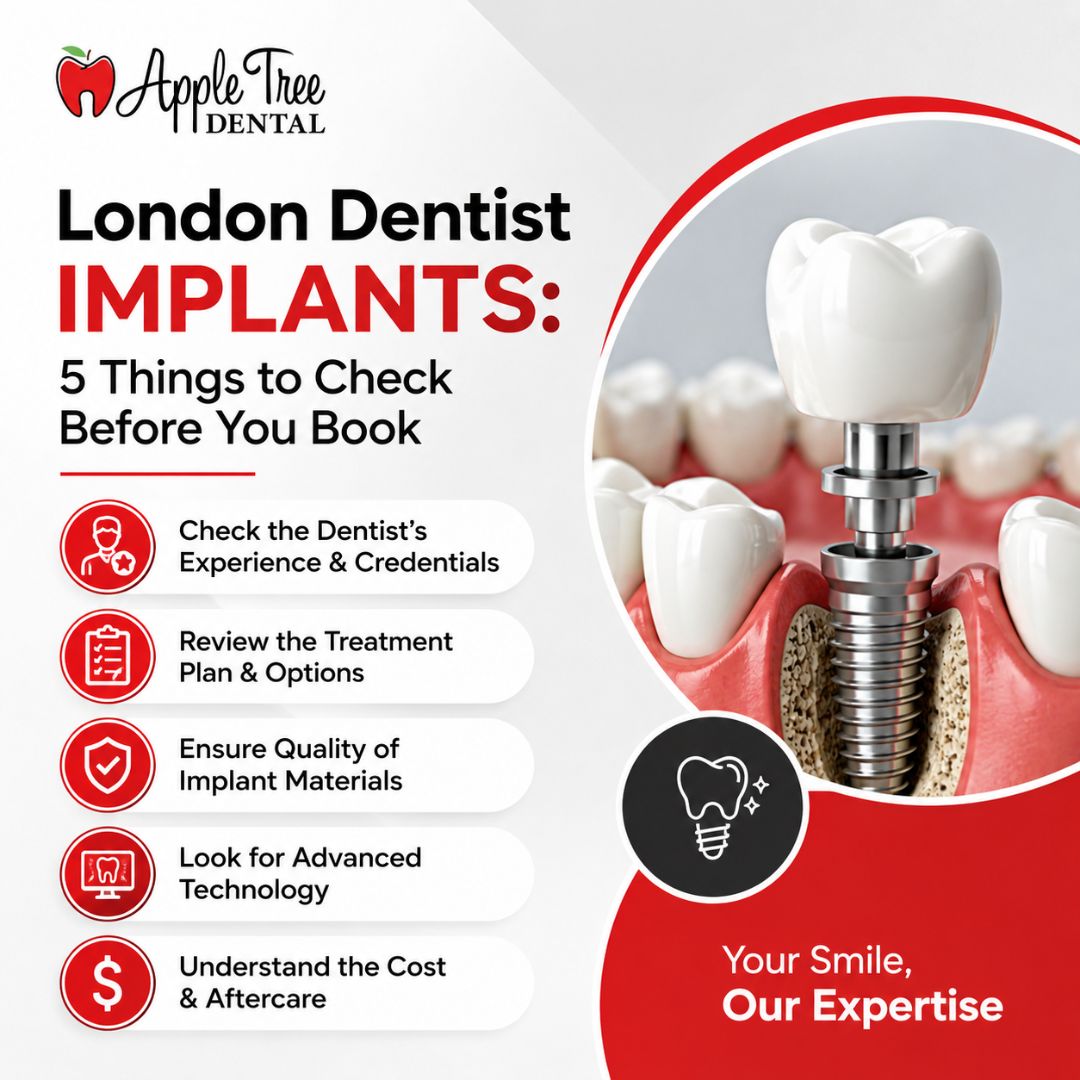
- Not every dentist who “offers implants” plans and places them in-house — ask directly.
- 3D cone-beam imaging changes how accurately an implant is placed. Confirm the clinic has it.
- A real candidacy check includes bone density, gum health, and your medical history, not just an X-ray.
- Implants typically take 3 to 6 months from placement to final crown, healing time included.
- Apple Tree Dental places and restores implants at both its London, Ontario locations, with financing options available.
Picking a dentist for implants is a bigger decision than picking one for a filling. This is surgery, and it’s permanent. You want someone who’s done it enough times that it’s routine for them, not for you.
What “Dentist for Implants” Actually Means
Some general dentists place implants themselves. Others plan the case, then refer the surgical part to a specialist and only handle the crown. Both are legitimate. But you should know which one you’re getting before you start.
Ask straight out: “Do you place the implant yourself, or is that done elsewhere?” A clinic that handles planning, placement, and the final crown under one roof usually means fewer appointments, one team tracking your healing, and one point of contact if something feels off.
Five Things to Check Before You Book
- 3D imaging on-site. Cone-beam CT scans show bone depth and nerve position in 3D, not just a flat X-ray. This is what implant placement accuracy is built on.
- A written treatment plan. You should get a plan that names the implant brand, the number of appointments, and the total cost before surgery, not an estimate given verbally.
- Case photos or examples. A dentist who places implants regularly can show you real before-and-after cases, not just stock images.
- A clear failure policy. Ask what happens if the implant doesn’t integrate with the bone. Reputable clinics have a documented process, not a shrug.
- Sedation options. If you’re anxious about the procedure, confirm sedation dentistry is available so you’re not finding out mid-consult.
Are You a Good Candidate?
Most healthy adults with one or more missing teeth qualify. But candidacy comes down to three specific things, not a general “yes.”
| Factor | What It Means | If It’s a Problem |
|---|---|---|
| Bone density | The jaw needs enough bone to hold the implant post | A bone graft can build up the site first |
| Gum health | Active gum disease raises the risk of implant failure | Gum disease is treated first, then implants proceed |
| Medical history | Uncontrolled diabetes or heavy smoking slows healing | Often still possible, with a modified plan |
None of these rule you out permanently. They just change the order of treatment. This is exactly why a proper exam matters more than a quick “yes, we can do that” over the phone.
Implants vs. Bridge vs. Denture
A dentist who’s upfront with you will explain all three, not just push implants.
- Dental implant: Replaces the tooth root, stops jawbone loss, lasts decades with care. Highest upfront cost, longest timeline.
- Fixed bridge: Faster and cheaper upfront, but relies on grinding down neighbouring teeth and doesn’t stop bone loss underneath.
- Denture: Lowest cost, removable, needs replacing every 5 to 8 years, and can shift or click when eating.
For a single missing tooth in an otherwise healthy mouth, an implant is usually the option that protects the surrounding teeth best. For several missing teeth, or budget constraints, a bridge or partial denture can still be the right call, at least for now.
What the Timeline Actually Looks Like
This is where most patients get surprised. An implant isn’t a one-visit procedure.
- Consultation and imaging — exam, 3D scan, treatment plan. About 1 visit.
- Implant placement — the titanium post is placed into the jawbone. 1 to 2 hours.
- Healing (osseointegration) — the bone fuses to the implant. 3 to 6 months.
- Abutment and crown — the connector and visible tooth are attached once healing is confirmed.
Total time from first visit to finished tooth is usually 3 to 6 months. Bone grafts, if needed, add extra healing time before placement can happen.
How Long Do Implants Actually Last?
The Canadian Dental Association lists implants among the most predictable procedures in modern dentistry, with success rates reported above 95% [Source: Canadian Dental Association, 2025]. The crown on top may need replacing after 10 to 15 years of normal wear. The implant post itself, if cared for, is designed to last a lifetime.
Failure is uncommon but not impossible. It’s usually tied to gum disease around the implant (peri-implantitis), smoking, or grinding your teeth at night without a guard. A dentist who mentions this upfront, instead of only talking about success stories, is being straight with you.
Looking After an Implant Once It’s In
- Brush and floss around it exactly like a natural tooth, twice a day
- Use a water flosser or interdental brush to clean under the crown
- Keep up with 6-month cleanings so early gum issues get caught
- Wear a night guard if you grind your teeth
- Avoid using the implant tooth to crack nuts or open packaging
An implant doesn’t get cavities, but the gum around it can still get infected if it’s neglected. Treat it like a real tooth, because functionally, it is one.
Dental Implants at Apple Tree Dental, London, Ontario
Apple Tree Dental plans, places, and restores dental implants at both its London locations — Beaverbrook Avenue North and Wonderland Road South. Every case starts with a 3D scan and a written plan, so you know the full picture before you commit to anything. Sedation is available for patients who feel anxious about the procedure, and financing options are in place for treatment that doesn’t fit a one-time budget.
If you’re comparing dentists for implants in London, book a consultation and bring your questions. A clinic confident in its work will answer all of them, not just the easy ones. For a full cost breakdown, see our dental implants pricing guide for London, Ontario.
Frequently Asked Questions
A: Confirm they place implants in-house, use 3D imaging, give a written treatment plan, and can show real case examples before you book surgery.
A: Many general dentists place implants themselves after additional training. Others refer the surgical step to a specialist. Ask directly which applies to your case.
A: Usually 3 to 6 months, including 3 to 6 months of healing between placement and the final crown. A bone graft adds extra time.
A: No. Age alone doesn’t disqualify you. What matters is bone density, gum health, and overall healing ability, which a dentist checks at consultation.
A: An implant replaces the tooth root and stands alone. A bridge relies on grinding down the teeth next to the gap for support.
A: Rarely. Failure is usually linked to gum infection around the implant, smoking, or untreated teeth grinding. Success rates are reported above 95%.
A: Only if your jawbone is too thin or soft at the implant site. A 3D scan at consultation shows whether this applies to you.
A: Apple Tree Dental places and restores dental implants at both its Beaverbrook North and Wonderland South locations in London.
Comparing Dentists for Dental Implants in London?
Book a consultation with Apple Tree Dental and get a written implant plan, no guesswork.