
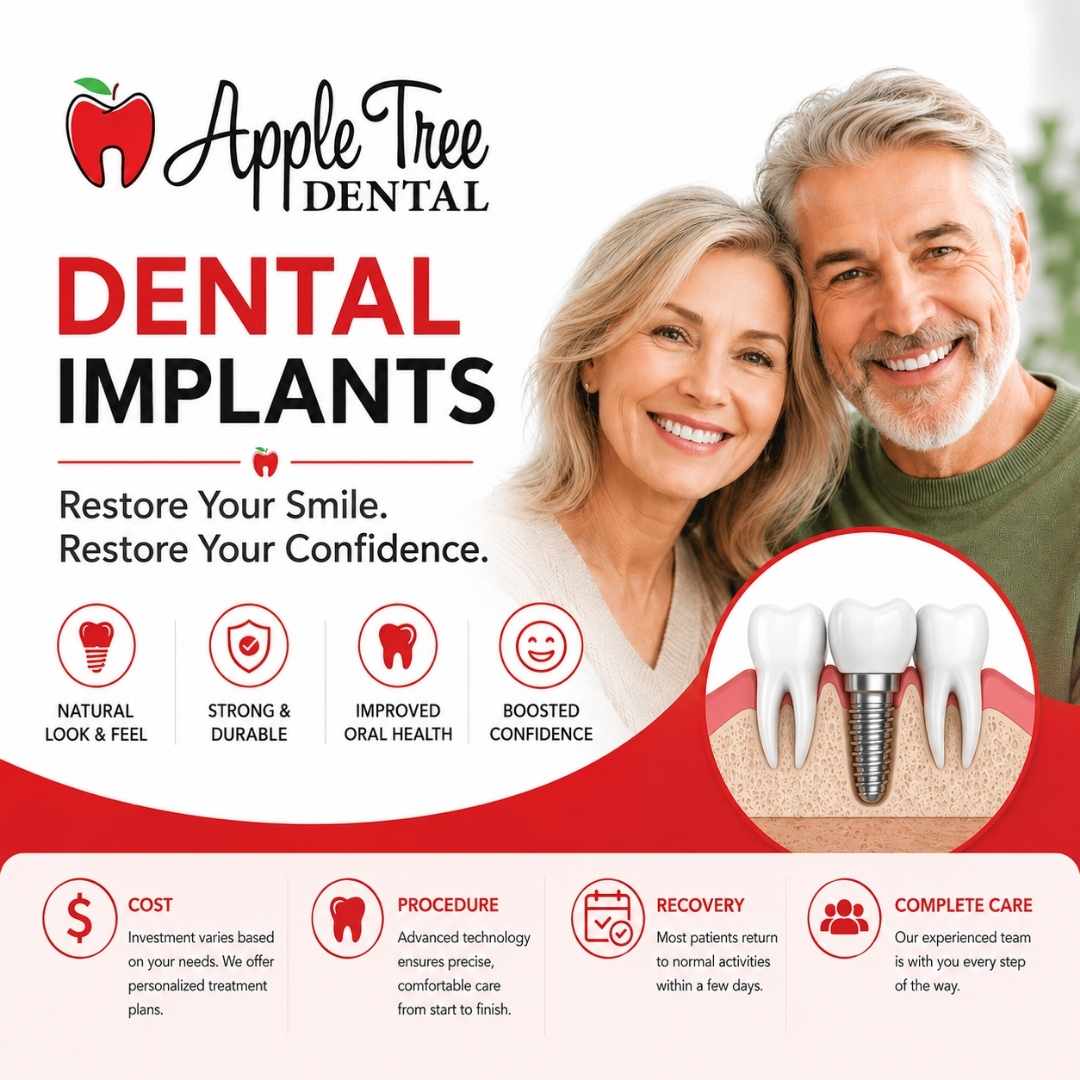
If you’ve been living with a missing tooth — or several — you already know the impact it has on more than just your smile. It affects how you eat, how you speak, and how you carry yourself in everyday situations. Permanent dental implants in London, Ontario offer a solution that doesn’t just fill the gap — they replace the tooth root itself, preserving your jawbone and giving you a result that looks, feels, and functions like the real thing for decades. At Apple Tree Dental, our team has helped patients across London — from our North London clinic on Beaverbrook Ave and our South London clinic on Wonderland Rd — reclaim their smiles with implants planned using advanced 3D imaging technology for precise, lasting outcomes.
What Makes a Dental Implant “Permanent”?
The word “permanent” gets used a lot in dentistry, but with implants it genuinely applies — and here’s why. Unlike dentures (which are removable) or bridges (which rely on neighbouring teeth and typically need replacing every 10–15 years), a dental implant involves placing a titanium post directly into your jawbone. Over the following months, the bone fuses around that post in a process called osseointegration — the same biological bonding process that holds natural tooth roots in place.
Once that fusion is complete, the implant becomes a fixed, permanent part of your jaw. The titanium post itself doesn’t decay, doesn’t loosen, and — with proper care — doesn’t need to be replaced. The visible crown on top does have a lifespan of around 10 to 15+ years, but the foundation beneath it is built to last a lifetime.
| Restoration Type | Replaces Root? | Lifespan | Preserves Bone? |
|---|---|---|---|
| Permanent Implant | ✅ Yes | Post: lifetime / Crown: 10–15+ yrs | ✅ Yes |
| Denture | ❌ No | 5–8 years | ❌ No |
| Bridge | ❌ No | 10–15 years | ❌ No |
10 Reasons Patients Choose Permanent Implants Over Other Options
1. They’re the Only Solution That Replaces the Root
Every other tooth replacement option addresses the visible gap. Only an implant addresses what’s beneath it — the root. That root-level anchoring is what gives implants their superior stability and what prevents the bone loss that silently occurs with dentures and bridges.
2. They Look Completely Natural
Each crown is custom-designed to match the colour, shape, and size of your surrounding teeth. Most people — including your dentist — won’t be able to tell the difference from a natural tooth.
3. You Can Eat Whatever You Like
Corn on the cob. Crusty sourdough. A crisp apple. Implants restore your full bite strength — something removable dentures simply can’t match. You won’t need to modify your diet or worry about a restoration shifting while you eat.
4. Your Jawbone Stays Healthy
When a tooth is lost, the jawbone beneath it begins to deteriorate because it’s no longer being stimulated. Implants mimic a natural tooth root, maintaining that stimulation and preserving both your bone structure and the natural shape of your face over time — a benefit dentures cannot provide.
5. No Impact on Neighbouring Teeth
A traditional bridge requires grinding down the healthy teeth on either side to act as anchors. Implants are entirely self-supporting — your surrounding teeth remain completely intact.
6. Implant Success Rates Exceed 95%
According to the Canadian Dental Association, dental implants are one of the most predictable and successful procedures in modern dentistry, with long-term success rates consistently above 95% in healthy patients.
7. They’re Cost-Effective Long-Term
Implants cost more upfront than dentures or bridges — but a denture may need replacing every 5 to 8 years. An implant post that lasts a lifetime, with only a crown replacement every 10–15 years, typically works out significantly cheaper over the course of a patient’s life.
8. Minimal Maintenance — Just Treat Them Like Natural Teeth
No adhesives, no overnight soaking, no special cleaning kits. Brush twice daily, floss, and keep up with your regular checkups — the same routine you’d follow for natural teeth.
9. Your Speech Stays Natural
Dentures can slip and cause slurring or whistling. Implants are fixed firmly in place — your speech patterns won’t be affected once the implant is fully integrated and the crown is placed.
10. The Confidence Boost Is Real
Many patients describe their implant as life-changing — not just physically, but emotionally. Smiling freely in photos, speaking clearly in professional settings, and feeling at ease socially are outcomes that go well beyond oral health.
Did You Know?
At Apple Tree Dental, all implant treatments are planned using advanced 3D imaging before any procedure begins — allowing our team to assess bone density, nerve positioning, and optimal implant placement with a level of precision that traditional X-rays simply can’t provide.
Are You a Candidate for Permanent Dental Implants?
Permanent implants are suitable for most healthy adults with one or more missing teeth. You’re likely a strong candidate if you:
- Have one or more missing teeth (single, multiple, or full arch)
- Have healthy gums with no active gum disease
- Have adequate jawbone density to support an implant post
- Are in generally good overall health
- Maintain good daily oral hygiene habits
- Are a non-smoker or prepared to stop smoking before and after surgery
Even if you’ve experienced significant bone loss since losing a tooth, you may still qualify through a bone grafting procedure, which rebuilds the foundation needed to support a permanent implant. Our 3D imaging assessment at consultation will determine exactly what’s needed in your specific case.
Important
Don’t self-diagnose your candidacy based on online articles alone. Bone density, gum condition, and overall health all affect eligibility. A comprehensive exam — including 3D scanning — at Apple Tree Dental gives you a definitive, personalised answer.
Types of Permanent Implant Solutions Available at Apple Tree Dental
Single Tooth Implant
One implant post supports one custom crown, replacing a single missing tooth without touching the surrounding teeth. The most natural-feeling option available for a single gap.
Implant-Supported Bridge
For several adjacent missing teeth, two implant posts anchor a row of replacement teeth — no healthy teeth ground down, no movement, no adhesives.
Full Arch Permanent Restoration
For patients who have lost most or all teeth on one arch, a full set of permanent implant-supported replacement teeth can be secured using a small number of strategically placed posts — delivering stability and function that removable dentures cannot match.
All-on-4 Dental Implants
A specialised permanent full-arch solution that uses just four implants to support an entire arch of teeth. Particularly well-suited for patients who have experienced more significant bone loss. Learn more in our full guide to All-on-4 dental implants in London, Ontario.
The Permanent Implant Process at Apple Tree Dental: Step by Step
| Stage | What Happens | Approx. Timeline |
|---|---|---|
| 1. Consultation | 3D scan, bone & gum assessment, personalised treatment plan | 1 visit |
| 2. Tooth Extraction | If the failing tooth is still present (same day or separate) | Same day or 1 visit |
| 3. Implant Surgery | Titanium post placed under local anaesthetic | 1–2 hours |
| 4. Osseointegration | Bone fuses to implant; temporary restoration worn | 3–6 months |
| 5. Abutment & Crown | Custom crown colour-matched and secured permanently | 2–4 weeks after healing |
Step 1: Consultation and 3D Assessment
Your journey begins with a thorough consultation at either our North or South London location. We take digital X-rays and 3D scans to assess your bone density, gum health, and the precise positioning needed for optimal implant placement. This is also your opportunity to ask every question you have — there are none too small.
Step 2: Implant Surgery
Under local anaesthetic, the titanium post is carefully positioned into your jawbone at the exact location mapped during your 3D assessment. The procedure typically takes one to two hours. Most patients are surprised by how manageable it is — many describe it as less uncomfortable than a tooth extraction.
Step 3: Osseointegration — The Healing Phase
Over the next three to six months, your jawbone gradually fuses with the implant post, creating a permanent, rock-solid bond. You’ll have a temporary restoration in place throughout this period so you’re never without a tooth.
Important Warning
Smoking significantly slows osseointegration and is one of the leading causes of implant failure. Patients are strongly advised to stop smoking before surgery and throughout the healing phase. Health Canada’s quit smoking resources can help.
Step 4: Abutment Placement
Once healing is confirmed, a small connector piece called an abutment is attached to the top of the implant. This is what your final permanent crown will be secured to.
Step 5: Your Permanent Crown
Your custom crown — colour-matched and shaped to blend seamlessly with your natural teeth — is permanently secured in place. Your new tooth is indistinguishable from the real thing. For full service details, visit our dental implants service page.
Recovery After Permanent Implant Surgery
Recovery is usually much more straightforward than patients expect. Most people are back to their normal routines within a day or two. What’s normal in the first few days:
- Mild swelling around the gums and jaw
- Minor soreness manageable with over-the-counter pain relievers
- Some tenderness when eating in the first few days
- Light bleeding in the first 24 hours
To support smooth healing: stick to soft foods for the first week, avoid smoking and alcohol, follow your post-op care instructions, and don’t skip follow-up appointments — that’s how your dentist confirms osseointegration is on track. Research from the National Institutes of Health confirms that recovery complications are uncommon in healthy patients.
Cost of Permanent Dental Implants in London, Ontario
The cost varies from patient to patient because every treatment plan is different. Key factors that affect pricing include:
- Number of implants required
- Whether bone grafting is needed
- Type of restoration (single crown, implant bridge, or full arch)
- Materials used for the crown
- Complexity of the surgical procedure
While implants involve a higher upfront cost than dentures or bridges, they are typically the most cost-effective solution long-term — a denture may need replacing every 5 to 8 years, whereas an implant post can last a lifetime. The Ontario government’s dental care resources may also be useful if you’re exploring coverage or financial assistance.
Apple Tree Dental Cost Transparency
At Apple Tree Dental, every patient receives a detailed, itemised cost breakdown at their consultation — before any treatment begins. We also discuss financing options to make permanent implants as accessible as possible. No surprises, no pressure.
Permanent Implants at Apple Tree Dental: What Sets Us Apart
Two Convenient London Locations
Apple Tree Dental offers implant consultations and treatment at both our North London clinic (Beaverbrook Ave) and our South London clinic (Wonderland Rd). Book at whichever location works best for your schedule.
3D Imaging for Precise Implant Planning
Every implant treatment at Apple Tree Dental is planned using state-of-the-art 3D scanning technology. This allows our team to assess bone density, map nerve locations, and determine the optimal implant position before any procedure begins — resulting in more predictable outcomes and fewer complications.
Specialist Prosthodontic Background
Dr. Nagham Altalib brings a specialist prosthodontics background — having trained and worked at a prosthodontics-focused academic centre and the DHCC European University team for Implants and Orthodontics before establishing Apple Tree Dental in London. That depth of experience in implant and restorative dentistry is directly applied to every permanent implant case we treat.
Personalised Care, No Pressure
Every treatment plan is built around your specific oral health, your goals, and your lifestyle. Our team takes the time to thoroughly explain every step, answer your questions, and ensure you feel fully informed — never rushed — throughout the entire process.
Full-Spectrum Restorative Support
We offer everything your implant journey may require under one roof — from tooth extractions and bone grafting assessments to implant-supported dentures and All-on-4 full-arch restorations. No referrals, no juggling multiple clinics.
How Long Do Permanent Dental Implants Last?
| Component | Expected Lifespan | Key Factor |
|---|---|---|
| Implant Post (titanium root) | Often a lifetime | Oral hygiene + no smoking |
| Dental Crown | 10–15+ years | Bite force + care routine |
The key to maximising implant lifespan is identical to caring for natural teeth: brush twice daily, floss, and keep up with your regular cleanings and checkups. With that level of maintenance, many patients keep their implant post for the rest of their life — making it a genuinely permanent investment in your oral health.
Frequently Asked Questions: Permanent Dental Implants in London, Ontario
Are dental implants truly permanent?
The titanium implant post is designed to be a permanent, lifetime solution. It fuses with your jawbone through osseointegration and — with proper care — does not need to be replaced. The crown attached on top typically lasts 10 to 15 or more years before needing replacement. No other tooth replacement option offers the same combination of root-level permanence and bone preservation.
Do permanent implants hurt?
The procedure is performed under local anaesthetic, so you won’t feel pain during surgery. Most patients experience only mild soreness for a few days afterwards, manageable with over-the-counter pain relief. The majority of our patients say it was far less uncomfortable than they anticipated.
How long does the full process take from consultation to permanent crown?
Most patients complete treatment within three to eight months from their first consultation. The longest part is osseointegration — the 3 to 6 month healing phase where your bone fuses with the implant post. During this time you’ll have a temporary restoration in place.
Do you offer permanent implants at both Apple Tree Dental locations?
Yes. Implant consultations and treatment are available at both our North London location (Beaverbrook Ave) and our South London location (Wonderland Rd). When you book your consultation, simply choose the location most convenient for you.
What financing options are available for permanent implants?
We discuss financing options at every implant consultation. Our team will walk you through a full, itemised cost breakdown for your specific treatment plan and outline the payment arrangements available to make permanent implants as accessible as possible. The Ontario government’s dental care resources may also provide additional guidance on coverage.
Do I need a bone graft before getting a permanent implant?
Not necessarily — many patients have sufficient bone for direct implant placement. However, if a tooth has been missing for some time, bone loss may have occurred. Our 3D imaging assessment during your consultation will determine exactly whether grafting is needed in your case, and if so, what that process involves.
How much do permanent dental implants cost in London, Ontario?
Cost depends on several factors — the number of implants, whether bone grafting is required, and the type of restoration. The only way to get an accurate figure is through a personalised consultation. At Apple Tree Dental, we provide a complete, transparent cost breakdown at that first appointment — no vague estimates, no surprises.
How do permanent implants compare to All-on-4?
Both are permanent solutions — the difference is scale. A single or multiple-tooth implant replaces individual missing teeth. All-on-4 is a full-arch solution that uses four strategically placed implants to support an entire row of teeth, making it better suited for patients who have lost most or all teeth on one arch. Read our full All-on-4 guide to understand which fits your situation.
Where can I book a permanent implant consultation in London, Ontario?
You can book online at either location: appletreedental.ca/book-your-appointment. You can also call us at (519) 641-1411 (North) or (226) 667-4600 (South).
Final Thoughts: Is a Permanent Implant Right for You?
Permanent dental implants are widely regarded as the gold standard for tooth replacement — and the reason is simple. They’re the only solution that replaces both the root and the crown, preserves your jawbone, and is genuinely designed to last a lifetime. If you’ve been putting off addressing a missing tooth because the process felt overwhelming or the costs felt unclear, we hope this guide has made things more straightforward.
The first step is simply a conversation. At Apple Tree Dental — at our North or South London location — our team is here to assess your situation honestly, answer your questions without pressure, and help you decide whether a permanent implant is the right path for your smile and your life.