
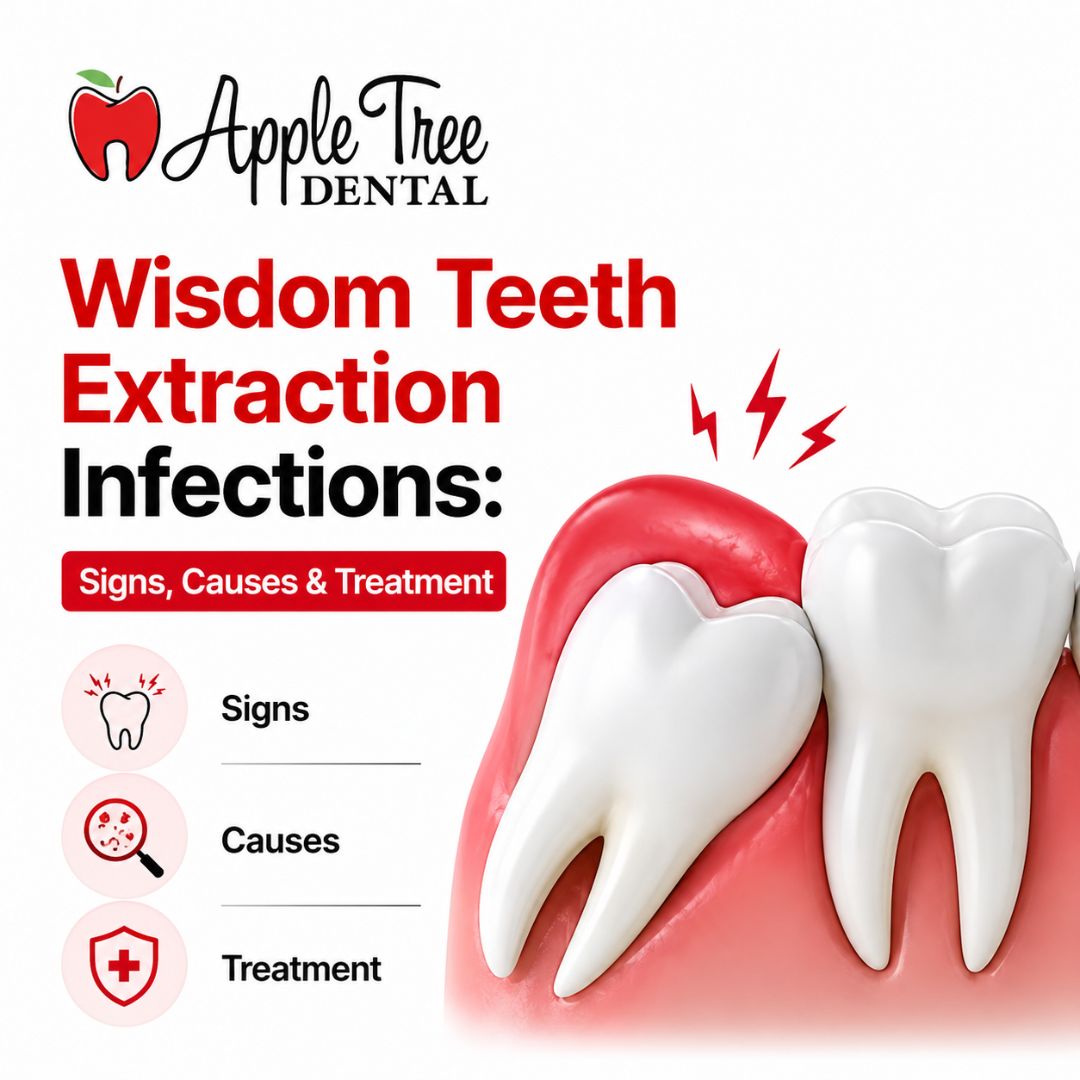
Quick answer: Wisdom teeth extraction infections happen when bacteria get into the socket after surgery, usually within the first week, and show up as worsening pain, swelling, pus, or a bad taste that doesn’t fade. Research on Canadian third-molar extractions puts the risk at roughly 1 in 15 patients, so catching wisdom teeth extraction infections early matters more than panicking about them.
Most people recover from wisdom tooth surgery without any trouble. But if your pain is getting worse instead of better three or four days out, or you keep tasting something foul, it’s fair to wonder if something’s wrong. At Apple Tree Dental in London, Ontario, we see this question a lot — and the honest answer is that real infections are less common than people assume, but they do need fast treatment when they happen.
This guide walks through what a genuine wisdom teeth extraction infection looks like, how it’s different from the far more common dry socket, and exactly when to pick up the phone.
Table of Contents
- Key Takeaways
- Signs of Wisdom Teeth Extraction Infections
- Why Wisdom Teeth Get Infected More Than Other Teeth
- Infection vs. Dry Socket: How to Tell the Difference
- Bad Taste in Your Mouth After Wisdom Teeth Removal
- How Soon Infection Shows Up (and How Long It Takes to Treat)
- What to Do If You Suspect an Infection
- How Dentists Treat an Infected Extraction Site
- How to Lower Your Infection Risk
- When to Go to Emergency Instead of Your Dentist
- Frequently Asked Questions
Key Takeaways
- Wisdom teeth extraction infections are less common than people think — studies on Canadian third-molar patients put the rate around 6–7%, not the majority of cases.
- Pain that worsens after day 3 is the biggest red flag; normal healing pain fades steadily instead.
- Infection and dry socket are different problems — one involves bacteria and pus, the other is an exposed bone with no clot, and they need different treatment.
- A lingering bad taste or smell past day 5–7 usually means bacteria have colonized the socket.
- Antibiotics alone rarely fix it — most infected sockets also need cleaning, drainage, or a follow-up visit with your dentist.
Signs of Wisdom Teeth Extraction Infections
A genuine infection announces itself differently than normal healing. Normal healing hurts less every day. An infected socket hurts more, or the pain plateaus and then spikes again after day three or four.
Watch for this cluster of symptoms together, not just one on its own:
- Throbbing pain that gets worse instead of better after day 3
- Swelling that spreads into your cheek, jaw, or neck
- Visible pus or cloudy discharge from the socket
- A persistent foul taste or smell that doesn’t improve with rinsing
- Fever, chills, or feeling generally unwell
- Difficulty opening your mouth fully (jaw stiffness)
- Swollen lymph nodes under your jaw
One symptom alone doesn’t confirm one of the wisdom teeth extraction infections we see. Some swelling and mild bad breath are normal for the first 48 hours. It’s the combination, and the fact that things are getting worse rather than better, that points to a problem worth calling your dentist about after tooth extraction.
💡 Expert Insight: In our London clinic, the patients who catch a wisdom tooth infection earliest are usually the ones who track their pain day by day rather than just how they feel in the moment. If day 4 hurts more than day 2 did, that’s the signal to call — don’t wait for a fever to show up first.
Why Wisdom Teeth Get Infected More Than Other Teeth
Wisdom teeth sit furthest back in your mouth, which makes them harder to reach with a toothbrush or floss even before surgery. Many are also impacted or only partially through the gum, so the surgical site is more complex than a routine extraction.
Food particles and bacteria collect more easily in that deep pocket, and it’s harder for you to keep the area clean while it heals. A prospective study of impacted lower third molars at a private Canadian dental practice found a 6.9% combined rate of dry socket, infection, and nerve-related complications [Source: Chuang et al., 2021]. That’s a useful number to keep in mind: infection is a real possibility, but it’s still the exception, not the rule.
Infection vs. Dry Socket: How to Tell the Difference
These two get confused constantly because both cause pain that shows up a few days after surgery. They’re not the same problem — wisdom teeth extraction infections involve bacteria, while dry socket doesn’t — and treating one like the other delays your recovery.
| Feature | Infection | Dry Socket |
|---|---|---|
| Cause | Bacteria in the wound | Blood clot dislodged too early |
| Typical onset | Day 3–7, sometimes weeks later | Day 2–4 |
| What the socket looks like | Pus, redness, cloudy discharge | Empty-looking, visible bone, no clot |
| Taste or smell | Foul, metallic, worsening | Unpleasant but milder |
| Fever | Possible | Rare |
| Pain pattern | Builds gradually, spreads to jaw/ear | Sharp, sudden, radiates to ear |
| Standard treatment | Cleaning, drainage, antibiotics if needed | Medicated dressing, pain control |
If you’re not sure which one you’re dealing with, that uncertainty is itself a reason to get it looked at rather than guess. A quick exam tells your dentist which one it is in minutes.
Bad Taste in Your Mouth After Wisdom Teeth Removal
A mild, blood-tinged taste is completely normal for the first two to three days. It comes from healing tissue and small amounts of blood in the socket, and it fades on its own.
A taste that’s still there — or getting worse — past day 5 to 7 is different. That usually means bacteria have settled into the socket and started producing the compounds that cause bad breath and a metallic or rotten flavour. Pair that with any swelling or pain, and it’s time to call your dental team rather than wait it out with more mouthwash.
How Soon Infection Shows Up (and How Long It Takes to Treat)
Most infections after wisdom tooth extraction develop within the first one to two days after surgery, but delayed-onset infections can appear two to eight weeks later, especially around partially formed roots.
A retrospective study of tooth extractions found an overall postoperative infection rate of 1.4%, with patients under 30 showing the highest incidence at 3.5% [Source: PMC, 2021]. Younger patients having wisdom teeth out are, statistically, a bit more likely to see this — one more reason not to shrug off symptoms just because you’re young and otherwise healthy.
Once treated properly, most infections start settling down within 2 to 4 days of starting antibiotics or having the site cleaned. Full soft-tissue healing around the socket still takes the usual 2 to 3 weeks.
What to Do If You Suspect an Infection
Follow these steps if your extraction site feels wrong past the first few days:
- Check the pain trend. Is today worse than two days ago? That trend matters more than the pain level itself.
- Look for pus or swelling. Use a mirror and good light to check the socket and the surrounding gum.
- Rinse gently with warm salt water. This won’t cure an infection, but it keeps the area clean while you get an appointment.
- Call your dentist the same day if you notice pus, spreading swelling, or fever — don’t wait for a scheduled follow-up.
- Avoid smoking, straws, and alcohol until you’ve been seen, since all three can make things worse.
- Take your temperature if you feel unwell, and mention it when you call.
How Dentists Treat an Infected Extraction Site
Treatment depends on how far the infection has progressed. Your dentist will usually start with an exam and sometimes an X-ray to see if it’s reached the bone.
- Cleaning and irrigation — flushing the socket to remove debris and bacteria
- Drainage — releasing pus if an abscess has formed
- Antibiotics — prescribed when infection has spread beyond the socket itself
- Follow-up visits — to confirm the infection is clearing rather than assuming it is
Antibiotics alone, without cleaning the site, often aren’t enough — which is part of why guidance from the Canadian Dental Association emphasizes proper in-office aftercare and hygiene alongside any medication.
How to Lower Your Infection Risk
You can’t eliminate the risk completely, but you can cut it down a lot with a few habits in the first week.
- Rinse gently with warm salt water starting 24 hours after surgery
- Avoid straws, smoking, and vaping for at least a week
- Stick to soft foods and avoid chewing near the socket
- Brush carefully around the area — skip it directly, but keep the rest of your mouth clean
- Take any prescribed antibiotics for the full course, not just until you feel better
- Keep scheduled follow-up appointments even if you feel fine
Good general oral hygiene before surgery also helps. Patients who come in for regular professional cleanings tend to have less bacteria buildup around the wisdom tooth site to begin with, which gives the socket a cleaner environment to heal in.
When to Go to Emergency Instead of Your Dentist
Most infections are handled by your dentist’s office. A small number need urgent hospital care because the infection has started spreading.
Go to the emergency room if you notice:
- Difficulty swallowing or breathing
- Swelling that’s closing your eye or spreading down your neck
- A fever above 38.5°C (101°F) with chills
- Rapid heart rate, confusion, or extreme weakness
These are signs the infection may be spreading beyond the socket, and they need faster treatment than a dental office visit can provide same-day.
Frequently Asked Questions
What are the first signs of infection after wisdom tooth extraction?
The earliest signs are usually pain that stops improving after day 3, swelling that spreads rather than shrinks, and a bad taste that doesn’t fade with rinsing.
How is a wisdom tooth extraction infection different from dry socket?
Infection involves bacteria, pus, and often fever. Dry socket is a dislodged blood clot with exposed bone and sharp pain, but no pus and rarely any fever.
Can a wisdom tooth extraction site get infected weeks later?
Yes. Delayed-onset infections can appear two to eight weeks after surgery, particularly around teeth that had limited space to erupt.
What does an infected wisdom tooth socket look like?
It typically shows redness, swelling, and visible pus or cloudy discharge, compared to a healthy socket that looks pink and gradually smaller over time.
Why do I have a bad taste in my mouth after wisdom teeth removal?
A mild taste in the first few days is normal healing. A taste that persists past day 5–7 or worsens usually points to bacteria in the socket.
How long does an infected wisdom tooth extraction take to heal with treatment?
Symptoms usually start improving within 2 to 4 days of proper treatment, though full tissue healing still takes the standard 2 to 3 weeks.
Do I need antibiotics after wisdom tooth extraction?
Not routinely. Antibiotics are typically reserved for confirmed infections rather than prescribed automatically after every extraction.
Can wisdom tooth extraction infection spread to other parts of the body?
In rare, untreated cases, yes. Infection can spread to the jawbone, surrounding tissue, or bloodstream, which is why prompt treatment matters.
How can I lower my risk of infection after wisdom teeth removal?
Salt water rinses, avoiding straws and smoking, sticking to soft foods, and completing any prescribed antibiotics all reduce your risk significantly.
When should I go to the emergency room instead of my dentist?
Go to the ER for difficulty breathing or swallowing, swelling spreading toward your eye or neck, or a fever above 38.5°C with chills.
Final Thoughts
Most people heal from wisdom tooth surgery without any complications, and true wisdom teeth extraction infections are still the less common outcome. What matters is paying attention to the trend of your recovery, not just how one day feels. Pain that’s climbing instead of settling, a taste that won’t quit, or swelling that keeps spreading are your cues to call. Our team at Apple Tree Dental is here to check it out and get you back on track — book an appointment if anything about your recovery feels off.