
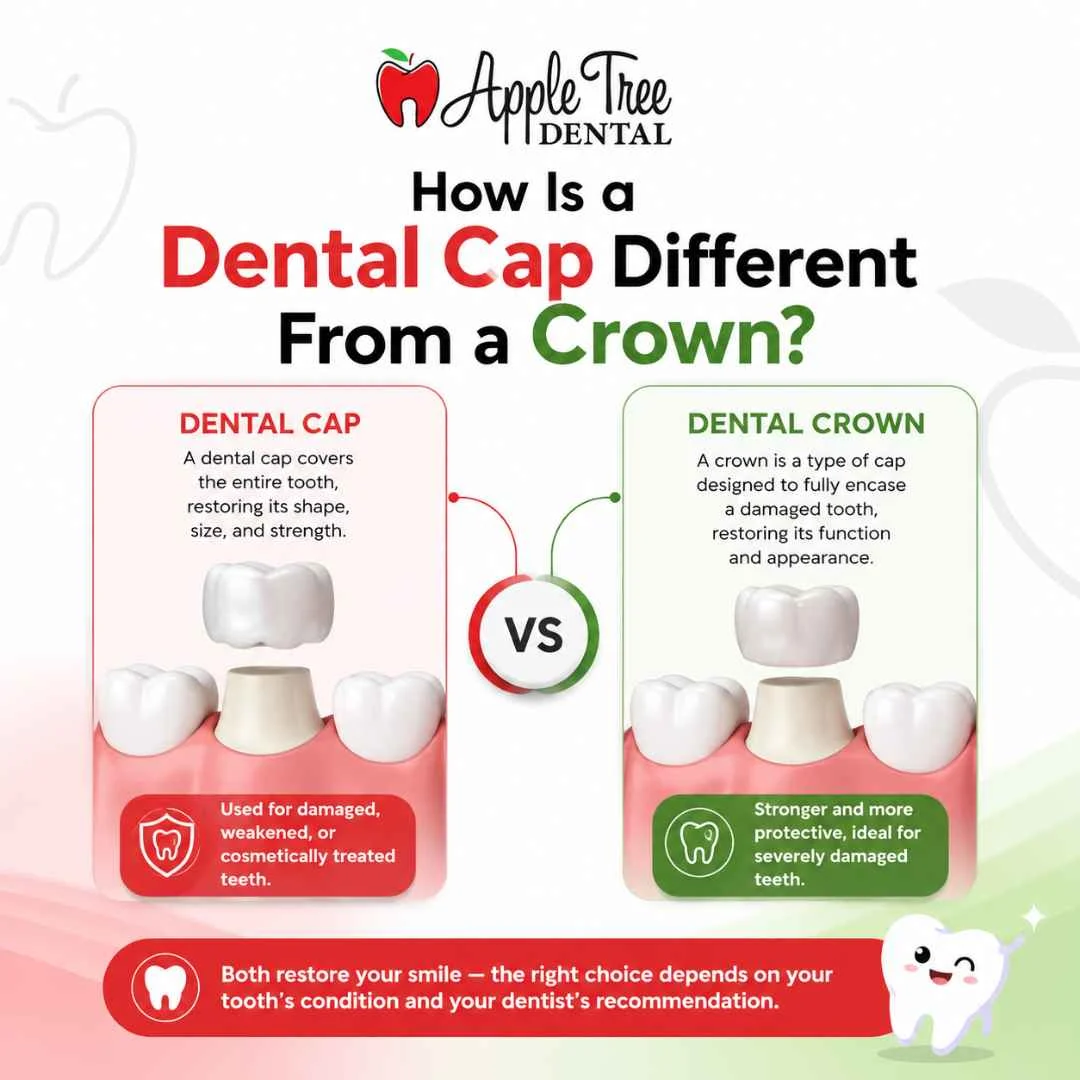
Quick answer: A dental cap and a dental crown are the same restoration. “Crown” is the term dentists use; “cap” is the everyday word patients reach for. Both describe a custom-made cover that fits over a damaged tooth to restore its shape, strength, and look. There’s no separate “dental cap” procedure — if your dentist books you for a cap, you’re getting a crown.
You’ve probably heard both words tossed around and wondered if you’re missing something. Did your neighbour get a “cap” while you’re being quoted for a “crown”? At Apple Tree Dental in London, Ontario, patients ask us this almost every week, usually right before we prep a tooth.
Here’s the short version: dental cap and dental crown are two names for one treatment. This guide covers where the confusion comes from, what actually happens during the procedure, how much it costs, and how to know if you need one.
📋 Table of Contents
✅ Key Takeaways
- Dental cap and dental crown mean the same restoration — “crown” is the clinical term, “cap” is the term patients commonly use.
- Some offices use “cap” loosely for partial coverage (an onlay or inlay), which is where real confusion can start.
- Full crowns cover the entire visible tooth, while an onlay only covers part of the biting surface.
- In Ontario, crowns typically run $1,000–$2,000+ per tooth, depending on material and whether a core build-up is needed.
- Well-placed crowns can last 10 to 15 years or longer with normal care and regular checkups.
Dental Cap vs Crown: Are They the Same Thing?
Yes, in almost every case. When a dentist says “crown,” and a patient says “cap,” they’re pointing at the same tooth-shaped cover that fits over what’s left of a damaged tooth. Your dentist cements it in place, and once seated, it looks, feels, and functions like a natural tooth.
The word “cap” comes from the same logic as a bottle cap or a hat — something that fits snugly over the top. Patients reach for it because it’s an easy mental picture. Dental schools, clinical notes, and insurance paperwork all use “crown” instead, which is why dentists default to it. Neither word describes a different treatment; they describe the same one from two different angles.
💡 Expert Insight: We hear “dental cap crown” phrased both ways in the same conversation constantly — a patient will ask about a “cap” and then read their treatment plan that says “crown” and worry we changed the plan. We haven’t. It’s the same restoration; only the word changed.
Where the Confusion Actually Comes From
The mix-up isn’t entirely pointless. A few dentists and older references use “cap” specifically for a partial restoration — something that only covers a portion of the tooth, closer to what’s formally called an onlay or inlay. By contrast, a full crown covers the entire visible tooth above the gumline.
So if someone tells you a cap needs less of your natural tooth removed than a crown, they’re likely talking about this narrower definition — not the everyday one. In the vast majority of dental offices across Canada, though, “cap” and “crown” are used as pure synonyms, and that’s the definition this guide uses going forward.
Dental Cap vs Dental Crown: Side-by-Side
To make the terminology concrete, here’s how the common usage and the narrower usage compare:
| Feature | Crown (Full Coverage) | “Cap” (Partial / Onlay Sense) |
|---|---|---|
| Coverage | Entire visible tooth, all sides | Biting surface and one or two sides |
| Tooth prep required | More enamel removed for a snug fit | Less enamel removed |
| Typical use case | Severe decay, cracks, after root canal | Moderate damage, one damaged surface |
| Common terminology | Almost always called a “crown” | Sometimes called a “cap,” more often an onlay/inlay |
| Materials used | Porcelain, ceramic, zirconia, metal, PFM | Same material options |
In everyday conversation — including most of what you’ll hear at a dental office — “dental cap” and “crown” describe the left-hand column. The right-hand column is a minority usage worth knowing about, not the default.
When You Actually Need a Dental Cap or Crown
Dentists reach for a crown when a tooth has lost enough structure that a filling alone won’t hold. Common reasons include:
- A large cavity that’s left too little healthy tooth for a standard filling
- Cracks or fractures severe enough that the tooth needs holding together
- Protecting a tooth after root canal treatment, which leaves it more brittle
- Covering and protecting a dental implant
- Restoring a tooth that’s severely worn down or discoloured
- Anchoring a dental bridge to neighbouring teeth
If your dentist has recommended a crown, ask what’s driving the decision — decay, a crack, or a cosmetic concern. That answer shapes which material makes sense for your situation.
Materials and Options
Crowns aren’t one-size-fits-all. The material affects strength, appearance, and cost:
- Zirconia — very strong, natural-looking, a common choice for back teeth
- Porcelain-fused-to-metal (PFM) — strong core with a tooth-coloured outer layer
- All-ceramic/porcelain — the best colour match, often used for front teeth
- Gold or metal alloy — extremely durable, mostly used on molars where looks matter less
Your dentist will usually recommend based on which tooth is involved — front teeth prioritize appearance, back teeth prioritize bite strength.
What the Procedure Involves
Getting a crown is usually a two-visit process, sometimes done same-day with in-office milling technology:
Exam and prep. Your dentist numbs the area and shapes the tooth to make room for the crown.
Impression or digital scan. This captures the exact shape needed for a precise fit.
Temporary crown placed. A lab crafts your permanent crown while a temporary one protects the tooth.
Fitting and cementing. At your next visit, your dentist checks the permanent crown for fit and bite, then cements it in place.
Follow-up check. Most dentists confirm your bite feels right within a week or two of placement.
Your dentist performs the procedure under local anesthesia, so it isn’t typically painful. Mild sensitivity for a few days afterward is normal.
Cost of a Dental Cap or Crown in Ontario
Cost varies by material, the tooth involved, and whether extra work like a core build-up is needed. As a general range for Ontario:
- PFM crowns: roughly $1,000–$1,400 per tooth
- All-ceramic or zirconia crowns: roughly $1,100–$1,700 per tooth
- Gold or metal crowns: roughly $1,000–$1,500 per tooth
Many dental insurance plans cover a portion of crown costs, especially when the crown is needed for function rather than cosmetics. Ask your provider for a pre-authorization estimate before booking.
How Long a Dental Cap or Crown Lasts
A well-placed crown typically lasts 10 to 15 years, and many last 20 to 30 years with good care. What shortens that lifespan is grinding your teeth at night, biting hard objects like ice or pens, and skipping regular checkups where a dentist can catch early wear before it becomes a crack.
If you grind your teeth, a nightguard protects both your natural teeth and any crowns significantly. Ask your dentist during your next cleaning appointment whether one makes sense for you.
Getting a Dental Cap or Crown in London, Ontario
If you’re in London, Ontario and think you might need a crown — whether it’s from a cracked tooth, an old filling that’s failing, or a dentist’s recommendation after a checkup — Apple Tree Dental can assess the tooth and walk you through material and cost options at either location.
📍 Two things worth knowing:
- Two-location access. Both the Beaverbrook Avenue North and Wonderland Road South locations offer crown consultations, impressions, and fittings, so you can choose whichever is more convenient.
- Same-visit temporary protection. If a tooth is actively cracked or painful, most patients can get a temporary crown fitted the same day the damage is assessed, so you’re not left with an exposed tooth while the permanent one is made.
Cracked or badly decayed teeth rarely get better on their own. The sooner a dentist evaluates it, the more likely a crown alone will fix it — waiting can sometimes turn a crown case into a root canal or extraction case instead.
Frequently Asked Questions
How is a dental cap different from a dental crown?
In everyday use, they aren’t different — “cap” and “crown” describe the same restoration. A small minority of dentists use “cap” for partial coverage closer to an onlay, but that’s not the common meaning.
How much does a dental cap or crown cost in Ontario?
Most crowns in Ontario range from around $1,000 to $1,700 per tooth depending on the material used and whether the tooth needs extra prep work.
How long does a dental cap or crown last?
A properly placed crown typically lasts 10 to 15 years, and many last 20 years or longer with good oral hygiene and regular dental checkups.
How painful is getting a dental cap or crown?
Your dentist performs the procedure under local anesthesia, so it’s not painful during the appointment. Mild sensitivity for a few days afterward is normal and usually manageable with over-the-counter pain relief.
Can a dental cap or crown fall off?
It’s uncommon but possible if the cement weakens or the underlying tooth decays further. Contact your dentist promptly if your crown feels loose or falls off, rather than trying to re-cement it yourself.
Do I need a root canal before getting a crown?
Not always. Crowns are often placed on teeth that still have a healthy nerve. You only need a root canal first if the tooth’s nerve is infected or severely damaged.
What’s the best material for a dental cap or crown?
There’s no single best material — zirconia and porcelain suit front teeth for appearance, while metal or PFM crowns often suit back teeth where bite strength matters more.
Is a dental cap covered by insurance?
Many dental insurance plans cover a portion of crown costs when medically necessary. Coverage varies by plan, so it’s worth requesting a pre-authorization estimate before treatment.
Whether you call it a cap or a crown, the goal is the same: protect what’s left of your tooth and get it working normally again. If a tooth feels cracked, sensitive, or has a filling that keeps failing, it’s worth getting checked before the damage gets worse.
Our team at Apple Tree Dental can assess your tooth and walk you through the right option for your situation.