
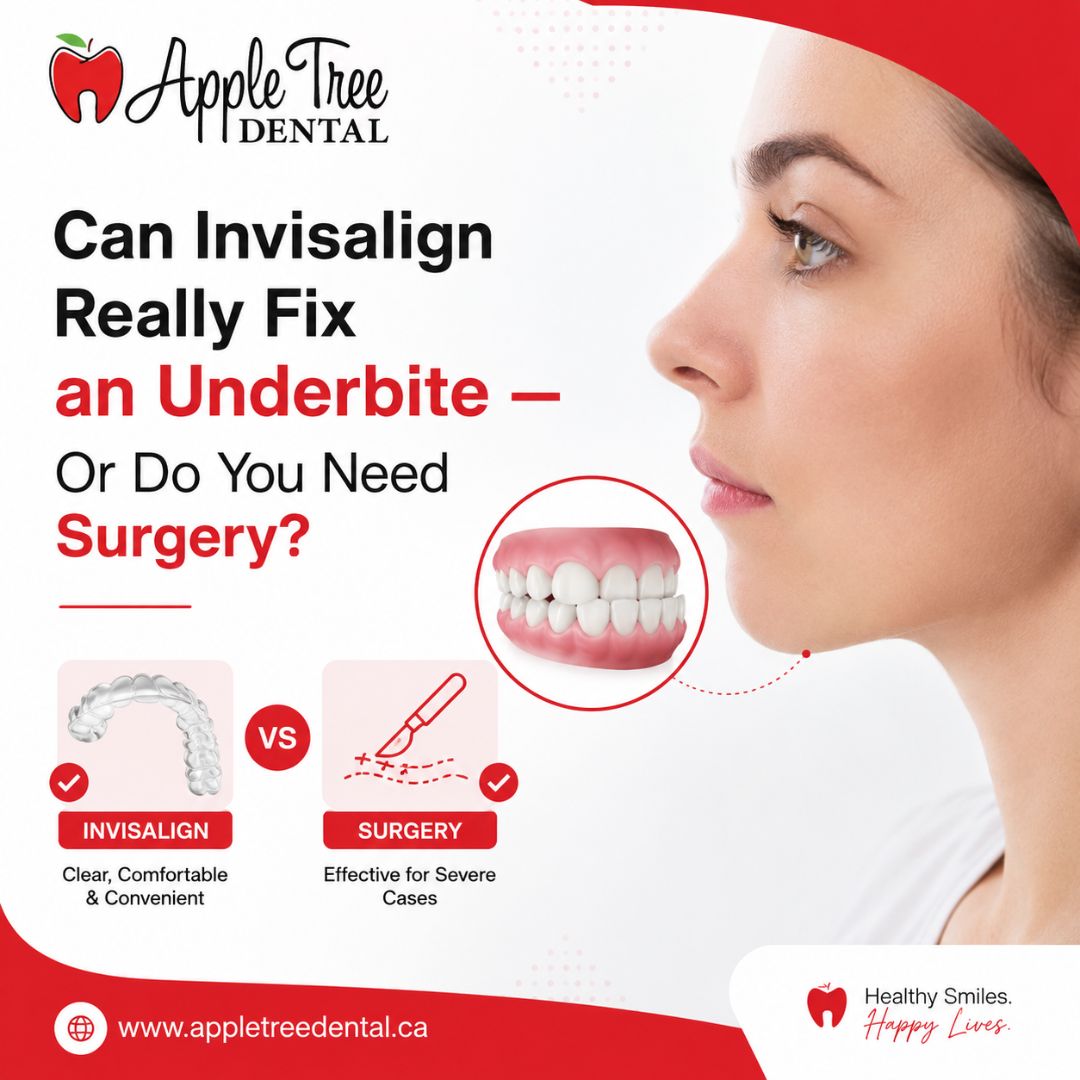
Quick answer: Yes, Invisalign can fix an underbite in mild to moderate cases, especially when the cause is tooth position rather than jaw structure. Aligners pull the lower teeth back and upper teeth forward to correct the bite. Severe, skeletal underbites — where the jawbone itself is misaligned — usually need Invisalign combined with attachments, elastics, or in rare cases jaw surgery.
You’ve noticed your bottom teeth sit in front of your top teeth when you bite down, and someone mentioned Invisalign as an option. Now you’re wondering if clear aligners can actually fix that, or if you’re stuck with metal braces or surgery. At Apple Tree Dental in London, Ontario, we get this question from adults almost every week, and the honest answer isn’t a flat yes or no.
It depends on what’s causing your underbite. This guide breaks down when Invisalign works, when it doesn’t, and what treatment actually involves.
📋 Table of Contents
✅ Key Takeaways
- Invisalign can fix mild to moderate underbites caused by tooth position, not jaw structure.
- A “dental” underbite responds well to aligners; a “skeletal” underbite involves the jawbone and usually needs more than aligners alone.
- Treatment typically runs 12 to 24 months, longer than a standard alignment case since bite correction takes more movement.
- Cost depends on severity and whether attachments or elastics are needed — get an accurate quote after a scan and consultation.
- Severe Class III underbites may require jaw surgery alongside orthodontics — a consultation and imaging determine which category you fall into.
What an Underbite Actually Is
An underbite happens when your lower teeth sit in front of your upper teeth when you close your mouth. Dentists also call this a Class III bite. It’s the opposite of an overbite, where the top teeth sit too far forward.
Underbites range from barely noticeable to severe. A mild underbite might only show up in a photo or during a dental exam. A severe one changes the shape of your jaw and face, and can make it hard to bite into food normally.
💡 Expert Insight: Most adults who ask us about Invisalign for an underbite have never had it formally classified. The first thing we do is figure out whether the problem is your teeth, your jaw, or both — because that single distinction decides whether Invisalign alone will work.
When Invisalign Works for an Underbite
Invisalign can fix an underbite when the cause is dental — meaning your teeth are misaligned within jawbones that are basically the right size and position relative to each other. In these cases, aligners move the lower front teeth back and the upper front teeth forward until the bite lines up correctly.
Dentists sometimes add small tooth-coloured attachments to the aligners, or use rubber-band-style elastics that clip between the upper and lower trays, to generate the extra pulling force an underbite correction needs. This is different from a standard straightening case, which usually just needs the aligners alone.
Invisalign is less reliable, and often not enough on its own, when the underbite is skeletal — when the lower jawbone itself grew longer or further forward than the upper jaw. No aligner can reposition bone. In these cases, aligners may still help align the teeth, but a surgeon typically needs to reposition the jaw for the bite to fully correct.
Dental Underbite vs Skeletal Underbite
This distinction is the single biggest factor in whether Invisalign will work for you:
| Feature | Dental Underbite | Skeletal Underbite |
|---|---|---|
| Cause | Teeth angled or positioned incorrectly | Lower jawbone longer or forward relative to upper |
| Can Invisalign fix it alone? | Usually, yes | Rarely — often needs surgery too |
| Facial profile | Typically unaffected | Often visibly protruding lower jaw |
| Typical treatment | Invisalign with elastics/attachments | Orthodontics plus orthognathic (jaw) surgery |
| How it’s confirmed | Clinical exam, digital scan | Clinical exam plus X-ray/cephalometric imaging |
How Invisalign Corrects an Underbite Bite
For a dental underbite, treatment usually involves:
Exam and digital scan. Your dentist takes a 3D scan and checks how your jaw and teeth relate at rest and on bite-down.
Treatment simulation. Software maps out each stage of tooth movement, showing whether the bite can realistically close with aligners alone.
Attachments placed. Small tooth-coloured bumps are bonded to certain teeth so the aligners can grip and apply directional force.
Elastics, if needed. Small bands connect the upper and lower trays to help pull the bite into the correct position.
Progress checks. Your dentist reviews fit and bite alignment every 6 to 8 weeks and adjusts the plan if progress stalls.
How Long Underbite Treatment Takes
A standard Invisalign case for straightening alone often finishes in 6 to 12 months. Underbite correction takes longer because moving a full bite relationship, not just individual teeth, requires more controlled movement. Most dental-underbite cases run 12 to 24 months, and your dentist will give you a more specific estimate once your scan and simulation are done.
Wearing your aligners for the recommended 20 to 22 hours a day matters more here than in a typical case — skipping wear time on a bite-correction case tends to stall progress more noticeably than it would with simple crowding.
Pricing & Insurance for Invisalign Underbite Treatment
Bite-correction cases cost more than standard Invisalign because they need more aligners, more attachments, and closer monitoring. Because pricing depends on how severe your underbite is and whether your plan needs elastics or extra attachments, the only way to get an accurate number is a scan and consultation — no two underbite cases move the same amount of tooth or jaw structure.
During your consultation, our team will:
- Confirm whether your underbite is dental, skeletal, or a mix of both
- Walk you through what your specific treatment plan involves
- Provide a written quote and check your insurance or Canadian Dental Care Plan eligibility before you commit to anything
Many Ontario dental insurance plans include an orthodontic benefit that applies toward Invisalign, and the Canadian Dental Care Plan may cover a portion of costs for eligible patients. Contact Apple Tree Dental for a personalized quote and pre-treatment insurance estimate.
Signs Your Underbite May Need Surgery, Not Just Aligners
A consultation with imaging is the only way to know for certain, but a few signs tend to point toward a skeletal cause that aligners alone won’t fully resolve:
- Your lower jaw visibly juts out further than your upper jaw when viewed from the side
- Your back teeth don’t touch properly even when your front teeth are close
- You have ongoing difficulty chewing or speaking that’s linked to your bite
- The underbite runs in your family and has been present since childhood
- A previous orthodontic evaluation already flagged a skeletal component
None of these confirm surgery is required on their own — only imaging and a clinical exam can. But if two or more apply, it’s worth raising jaw surgery as a possibility during your consultation rather than assuming aligners will be enough.
Getting Assessed for Invisalign Underbite Treatment in London, Ontario
If you’re in London, Ontario and wondering whether your bite can be corrected without surgery, Apple Tree Dental’s Invisalign team can assess your underbite and map out a realistic plan using 3D digital imaging.
📍 Two things worth knowing:
- Certified Invisalign provider. Apple Tree Dental is a certified Invisalign dentist in London, so bite-correction cases are handled in-house rather than referred out for routine monitoring.
- Clear next step if surgery is needed. If your case turns out to be skeletal, your dentist will walk you through what a combined orthodontic-and-surgical plan looks like before you commit to anything.
If you’re also weighing Invisalign against traditional options, our guide on Invisalign vs braces in London Ontario and our comparison of Fastbraces and Invisalign cover how bite-correction cases stack up against each alternative.
Frequently Asked Questions
Can Invisalign fix an underbite completely?
Invisalign can fully correct mild to moderate dental underbites. Severe or skeletal underbites often need Invisalign combined with jaw surgery for a complete correction.
How do I know if my underbite is dental or skeletal?
Only a dentist or orthodontist can confirm this, using a clinical exam and imaging such as a cephalometric X-ray. A visibly protruding lower jaw is a common sign of a skeletal cause.
How long does Invisalign take for an underbite?
Most dental-underbite cases take 12 to 24 months, longer than standard Invisalign treatment because correcting a bite relationship requires more controlled tooth movement.
Does Invisalign for an underbite hurt more than regular Invisalign?
Not significantly more, though attachments and elastics used for bite correction can cause mild extra soreness for the first few days after each new set of aligners.
What happens if Invisalign alone doesn’t fix my underbite?
If your case turns out to be skeletal, your dentist will typically refer you to an oral surgeon for a combined orthodontic-and-surgical plan rather than continuing with aligners alone.
How much does Invisalign for an underbite cost in Ontario?
Cost depends on the severity of your underbite and whether attachments or elastics are required, so it varies case to case. Contact Apple Tree Dental for a personalized quote after a consultation and scan.
Can adults get Invisalign for an underbite, or is it too late?
Adults can get Invisalign for a dental underbite at any age, since tooth movement isn’t limited by growth. Skeletal cases may still benefit from orthodontics even if surgery is also needed.
Is Invisalign covered by insurance for underbite correction?
Many Ontario dental plans include an orthodontic benefit that applies to Invisalign, and the Canadian Dental Care Plan may cover part of the cost for eligible patients. Confirm specifics with your provider before starting.
Whether Invisalign can fix your underbite comes down to one question: is it your teeth, your jaw, or both? That’s not something you can answer from a mirror — it takes a scan and a trained eye.
Our team at Apple Tree Dental can assess your bite, tell you honestly whether Invisalign alone will work for you, and give you a personalized quote.