Dental Tooth Crown Explained: When You Need It and How It Protects Your Teeth

A dental tooth crown is one of the most effective solutions for restoring damaged teeth and protecting your long-term oral health. Whether you’re dealing with a cracked tooth, severe decay, or have recently completed a root canal, a crown tooth can restore both function and appearance. At Apple Tree Dental in London, Ontario, dental crowns are a common restorative treatment designed to strengthen teeth and improve smiles with long-lasting results.

What Is a Dental Tooth Crown?

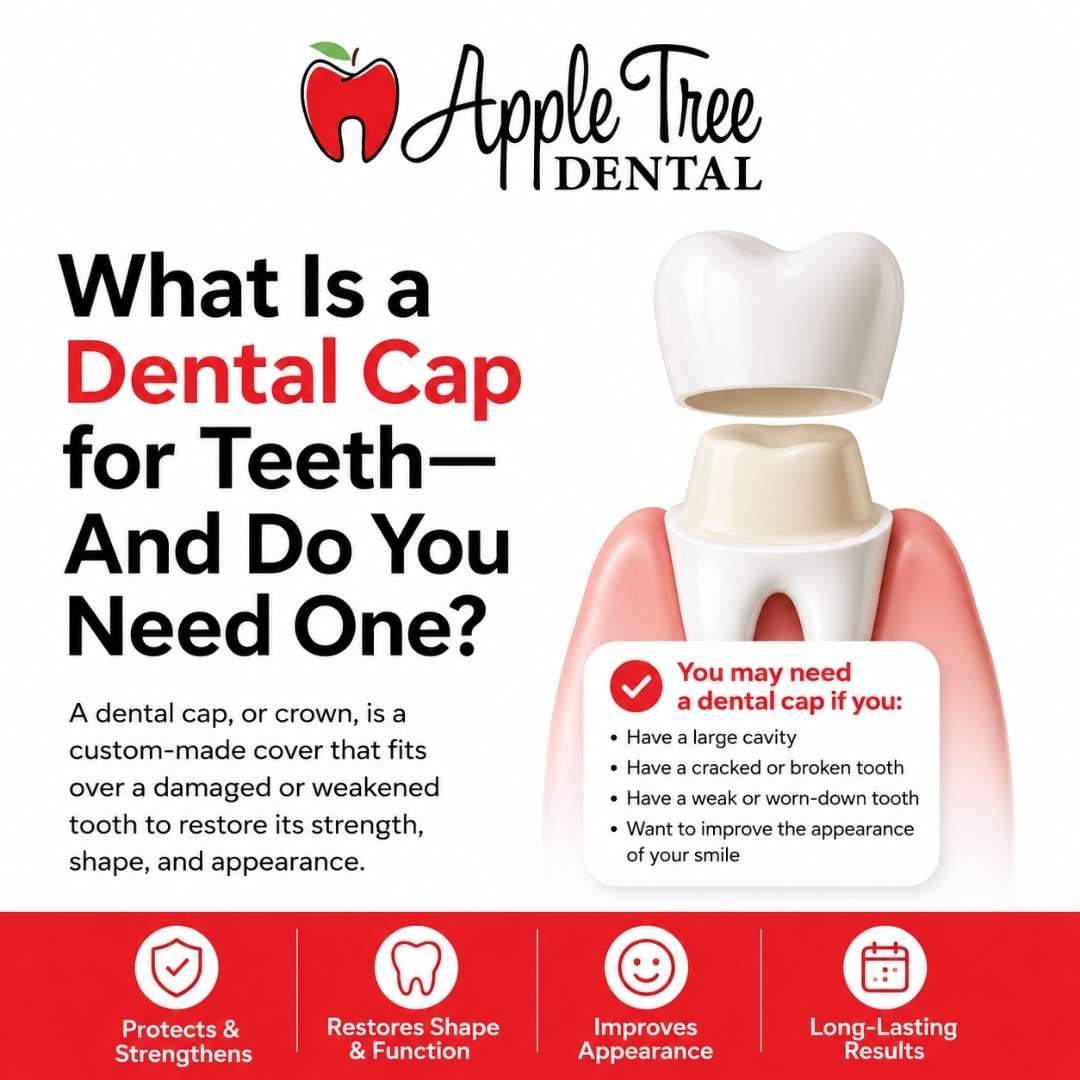
A dental tooth crown is a custom-made cap placed over a damaged or weakened tooth to restore its shape, strength, and function. It fully covers the visible part of the tooth, making it stronger and more resistant to further damage. As part of Apple Tree Dental’s comprehensive dental crowns and bridges service, patients receive customized solutions tailored to their specific dental needs.

When Do You Need a Dental Tooth Crown?

You may need a tooth crown in the following situations:

  • Cracked or Broken Tooth — A crown helps prevent further damage and restores structural integrity. In urgent cases, emergency dental care can stabilize the tooth before placing a permanent crown.
  • Large Cavities — When decay is too extensive for a filling, a crown tooth provides full protection.
  • After Root Canal Treatment — After undergoing a root canal, the tooth can become fragile. Placing a dental tooth crown is essential to protect it from fractures and ensure long-term stability.
  • Worn Teeth from Grinding — Teeth that are worn down due to grinding can be rebuilt using crowns. Family dentistry checkups help detect grinding early before extensive damage occurs.
  • Crown on Molar Protection — A crown on molar is especially important because molars handle heavy chewing forces daily.
  • Cosmetic Improvements — Crowns can also enhance the appearance of discoloured or misshapen teeth. Patients seeking additional smile improvements may explore cosmetic dentistry options alongside crown placement, including teeth whitening for a complete smile transformation.

Types of Dental Tooth Crowns

Crown Type Best For
Porcelain Crowns Front teeth — ideal for natural appearance
Ceramic Crowns Visible teeth — metal-free and highly aesthetic
Metal Crowns Back teeth and molars — extremely durable
Porcelain-Fused-to-Metal (PFM) Balance between strength and aesthetics

Dental Tooth Crown Procedure (Step-by-Step)

  • Step 1 — Consultation and Diagnosis: Your dentist at Apple Tree Dental in London, Ontario will assess your tooth and determine if a crown is the right solution.
  • Step 2 — Tooth Preparation: The tooth is reshaped to ensure the crown fits properly.
  • Step 3 — Digital Impressions: Accurate impressions are taken for a precise fit.
  • Step 4 — Temporary Crown Placement: A temporary crown protects your tooth while the permanent one is being prepared.
  • Step 5 — Final Crown Placement: The permanent dental tooth crown is securely bonded and adjusted for comfort. Patients with dental anxiety can benefit from sedation dentistry to make the procedure more comfortable.

How a Dental Tooth Crown Protects Your Teeth

A crown tooth acts as a protective shield that:

  • Prevents cracks from spreading
  • Restores chewing ability
  • Protects against further decay
  • Strengthens weakened teeth
  • Extends the life of the natural tooth

With proper care, crowns can last 10–15 years or more. The Canadian Dental Association recognizes dental crowns as a proven restorative solution that, when placed correctly, can preserve a natural tooth for many years.

Benefits of Choosing a Dental Tooth Crown

  • Restores damaged teeth
  • Improves smile aesthetics
  • Enhances chewing function
  • Provides long-term durability
  • Supports overall oral health

Dental Tooth Crown Cost in London, Ontario

The cost of a dental tooth crown in London, Ontario depends on factors like material, tooth condition, and treatment complexity. Apple Tree Dental also offers special offers to make dental care more accessible. For accurate pricing, contact the South London location or the North London location for a personalized treatment plan.

Dental Tooth Crown Near Me in London, Ontario

If you’re searching for a dental tooth crown near me, it’s important to choose a clinic that combines experience with modern dental technology. Apple Tree Dental operates two convenient locations — North London and South London — providing patients with customized care plans and advanced restorative solutions designed for long-term success.

How Dental Crowns Fit into Your Overall Dental Care

A dental tooth crown is often part of a broader treatment plan. For example:

  • After a deep cleaning or routine teeth cleaning in London, your dentist may detect issues early before a crown is needed.
  • In urgent situations, visiting Apple Tree Dental’s emergency dental care service in London can help stabilize a damaged tooth before placing a crown.
  • If the tooth is severely infected, a root canal treatment is usually performed before placing the crown.
  • For missing teeth adjacent to a crown, dental implants or dental bridges may be recommended as part of a complete restoration plan.

This integrated approach ensures your tooth is fully restored and protected. Learn more about all available treatments on the Apple Tree Dental services page.

How to Care for Your Crown Tooth

  • Brush twice daily using fluoride toothpaste
  • Floss carefully around the crown
  • Avoid chewing hard foods like ice
  • Maintain regular dental checkups with Apple Tree Dental

Signs You May Need a Dental Tooth Crown

  • Pain when chewing
  • Cracked or chipped tooth
  • Large filling failure
  • Tooth sensitivity
  • Visible wear or damage

If you notice any of these signs, don’t wait — book an appointment at our North location or South location for prompt evaluation.

Dental Crowns for Children

Children can also require dental crowns due to severe decay or injury to baby or permanent teeth. Apple Tree Dental’s children’s dentistry service provides a calm, supportive environment to make crown procedures comfortable and stress-free for young patients.

Advanced Crown Placement with Laser Dentistry

Apple Tree Dental uses the latest technology to improve precision and comfort during crown procedures. Laser dentistry can assist in gum contouring and tissue management around the crown area, resulting in better fit and faster healing.

Why Choose Apple Tree Dental in London, Ontario

  • Experienced dental professionals at two convenient London locations
  • Advanced crown materials and techniques including laser dentistry
  • Patient-focused care with sedation options for anxious patients
  • Long-lasting restorative solutions and special offers for new and existing patients
  • Read real patient experiences on our video testimonials and patient gallery

Frequently Asked Questions (FAQ)

What is a dental tooth crown?

A dental tooth crown is a cap placed over a tooth to restore its strength, shape, and appearance. Apple Tree Dental offers comprehensive dental crowns and bridges for patients across London, Ontario.

How long does a crown tooth last?

Most crowns last between 10–15 years or longer with proper care and regular teeth cleaning appointments.

Is getting a dental crown painful?

No, the procedure is comfortable and performed under local anesthesia. For patients with dental anxiety, sedation dentistry is also available.

Can you get a crown on a molar?

Yes, a crown on molar is very common and helps withstand chewing pressure. Metal and PFM crowns are particularly suited for molar protection.

How do I know if I need a crown tooth?

If your tooth is cracked, weakened, or has extensive decay, a crown may be recommended. Schedule an assessment at either our North London or South London clinic.

How long does the procedure take?

Typically, the process takes two visits unless same-day crowns are available. For more information, visit our dental health blog.

External Reference

For professional dental care guidelines and standards in Ontario, visit the Ontario Dental Association (ODA).

Conclusion: Restore Your Smile with a Dental Tooth Crown

If you’re dealing with a damaged or weakened tooth, a dental tooth crown can restore your smile and protect your oral health for years to come. Whether you need a crown after a root canal, to cover a cracked tooth, or to strengthen a heavily decayed molar, Apple Tree Dental in London, Ontario provides personalized, expert care using advanced crown materials and techniques. From cosmetic improvements to full structural restoration, our team is equipped to handle every aspect of your dental health. Don’t let a damaged tooth affect your quality of life — the right restoration can make all the difference.

Book your consultation with Apple Tree Dental today at our North London clinic or South London clinic. Check our special offers and book your appointment online today.

All-on-4 Dental Implants London Ontario: Full Guide + Consultation (2026)

If you’re missing most or all of your teeth — or struggling with loose, uncomfortable dentures — All-on-4 dental implants in London, Ontario may be the most effective solution available. Using just four strategically placed implants per arch, All-on-4 delivers a full set of fixed, permanent teeth that look and function like natural ones. At Apple Tree Dental, we offer All-on-4 consultations at both our North London (Beaverbrook Ave) and South London (Wonderland Rd) locations, using advanced 3D imaging for precise treatment planning and lasting outcomes.

✦ Key Takeaways

All-on-4 Dental Implants London Ontario — Quick Summary

  • All-on-4 uses just 4 implants per arch to support a full fixed set of teeth — fewer implants than traditional protocols.
  • Temporary teeth are placed the same day as surgery — you leave the clinic with a functional smile.
  • Bone grafting is rarely needed — angled rear implants use available bone more efficiently.
  • Recovery is faster than conventional multi-implant protocols — most patients return to normal routines within a few days.
  • Success rates exceed 95% in healthy patients with good post-surgical care.
  • Available at both Apple Tree Dental locations in London — North and South.
  • Cost in London ON: approximately CAD $20,000–$30,000 per arch depending on materials and complexity.

What Are All-on-4 Dental Implants?

All-on-4 dental implants are a full-arch tooth replacement system that uses exactly four implants per arch — two placed vertically at the front, two angled at approximately 45 degrees at the rear — to support a complete fixed set of replacement teeth. The angled rear placement is the key innovation: it maximises contact with available bone, eliminates the need for grafting in most cases, and provides the same stability as conventional protocols that use six to eight implants per arch.

You may also see this treatment referred to as all-on-four implants, all-on-four dentures, or teeth-in-a-day — the goal is consistent: a fixed, non-removable full arch of teeth delivered in significantly less time than traditional implant protocols.

Did You Know?

According to the Canadian Dental Association, proper case planning and professional guidance significantly improve long-term implant outcomes. At Apple Tree Dental, every All-on-4 case begins with a comprehensive 3D scan to map bone density, nerve positions, and optimal implant angles before surgery begins.

How All-on-4 Works: The Science Behind 4 Implants

The All-on-4 system solves a fundamental challenge in full-arch implant dentistry: the rear jawbone (where most chewing force is applied) is also where bone loss occurs most rapidly after tooth loss. Traditional protocols requiring 6–8 implants often need bone grafting at these sites — adding months to treatment time.

All-on-4 solves this by angling the two rear implants at approximately 45 degrees, which:

  • Reaches denser bone further forward in the jaw
  • Increases the implant-to-bone contact surface area
  • Distributes chewing forces across a wider area
  • Eliminates the need for sinus lifts in the upper jaw in most cases

The result: full-arch restoration with only four surgical sites, faster healing, and — crucially — same-day temporary teeth placement in most cases.

Step-by-Step: The All-on-4 Procedure at Apple Tree Dental

StageWhat HappensTimeline
1. Consultation3D imaging, bone assessment, treatment plan, cost breakdown1 visit
2. ExtractionsAny remaining failing teeth removed (same day as surgery if needed)Same day or separate
3. Implant Placement4 implants placed under local anaesthetic or sedation2–4 hours
4. Temporary ArchTemporary teeth attached same day — you leave with a smileSame day
5. OsseointegrationBone fuses with implants — soft diet required3–6 months
6. Final ArchPermanent zirconia or acrylic arch fitted and securedAfter healing confirmed

Step 1: Consultation and 3D Imaging

Your All-on-4 journey starts with a comprehensive assessment at either Apple Tree Dental location. We take detailed 3D scans to map your bone density, assess nerve positions, plan exact implant angles, and build a fully personalised treatment plan. You’ll receive a complete cost breakdown at this appointment — nothing is hidden or added later.

Step 2: Extractions (If Required)

If you have remaining failing or damaged teeth, these are removed — often on the same day as implant surgery to minimise appointments. Our team will confirm the best approach during your consultation.

Step 3: Implant Placement Surgery

Under local anaesthetic — or sedation dentistry for patients with dental anxiety — all four implants are placed in a single surgical session. The procedure typically takes 2 to 4 hours per arch. Most patients are surprised by how manageable the experience is.

Step 4: Same-Day Temporary Teeth

In most cases, a temporary prosthetic arch is attached to the implants the same day as surgery. You leave the clinic with functional teeth — this is the “teeth in a day” aspect of All-on-4 that makes it so appealing compared to conventional implant timelines.

Step 5: Osseointegration — The Healing Phase

Over the following 3 to 6 months, your jawbone fuses with the implant posts through osseointegration. During this period you’ll follow a soft food diet and attend follow-up appointments so your dental team can monitor healing progress. Health Canada recognises dental implants as regulated Class II medical devices — following post-surgical care instructions during this phase is essential to long-term success.

Important Warning

Smoking is one of the leading causes of All-on-4 implant failure. It significantly slows osseointegration and increases infection risk. Patients are strongly advised to stop smoking before surgery and throughout the healing phase. Health Canada’s quit smoking resources can help.

Step 6: Your Permanent Final Arch

Once osseointegration is confirmed at your follow-up appointment, your permanent prosthetic arch — typically zirconia for its durability and natural appearance — is custom-fabricated and permanently secured to your implants. This is your final smile.

Are You a Candidate for All-on-4 in London, Ontario?

All-on-4 is suitable for a wider range of patients than traditional implant protocols. You may be a strong candidate if you:

  • Are missing most or all teeth on one or both arches
  • Currently wear dentures and want a fixed, non-removable solution
  • Have been told you have moderate bone loss (often not a barrier with All-on-4)
  • Were previously told you weren’t a candidate for traditional implants
  • Are in generally good overall health
  • Are a non-smoker or prepared to stop smoking before and after surgery

Even patients with significant bone loss may qualify — the angled implant technique is specifically designed to work with reduced bone volume in the rear of the jaw. A 3D imaging assessment at your consultation is the only way to confirm candidacy with certainty.

Prosthetic Material Options: Acrylic vs. Zirconia

MaterialDurabilityAestheticsBest ForCost
ZirconiaExcellent — chip resistantMost natural-lookingPermanent final archHigher
AcrylicGood — some wear over timeGood appearanceTemporary / budget optionLower

Zirconia is the preferred material for permanent All-on-4 restorations at Apple Tree Dental. It is exceptionally strong, highly aesthetic, and does not stain over time. Acrylic is commonly used for the temporary arch during the healing phase, and is sometimes chosen as a permanent option for budget considerations — your dentist will discuss what’s right for your case.

All-on-4 vs. Dentures vs. Traditional Implants

FeatureAll-on-4Traditional DenturesConventional Implants (6–8)
Fixed / RemovableFixed ✅Removable ❌Fixed ✅
Same-Day TeethYes ✅Yes ✅Rarely ❌
Bone Graft RequiredRarely ✅Never ✅Often ❌
Preserves JawboneYes ✅No ❌Yes ✅
Implants Per Arch406–8
Treatment TimelineFaster ✅Immediate ✅Longer ❌
Long-Term DurabilityExcellent ✅5–8 years ❌Excellent ✅
Chewing StrengthNear natural ✅Reduced ❌Natural ✅

Benefits of All-on-4 at Apple Tree Dental London

Fixed, Non-Removable Teeth

Unlike dentures, your All-on-4 arch is permanently secured to the implants. No adhesives, no overnight soaking, no shifting while eating or speaking. You treat them exactly like natural teeth.

Eat What You Want Again

Once healing is complete, All-on-4 patients can eat a full range of foods — including harder textures that denture wearers often avoid. Chewing strength returns to near-natural levels.

Jawbone Preservation

The four implant posts stimulate the jawbone the same way natural tooth roots do — preventing the bone resorption that causes the sunken facial appearance common in long-term denture wearers. This is a benefit dentures fundamentally cannot provide.

Faster Treatment Than Conventional Implants

Because bone grafting is rarely required and all four implants are placed in a single session, All-on-4 significantly reduces total treatment time compared to conventional full-arch implant protocols.

Natural Appearance

Zirconia arches are custom-designed to match your facial structure and aesthetic goals — giving you a completely natural-looking smile that most people won’t distinguish from real teeth.

Dramatically Improved Confidence

For patients who have been self-conscious about their smile for years, All-on-4 is genuinely life-changing. Speaking clearly, smiling freely, and eating without anxiety are outcomes that extend well beyond oral health.

All-on-4 Cost in London, Ontario

All-on-4 cost in London, Ontario depends on several factors specific to your case:

TreatmentEstimated Cost (CAD)
All-on-4 — Single Arch (Acrylic)$20,000 – $25,000
All-on-4 — Single Arch (Zirconia)$25,000 – $30,000
All-on-4 — Both Arches$40,000 – $60,000+
Extractions (if needed)Confirmed at consultation

Every patient at Apple Tree Dental receives a full itemised cost breakdown at their consultation — before any treatment begins. Financing options are available to make All-on-4 more accessible. For a broader overview of implant pricing across Canada, see our dental implants cost Canada guide.

Cost Tip

If you need both arches restored, treating upper and lower at the same time is usually more cost-efficient than two separate surgeries. Ask our team about combined-arch treatment plans at your consultation.

Recovery After All-on-4 Surgery

First Few Days

Expect mild swelling, some soreness, and light bleeding in the first 24–48 hours. Most patients manage this comfortably with over-the-counter pain relief. Rest, ice packs on the jaw, and sticking to liquids and very soft foods are the key priorities. Most people return to light normal activities within 2–3 days.

During Osseointegration (3–6 Months)

Follow a soft diet as directed — avoid hard, crunchy, or sticky foods that could put stress on the healing implants. Maintain consistent oral hygiene around the temporary arch. Attend all follow-up appointments — these are how your dental team confirms osseointegration is proceeding correctly.

Long-Term Maintenance

All-on-4 requires the same care as natural teeth — brushing twice daily, flossing, and regular professional cleanings. With this routine, All-on-4 implants can last decades — the posts potentially for life, the prosthetic arch for 10–20+ years before any replacement is needed.

Common Mistakes to Avoid with All-on-4

  • Choosing a clinic based on price alone — quality of materials, imaging technology, and provider experience directly affect long-term outcomes
  • Skipping the 3D imaging consultation — proper bone assessment is non-negotiable for accurate implant placement
  • Continuing to smoke — the single biggest risk factor for implant failure
  • Eating hard foods too soon — putting stress on implants during osseointegration risks failure
  • Missing follow-up appointments — healing must be monitored by your dental team throughout the process
  • Not asking about prosthetic material — acrylic and zirconia have very different durability profiles; understand what you’re getting

Frequently Asked Questions: All-on-4 Dental Implants London Ontario

How long do All-on-4 implants last?

The titanium implant posts can last decades — often a lifetime with proper care. The prosthetic arch (zirconia or acrylic) typically lasts 10–20+ years before any replacement or adjustment is needed, depending on material, bite forces, and maintenance habits.

Is the All-on-4 procedure painful?

The procedure is performed under local anaesthetic — you won’t feel pain during surgery. Most patients experience manageable swelling and soreness for 2–5 days afterwards, controlled with over-the-counter pain relief. Many patients describe the experience as less uncomfortable than expected. Sedation is available for patients with dental anxiety.

Do I need bone grafting for All-on-4?

In most cases, no — this is one of All-on-4’s key advantages over conventional implant protocols. The angled rear implants are designed to use available bone in areas less affected by resorption. Your 3D imaging assessment will confirm whether any grafting is needed in your specific case.

Can I eat normally after All-on-4?

After the healing phase is complete and your permanent arch is fitted, yes — you can eat a full range of foods comfortably. During the healing phase (3–6 months), a soft diet is required to protect the implants during osseointegration.

How much do All-on-4 implants cost in London, Ontario?

A single arch All-on-4 in London, Ontario costs approximately CAD $20,000–$30,000 depending on prosthetic material (acrylic vs. zirconia) and case complexity. Both arches together range from $40,000–$60,000+. Financing options are available — ask at your consultation for a full itemised breakdown.

How is All-on-4 different from regular dental implants?

Traditional full-arch protocols use 6–8 implants per arch and often require bone grafting. All-on-4 uses just four implants with angled rear placement to achieve the same stability — with less surgery, no grafting in most cases, and faster treatment. For patients missing only one or a few teeth, single or multiple permanent implants are the more appropriate solution.

Do you offer All-on-4 at both Apple Tree Dental locations?

Yes. All-on-4 consultations and treatment are available at both our North London location (Beaverbrook Ave) and South London location (Wonderland Rd). Book at whichever location is most convenient for you.

Are All-on-4 implants better than dentures?

For most patients seeking a full-arch solution, yes — All-on-4 provides superior stability, natural chewing ability, jawbone preservation, and long-term durability compared to removable dentures. Dentures do not stimulate the jawbone and typically need replacing every 5–8 years. If you’re weighing both options, see our comparison guide: dental implants vs. dentures.

Final Thoughts: Is All-on-4 Right for You?

All-on-4 dental implants are one of the most significant advances in modern restorative dentistry — delivering a full, fixed, natural-looking smile using just four implants per arch, often without bone grafting, and with same-day temporary teeth. For patients in London, Ontario who are struggling with missing teeth or uncomfortable dentures, it represents a genuine long-term investment in quality of life.

The first step is always a conversation. Our team at Apple Tree Dental is here to assess your specific situation honestly, confirm whether All-on-4 is the right solution for you, and give you a complete, transparent picture of what treatment involves and what it costs — with no pressure and no surprises.

✦ Book Your All-on-4 Consultation

Apple Tree Dental — London, Ontario

3D imaging, same-day teeth, transparent pricing, and financing options. All-on-4 consultations available at both North and South London locations.

📍 North London

1365 Beaverbrook Ave, Unit 102
London, Ontario N6H 0J1

(519) 641-1411

📍 South London

3429 Wonderland Rd S, Unit 6
London, Ontario N6L 0E3

(226) 667-4600

Mon–Wed: 9:30 AM–6:00 PM  |  Thu: 11:00 AM–7:00 PM  |  Sat: Twice monthly

Book a Consultation →

How Long Does It Take for a Dental Cleaning? A Simple Breakdown

If you have ever wondered how long does a dental cleaning take, you are not alone. It is one of the most common questions patients ask before booking a preventive appointment. The answer depends on your oral health, how recently you last visited a dentist, and whether any additional treatment is required. For most patients at Apple Tree Dental in London, Ontario, a routine cleaning is a straightforward, comfortable, and quick experience — but understanding what goes into it helps you plan your visit with confidence.

Quick Answer: How Long Does a Dental Cleaning Take?

A dental cleaning usually takes 30 to 60 minutes. First-time visits or deep cleanings may take 60 to 90 minutes or longer, depending on oral health and plaque buildup.

How Long Does a Dental Cleaning Take on Average?

For most patients, dental cleaning appointments fall into three general time ranges depending on the type of visit and the current condition of your teeth and gums.

  • Routine cleaning: 30–60 minutes
  • First appointment: 60–90 minutes
  • Deep cleaning: 1–2 hours, or across multiple visits

If you are asking how long is a dental cleaning, the honest answer is that it depends on your oral health and how consistently you visit your dentist. Patients who come in regularly typically have faster, simpler appointments compared to those returning after a long gap.

What Happens During a Dental Cleaning? (Step-by-Step)

According to the American Dental Association (ADA), a professional dental cleaning — also called a dental prophylaxis — is a cornerstone of preventive oral health care and is recommended for all patients on a consistent schedule. Understanding each step helps answer how long does it take for a dental cleaning.

1. Oral Exam

Your teeth and gums are visually assessed for signs of cavities, inflammation, or gum disease. This step often includes a review of any dental X-rays taken during the visit.

2. Plaque and Tartar Removal

Hardened tartar and soft plaque are carefully removed using professional scaling instruments. This is the step that takes the most time, particularly for patients with significant buildup.

3. Teeth Polishing

A gritty polishing paste is applied to smooth enamel surfaces and remove surface stains that regular brushing cannot eliminate.

4. Flossing and Rinse

Your hygienist flosses between all teeth to clear any remaining debris and checks for areas of concern between contact points.

5. Fluoride Treatment (Optional)

A fluoride application may be offered to strengthen enamel and provide added protection against decay. This step is quick and optional based on individual risk factors.

How Long Is Teeth Cleaning for Different Cases?

The Canadian Dental Association (CDA) recognises that preventive care needs vary between patients based on age, oral health history, and systemic health conditions. Here is a breakdown of typical cleaning durations by case type.

Cleaning Type Estimated Duration When It Applies
Routine Cleaning 30–60 minutes Patients with healthy gums attending regular visits
Deep Cleaning 1–2 hours or multiple visits Patients with gum disease or significant tartar buildup
First or Overdue Visit 60–90 minutes Includes full exam, X-rays, and comprehensive assessment

This breakdown explains how long should a dentist cleaning take based on your specific oral health situation and visit history.

What Affects How Long a Dental Cleaning Takes?

Several factors influence how long teeth cleaning takes from start to finish. Being aware of these helps you set realistic expectations before your appointment.

  • Your daily oral hygiene habits — consistent brushing and flossing directly reduces treatment time
  • How frequently you attend professional cleanings
  • The current health of your gums and presence of any gum disease
  • Levels of tartar accumulation and surface staining
  • Whether additional services such as X-rays or a full dental exam are included in the appointment

How Often Should You Get Your Teeth Cleaned?

Health Canada’s oral health guidelines recommend that Canadians maintain routine dental visits for professional cleaning and examination, with frequency determined by individual risk factors and the advice of a dental professional.

  • Standard recommendation: Every 6 months for most adults and children
  • High-risk patients: Every 3–4 months for those with active gum disease or heavy buildup
  • Low-risk patients: Once per year if oral health is consistently excellent

At Apple Tree Dental in London, Ontario, cleaning schedules are personalised based on a thorough assessment of your oral health history and current condition. Our family dentistry team works with patients of all ages to establish a preventive routine that protects long-term oral health.

Why Regular Dental Cleanings Matter

Routine professional cleanings deliver benefits that go well beyond a fresh, polished feeling. Consistent preventive care is the most effective way to protect your oral health over the long term.

  • Prevents cavities and the early stages of gum disease
  • Removes tartar buildup that brushing and flossing cannot address at home
  • Improves breath by eliminating bacteria-harbouring plaque
  • Allows your dentist to detect developing issues early — including decay, gum recession, and signs that may require urgent dental attention
  • Reduces long-term dental costs by preventing the need for more complex restorative treatments

Patients who attend cleanings on a consistent schedule find that each appointment becomes faster and more straightforward over time.

Dental Cleaning vs Other Dental Procedures

To put cleaning appointment time in context, here is how it compares to other common dental treatments.

  • Routine cleaning: 30–60 minutes
  • Dental filling: 45–90 minutes
  • Root canal treatment: 90 minutes or more

A professional cleaning is one of the fastest and most effective preventive treatments available in dentistry. Paired with a professional teeth cleaning appointment at Apple Tree Dental, patients also benefit from a full review of their cosmetic and restorative dental needs. Those interested in improving their smile alongside their preventive care can explore our cosmetic dentistry services as well.

Tips to Reduce Your Dental Cleaning Time

Certain daily habits directly shorten the time your hygienist spends removing buildup at each visit. The Canadian Dental Association emphasises that proper brushing and flossing technique at home is foundational to maintaining good oral health between professional visits.

  • Brush thoroughly twice daily using a fluoride toothpaste
  • Floss once a day to remove plaque from between teeth and along the gumline
  • Limit sugary and acidic foods and beverages
  • Stay well hydrated to support healthy saliva flow
  • Attend professional cleanings regularly rather than extending gaps between visits

Patients who maintain strong at-home hygiene routines consistently experience shorter, smoother cleaning appointments.

Professional Dental Cleaning in London, Ontario

If you are searching for a dental cleaning appointment in London, Ontario, Apple Tree Dental offers efficient, comfortable, and thorough cleanings for patients of all ages. Whether you are due for a routine visit or returning after a long gap, our team will assess your needs and complete your cleaning with care and precision.

Patients eligible for the Canada Dental Care Plan (CDCP) are welcome to ask our front desk team about available coverage before booking. Our practice accepts most major insurance plans and provides a full cost breakdown before any treatment begins. Visit our dental health blog for more guidance on preventive care, or explore our complete dental services to learn what we offer beyond routine cleanings.

Frequently Asked Questions

How long does a dental cleaning take?

Most routine dental cleanings take between 30 and 60 minutes. The exact duration depends on your oral health, the amount of tartar buildup present, and whether additional services such as X-rays are included in the appointment.

How long is a dental cleaning for first-time patients?

First-time patients can typically expect their appointment to run between 60 and 90 minutes, as the visit includes a comprehensive oral exam, X-rays, and a detailed assessment of their dental history alongside the cleaning itself.

How long does it take for a dental cleaning with gum disease?

Patients with active gum disease usually require a deep cleaning, which can take between one and two hours. In more advanced cases, treatment may be divided across two or more appointments to ensure thorough and comfortable care.

How often should you get your teeth cleaned?

The standard recommendation is every six months for most patients. However, individuals with gum disease, a history of heavy buildup, or other risk factors may benefit from cleanings every three to four months. Your dentist will advise the right schedule for your needs.

How long should a dentist cleaning take?

A standard dentist cleaning should take under one hour for patients who attend regularly. Appointments that include additional assessments or address accumulated buildup will naturally take longer.

Book Your Dental Cleaning in London, Ontario

If you have been wondering how long does a dental cleaning take, the answer is simple — it is one of the fastest, most effective steps you can take for your long-term oral health. Most patients are in and out in under an hour, and the benefits extend far beyond the appointment itself.

Apple Tree Dental in London, Ontario provides professional cleanings designed to be efficient, thorough, and comfortable for every patient. Book your appointment today and take the first step toward a healthier, cleaner smile. For any questions before your visit, contact our team — we are here to help.

Invisalign vs Braces in London Ontario: Which Is Better for Your Smile?

If you are comparing Invisalign vs braces in London Ontario, you are likely asking one key question: which option is faster, more comfortable, and worth your investment? The answer depends on your dental condition, lifestyle, and goals. Both treatments are highly effective — but choosing the right one can significantly impact your experience and results. At Apple Tree Dental in London Ontario, patients frequently ask which orthodontic solution is best. This guide breaks everything down clearly so you can make the right decision.

Quick Answer: Invisalign vs Braces

Choose Invisalign if you want a clear, removable, and comfortable option. Choose traditional braces if you have complex alignment or bite issues.

What Is Invisalign?

Invisalign is a modern orthodontic treatment that uses clear, custom-made aligners to gradually move your teeth into the correct position. According to the American Dental Association (ADA), clear aligner therapy has become one of the most widely adopted orthodontic approaches for adult patients seeking discreet correction.

Key Benefits of Invisalign

  • Nearly invisible appearance
  • Removable for eating and brushing
  • Smooth and comfortable material
  • Fewer in-clinic visits
  • No food restrictions

This makes Invisalign one of the most popular choices for adults and professionals in London Ontario who want a discreet solution.

What Are Traditional Braces?

Traditional braces use metal or ceramic brackets attached to your teeth, connected by wires that apply consistent pressure to shift teeth over time. The Canadian Dental Association (CDA) recognises orthodontic treatment — including traditional braces — as a clinically proven method for correcting a wide range of bite and alignment issues across all age groups.

Key Benefits of Braces

  • Effective for all types of cases, including severe issues
  • Precise control over tooth movement
  • Suitable for children, teens, and adults
  • No need to remember to wear them

Braces remain the gold standard for complex orthodontic corrections.

Invisalign vs Braces: Side-by-Side Comparison

Feature Invisalign Traditional Braces
Appearance Clear, nearly invisible Visible metal or ceramic
Comfort Smooth, less irritation Can cause discomfort
Removability Yes No
Cleaning Easy Requires extra effort
Effectiveness Mild to moderate cases All cases
Dental Visits Fewer More frequent

Is Invisalign Faster Than Braces?

In many cases, yes.

  • Invisalign treatment: 6–18 months
  • Braces treatment: 12–24 months

When Invisalign Is Faster

  • Mild crowding
  • Small gaps
  • Minor alignment issues

When Braces May Be Faster

  • Severe bite problems
  • Complex tooth rotations
  • Significant crowding

At Apple Tree Dental, advanced 3D digital scans are used to map your treatment and estimate your exact timeline before starting. Ask about our digital dental exams and X-rays to get a precise picture of your orthodontic needs.

Cost of Invisalign vs Braces in London Ontario

The cost of orthodontic treatment varies depending on your specific case. Health Canada’s oral health resources note that patients are encouraged to discuss full treatment costs and insurance coverage with their dental provider before beginning any orthodontic plan.

What Affects the Cost?

  • Severity of your case
  • Treatment duration
  • Type of braces (metal vs ceramic)
  • Insurance coverage

Every smile is different, and so is every treatment plan. For an accurate cost estimate tailored to your specific needs, contact Apple Tree Dental in London Ontario or book a consultation — our team will provide a full breakdown of costs, payment options, and insurance coverage before you commit to any treatment. Patients eligible for the Canada Dental Care Plan (CDCP) can also ask our team about available coverage.

Which Option Is More Comfortable?

If comfort is your priority, Invisalign clearly stands out.

Invisalign

  • No wires or brackets
  • Minimal irritation
  • Gentle pressure

Braces

  • Can cause soreness after adjustments
  • Brackets may irritate cheeks and gums

Patients who want a smoother experience typically prefer Invisalign.

Which Option Looks Better?

Appearance is one of the biggest deciding factors. Invisalign aligners are virtually invisible, while braces remain noticeable even with ceramic options. For adults — especially those working in professional environments — Invisalign is often the preferred choice for maintaining a confident, natural smile throughout treatment. Learn more about our full range of cosmetic dentistry services at Apple Tree Dental.

Oral Hygiene: Invisalign vs Braces

The Canadian Dental Association emphasises that maintaining proper oral hygiene during orthodontic treatment is essential to preventing cavities and gum disease. The two options differ significantly in how easy they make this.

Invisalign

  • Remove aligners to brush and floss normally
  • Better overall oral hygiene during treatment

Braces

  • Food can get stuck around brackets and wires
  • Requires special cleaning tools such as floss threaders
  • Higher risk of plaque buildup

Better hygiene during treatment means lower chances of cavities and gum issues. Our team at Apple Tree Dental also recommends regular professional teeth cleanings throughout your orthodontic treatment regardless of which option you choose.

Pain Level: Invisalign vs Braces

Both treatments involve some discomfort, but the experience differs. Invisalign causes mild pressure when switching to a new set of aligners, while braces typically produce more noticeable pain following each adjustment appointment. Overall, Invisalign is considered less painful. If you experience significant discomfort at any stage, our emergency dental care team is available to help.

Who Should Choose Invisalign?

You are a good candidate for Invisalign if you:

  • Have mild to moderate alignment issues
  • Want a discreet orthodontic solution
  • Can commit to wearing aligners 20–22 hours per day
  • Prefer flexibility with eating and oral hygiene

Who Should Choose Braces?

Braces are the better choice if you:

  • Have severe crowding or bite problems
  • Need precise and complex tooth movement
  • Prefer a fixed, low-maintenance option that requires no daily discipline

Invisalign vs Braces for Adults in London Ontario

Most adults prefer Invisalign because it is discreet, fits busy lifestyles, requires fewer dental visits, and places no dietary restrictions on patients. The ADA notes that orthodontic treatment for adults is increasingly common, with clear aligner systems representing one of the fastest-growing treatment categories. At Apple Tree Dental, a large percentage of adult patients choose Invisalign for its convenience and aesthetics. Book a consultation appointment to find out which option suits your smile goals.

Invisalign vs Braces for Teens

For teenagers, both options can work effectively. Traditional braces are more reliable when patient compliance is uncertain, since they are fixed and cannot be removed. Invisalign Teen includes compliance indicators — small blue dots that fade with wear — to help parents and dentists confirm the aligners are being worn as prescribed. The right choice depends on the teen’s level of responsibility and daily habits. Our family dentistry team can evaluate your child and make a personalised recommendation.

Maintenance Tips for Best Results

Invisalign

  • Wear aligners consistently — 20–22 hours per day minimum
  • Clean aligners daily with a soft toothbrush and lukewarm water
  • Never eat or drink (except plain water) while wearing aligners

Braces

  • Brush after every meal to remove food trapped around brackets
  • Avoid sticky, hard, or chewy foods that can damage wires
  • Attend all scheduled adjustment appointments

Proper care ensures faster and better results regardless of the option you choose. Health Canada’s oral health guidelines recommend maintaining consistent brushing and flossing habits throughout all stages of dental treatment.

Frequently Asked Questions

Is Invisalign better than braces?

Invisalign is better for comfort and appearance, while braces are more effective for complex dental corrections. The best option depends on the severity of your case — your dentist can advise you after a clinical evaluation.

Is Invisalign faster than braces?

Yes, Invisalign can be faster for mild to moderate cases, typically completing treatment in 6 to 18 months compared to 12 to 24 months for braces. However, braces may be more efficient for severe alignment issues.

Is Invisalign worth it?

Yes, especially if you want a discreet, comfortable, and flexible orthodontic solution. The slightly higher cost is offset by fewer clinic visits, no dietary restrictions, and significantly easier oral hygiene during treatment.

Can Invisalign fix severe problems?

In some cases, yes — but braces are usually more effective for complex orthodontic issues involving significant crowding, bite problems, or large rotations. A consultation with your dentist will determine candidacy.

How do I choose between braces and Invisalign?

The best way is to consult a dentist in London Ontario who can evaluate your specific dental condition, lifestyle, and goals. Contact Apple Tree Dental to schedule a personalised orthodontic consultation.

Does insurance cover Invisalign or braces in London Ontario?

Many dental insurance plans provide partial coverage for orthodontic treatment. Coverage varies by plan and case. Apple Tree Dental accepts most major insurance plans and can provide a pre-treatment estimate. Eligible patients can also inquire about the Canada Dental Care Plan (CDCP).

Final Verdict: Invisalign vs Braces

Choose Invisalign for comfort, aesthetics, and flexibility. Choose braces for powerful and precise correction of complex alignment issues. The best choice depends entirely on your smile — and getting expert advice is the first step toward the right decision.

For patients in London Ontario ready to take that step, book your consultation at Apple Tree Dental today. Our team will assess your dental condition, walk you through your options, and provide a customised treatment plan complete with a timeline and cost estimate — so you can move forward with confidence. Explore our full range of dental services or visit our dental health blog to learn more about caring for your smile.

What Is a Dental Crown and Do You Really Need One?

If you have been told you may need a dental crown, you are in good company — it is one of the most commonly recommended restorative procedures in dentistry. However, many patients still have questions about what a crown actually involves, how much it costs, and whether it is truly necessary. Simply put, a tooth crown — also called a dental cap for teeth — is a custom-made covering that fits permanently over a damaged, weakened, or decayed tooth to restore its shape, strength, function, and appearance. Without treatment, a tooth that needs a crown will continue to break down and, as a result, may eventually require more complex and costly procedures such as a root canal or extraction. That is why patients searching for dental crowns in London turn to Apple Tree Dental in London, Ontario — to understand their options and receive personalised, comfortable care at two convenient locations.

What Is a Crown in Dentistry?

In dentistry, a crown is a protective cap that bonds permanently over a damaged tooth to restore its shape, strength, and appearance. Specifically, dentists use a crown tooth restoration after root canal treatment, for cracked or severely decayed teeth, and to anchor dental bridges. Furthermore, common materials include porcelain, zirconia, ceramic, and metal. With proper care, dental crowns last 10 to 15 years or longer.

  • Restores shape, strength, and appearance of a damaged tooth
  • Dentists recommend it after root canal treatment in most cases
  • Ideal for cracked, broken, or severely decayed teeth
  • Available in multiple dental cap types including porcelain, zirconia, ceramic, PFM, and metal
  • Your dentist typically completes the process in two dental visits
  • Lasts 10–15 years on average, and often longer with proper care

What Is a Dental Crown?

So what is a dental crown, exactly? A dental crown fully encases the visible portion of a tooth above the gumline. Once your dentist cements it in place, the crown tooth restoration becomes the tooth’s new outer surface and, consequently, protects the underlying structure from further damage while restoring full chewing function. Moreover, understanding what is a crown in dentistry means recognising that crowns serve both restorative and cosmetic purposes — for example, they strengthen a damaged back tooth just as effectively as they improve the appearance of a discoloured front tooth. For this reason, dental crowns and bridges at Apple Tree Dental are custom-fabricated to match the shape and colour of your natural teeth, ensuring a result that looks and feels completely natural.

When Do You Need a Dental Crown?

Dental crowns rank among the most versatile treatments in restorative dentistry. In fact, dentists recommend a tooth crown for a wide range of situations, including:

  • A tooth that is cracked, chipped, or fractured
  • A cavity too large for a filling to restore adequately
  • A tooth that decay or a large previous filling has weakened
  • Completion of root canal treatment — because the tooth becomes brittle afterwards and needs protection
  • Severe tooth wear from bruxism (teeth grinding)
  • Anchoring a dental bridge to replace a missing tooth
  • Covering a dental implant to complete tooth replacement
  • Cosmetic improvement of a severely discoloured or misshapen tooth

Notably, a crown on molar is especially common. This is because molars endure the heaviest chewing forces in the mouth — typically up to 200 lbs of pressure per bite — and therefore crack and break down far more often than other teeth.

Signs You May Need a Dental Crown

Recognising the early warning signs gives you the opportunity to seek treatment before a tooth needs more complex care. Therefore, contact Apple Tree Dental as soon as you experience any of the following:

  • Pain or sensitivity when you bite down
  • Sensitivity to hot or cold that lingers after the stimulus disappears
  • A visible crack, chip, or fracture in a tooth
  • A tooth that feels rough, uneven, or structurally unstable
  • An old large filling that is cracking or breaking down
  • Swelling or tenderness around a specific tooth

Importantly, early treatment consistently leads to simpler and less costly procedures. In contrast, a tooth that qualifies for a dental cap for teeth today may end up requiring emergency dental care or extraction if you leave it unaddressed.

What Are Tooth Crowns Made Of?

Before starting treatment, many patients ask: what are tooth crowns made of? The answer depends on where the tooth sits in your mouth, how much bite force it handles, and your personal aesthetic preferences. Additionally, each material offers a different balance of strength, appearance, and longevity. The Canadian Dental Association recognises several crown materials in common clinical use today, so your dentist will recommend the most appropriate one for your specific tooth.

  • Porcelain and ceramic: the most natural-looking materials, closely resembling real enamel in colour and texture
  • Zirconia: a high-strength ceramic that combines excellent aesthetics with exceptional durability — as a result, it suits both front and back teeth
  • Porcelain-fused-to-metal (PFM): a metal base with a porcelain coating that gives patients both strength and a reasonably natural appearance
  • Gold and metal alloys: the most durable option overall — dentists primarily use these on back molars where longevity matters more than aesthetics
  • Composite resin: a more affordable choice that dentists occasionally use for temporary or short-term restorations

Types of Dental Crowns

Understanding the different types of dental crowns — and the specific dental cap types your dentist may offer — helps you make a more informed decision before you commit to treatment. In short, each option suits a different clinical situation, so the choice matters.

Porcelain Crowns

Porcelain crowns deliver a highly aesthetic, natural-looking result. Because of this, dentists consider them one of the most popular dental cap types for front teeth where appearance takes priority. However, their moderate durability makes them less suitable for high-pressure molar positions.

Ceramic (All-Ceramic) Crowns

All-ceramic crowns contain no metal and, as a result, work well for patients with metal sensitivities. They deliver outstanding aesthetics comparable to natural enamel. In addition, dentists recommend them specifically for front teeth and for patients who prioritise a fully metal-free restoration.

Zirconia Crowns

Among all the types of dental crowns available today, zirconia has become the most popular modern choice. This is because zirconia combines exceptional strength with a natural tooth-like appearance, making it suitable for both front and back teeth. Furthermore, zirconia crowns typically last 15 to 25 years or longer with proper oral hygiene.

Porcelain-Fused-to-Metal (PFM) Crowns

PFM crowns use a metal base with a porcelain outer layer — consequently, patients get both durability and a reasonably natural look. They remain a widely used and reliable option. However, the metal margin can sometimes become visible near the gumline over the years.

Metal Crowns (Gold / Alloy)

Metal crowns are the longest-lasting of all dental cap types — they can survive 20 to 30 years or more. For this reason, dentists primarily recommend them for out-of-sight molars where strength matters most and aesthetics are less of a concern.

Types of Dental Crowns — At a Glance

Crown Type Durability Aesthetics Best For Approx. Lifespan
Porcelain Moderate Excellent Front teeth 10–15 years
Ceramic (all-ceramic) Moderate–High Excellent Front teeth, allergy patients 10–15 years
Zirconia Very High Very Good Front and back teeth 15–25+ years
Porcelain-Fused-to-Metal (PFM) High Good Back teeth 10–15 years
Metal (Gold/Alloy) Excellent Poor Molars, back teeth 20–30+ years

Dental Crown Cost in London, Ontario

One of the most common questions patients searching for dental crowns London ask is: how much does a dental crown cost? Crown costs vary based on the material and the complexity of each case. To help you plan ahead, here is a general cost guide.

Crown Material Estimated Cost (Per Tooth)
Porcelain / Ceramic $1,200 – $1,800
Zirconia $1,400 – $2,000
Porcelain-Fused-to-Metal (PFM) $1,100 – $1,700
Metal (Gold/Alloy) $900 – $1,500

Most dental insurance plans cover 50 to 80 percent of crown costs when the procedure qualifies as medically necessary. In addition, Apple Tree Dental proudly accepts the Canada Dental Care Plan (CDCP) with no additional fees for eligible insured patients. Furthermore, we accept most major insurance plans and provide pre-treatment cost estimates so you know your out-of-pocket expenses before you commit to any procedure. According to Health Canada’s oral health resources, publicly funded programs such as the CDCP continue to expand access to necessary dental procedures — including restorative treatments like crowns — for eligible Canadians.

The Dental Cap Procedure: Step by Step

The dental cap procedure at Apple Tree Dental follows a comfortable, predictable process. In most cases, your dentist completes the entire treatment in just two visits, with minimal discomfort at each stage.

Visit 1 — Preparation (60 to 90 Minutes)

First, your dentist prepares the tooth to receive the crown. Specifically, the dental cap procedure at this stage includes:

  • Examination and X-rays — your dentist assesses the tooth and surrounding bone to confirm a crown is the right treatment
  • Local anesthesia — your dentist numbs the area so you stay comfortable throughout
  • Tooth reshaping — your dentist gently files the tooth on all sides to create space for the crown
  • Impressions or digital scan — your dentist takes a precise mold and sends it to the dental lab for fabrication
  • Temporary crown — a temporary restoration protects your tooth while the lab crafts the permanent crown, usually over one to two weeks

Visit 2 — Permanent Placement (30 to 60 Minutes)

  • Your dentist carefully removes the temporary crown
  • Your dentist checks the permanent crown for fit, bite alignment, and colour match
  • Your dentist permanently bonds the crown with dental cement
  • Finally, your dentist makes any adjustments needed to ensure a completely natural bite and feel

Additionally, some cases qualify for same-day crown fabrication using digital scanning and in-office milling technology. As a result, you leave the clinic with your permanent crown in a single appointment. Ask our team at either Apple Tree Dental location whether you qualify for same-day treatment.

Crown on Molar: Why It Matters

A crown on molar ranks among the most important and commonly placed restorations in dentistry. This is because molars handle the overwhelming majority of your chewing force every time you eat — consequently, a damaged molar that goes unprotected poses a serious long-term risk to your oral health. Specifically, molars tend to:

  • Crack under sustained heavy bite pressure
  • Fracture after root canal treatment — because the tooth loses its nerve and blood supply and becomes brittle
  • Develop large cavities that a filling alone cannot adequately restore

Therefore, when placing a crown on molar teeth, dentists typically recommend zirconia or metal crowns for their superior strength and longevity. Your dentist will advise you on the best material based on your specific tooth and bite.

How Long Do Dental Crowns Last?

With proper care, dental crowns deliver a long-lasting restorative result. However, expected lifespans do vary by material:

  • Porcelain and ceramic crowns: 10 to 15 years on average
  • Zirconia crowns: 15 to 25 years or longer
  • Metal crowns: 20 to 30 years or more

Several factors shorten crown lifespan — for example, teeth grinding (bruxism), poor oral hygiene, chewing on hard objects like ice, and skipping professional dental visits all contribute to faster wear. For this reason, attending regular professional teeth cleanings every six months helps extend your crown’s life and protects the underlying tooth structure.

Dental Crown Aftercare Tips

To protect your tooth crown and get the most years out of it, follow these straightforward care recommendations:

  • Brush at least twice daily with a soft-bristled toothbrush and fluoride toothpaste
  • Floss once daily, paying close attention to the margin where the crown meets the gumline
  • Avoid biting hard objects such as ice, hard candy, or fingernails
  • Wear a custom nightguard if you grind your teeth during sleep
  • Additionally, attend regular checkups at Apple Tree Dental every six months so your dentist can monitor the crown and surrounding teeth

Dental crowns frequently form part of a broader treatment plan. Depending on your situation, your dentist may also recommend one of the following services:

  • Root canal treatment — dentists often perform this before placing a crown on a severely infected tooth
  • Dental implants — your dentist places a crown on top of an implant to replace a missing tooth completely
  • Dental bridges — two crowns anchor a bridge to replace one or more missing teeth
  • Emergency dental care — same-day appointments are available for cracked, broken, or acutely painful teeth
  • Cosmetic dentistry — in addition to restoring function, crowns can address severe discolouration or misshapen teeth as part of a complete smile makeover

Frequently Asked Questions

1. What is a dental crown?

A dental crown is a custom-made cap that your dentist bonds permanently over a damaged or weakened tooth to restore its shape, strength, and appearance. Once in place, the crown functions as the tooth’s new outer surface.

2. What is a crown in dentistry used for?

In dentistry, dentists use a crown to protect cracked or broken teeth, restore teeth with large cavities, cover teeth after root canal treatment, support dental bridges, and cap dental implants. In other words, it serves both structural and cosmetic purposes depending on what the patient needs.

3. What are tooth crowns made of?

Dentists make tooth crowns from porcelain, ceramic, zirconia, porcelain-fused-to-metal (PFM), gold, or other metal alloys. Specifically, the right material depends on the tooth’s location, your bite, and your aesthetic goals. Your dentist at Apple Tree Dental will recommend the most suitable option for your situation.

4. How much does a dental crown cost in London, Ontario?

Dental crown costs in London, Ontario typically range from approximately $900 to $2,000 per tooth, depending on the material. Most insurance plans cover 50 to 80 percent of the cost when the crown qualifies as medically necessary. Furthermore, Apple Tree Dental accepts the Canada Dental Care Plan (CDCP) with no additional fees for eligible patients.

5. Does the dental cap procedure hurt?

No. Your dentist performs the dental cap procedure under local anesthetic, so you feel no pain during treatment. After placement, you may notice mild sensitivity around the crown for a few days — however, this resolves on its own.

6. How long does a dental crown last?

Most crowns last 10 to 15 years with proper care. Zirconia and metal crowns can last 20 years or more. Additionally, regular professional cleanings and checkups give your crown the best chance of reaching its full lifespan.

7. Is a crown on molar always necessary after a root canal?

In most cases, yes. Root canal treatment removes the tooth’s nerve and blood supply — as a result, the tooth becomes brittle. Placing a crown on molar teeth after this procedure protects them from fracturing under normal chewing pressure.

8. What is the difference between a dental crown and a dental cap?

They refer to exactly the same thing. In other words, “dental cap for teeth” is simply the everyday term people use for a dental crown — both describe a custom restoration that fully covers a damaged tooth above the gumline.

9. When should I contact a dentist about a possible crown?

Contact a dentist as soon as you notice tooth sensitivity, visible cracking, pain when biting, or a failing old filling. The sooner you act, the simpler the treatment tends to be. Reach out to the team at Apple Tree Dental for an evaluation — early assessment almost always leads to a more straightforward solution.

Conclusion

A tooth crown is one of the most reliable ways to protect a damaged tooth and restore full function for a decade or more. Whether you are asking what is a dental crown, comparing the different types of dental crowns available, learning about the dental cap procedure, or wondering what are tooth crowns made of, having the right information puts you in control. Furthermore, knowing when a crown on molar is essential — and understanding the different dental cap types — helps you make a confident decision with your dentist.

To get the most from your crown tooth restoration, maintain consistent oral hygiene, attend regular professional checkups, and wear a nightguard if you grind your teeth. Above all, do not wait for the problem to progress — earlier treatment consistently produces better outcomes and lower overall costs.

For patients seeking dental crowns London and surrounding communities, Apple Tree Dental provides comprehensive dental exams, digital X-rays, and personalised restorative care at two convenient locations. Check our special offers page for current promotions and explore our full range of dental services to find the right care for your needs.

About the Author

This article was written by the dental care team at Apple Tree Dental in London, Ontario. Our experienced dentists and oral health professionals dedicate themselves to providing patients with accurate, up-to-date information that supports informed dental decisions. Apple Tree Dental offers a comprehensive range of services, including family dentistry, cosmetic dentistry, and emergency dental care for patients across London, Ontario and surrounding communities, including Strathroy, St. Thomas, Aylmer, and Thorndale. Our team reviews all content for accuracy and aligns it with guidelines from the Canadian Dental Association and Health Canada’s oral health resources. To learn more or book an appointment, visit our dental health blog or book your appointment online today.

What Can I Eat After Tooth Extraction? Complete Food Guide

Recovering after a tooth extraction requires proper care, and one of the most important parts of recovery is choosing the right foods. Many patients ask what can I eat after tooth extraction and how long they should follow a soft diet while their gums heal. After a tooth is removed, the body forms a protective blood clot in the extraction socket. Eating the wrong foods too soon may disturb the clot and lead to complications such as dry socket. Patients who visit Apple Tree Dental in London, Ontario are often given detailed aftercare instructions to help them recover comfortably after tooth extraction procedures.

Quick Answer: What Can I Eat After Tooth Extraction?

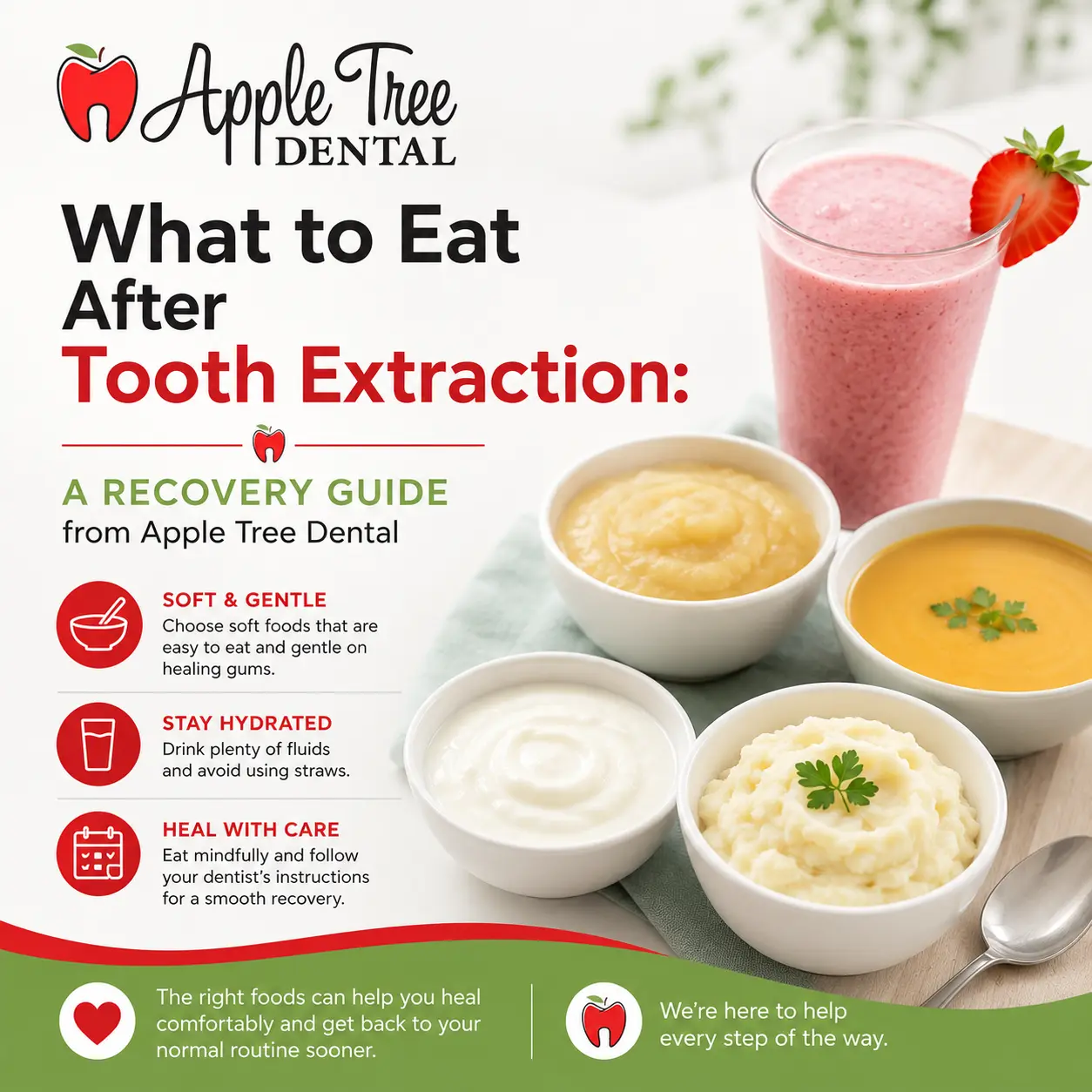
After a tooth extraction, the safest foods are soft foods that require minimal chewing and are easy to swallow. Common foods to eat after tooth extraction include:

  • Yogurt
  • Mashed potatoes
  • Scrambled eggs
  • Applesauce
  • Smoothies (without a straw)
  • Soft oatmeal
  • Warm soups and broths

These foods are gentle on sensitive gums and help protect the healing extraction site. According to the Canadian Dental Association, following proper post-extraction dietary guidelines plays a key role in smooth and safe recovery.

Why Diet Matters After Tooth Extraction

Choosing the right foods after dental surgery can help prevent irritation and support the healing process. Immediately after tooth removal, the extraction site is sensitive and vulnerable. Eating soft foods helps:

  • Protect the healing blood clot
  • Reduce pressure on the gums
  • Lower the risk of complications
  • Make eating more comfortable

Patients often search for what to eat after extracting tooth procedures because the wrong foods can slow recovery. Learn more about how our team supports your healing journey at Apple Tree Dental’s tooth extraction service page.

Best Foods to Eat After Tooth Extraction

Eating soft and nutritious foods during recovery helps protect the extraction site while keeping your body energized.

Yogurt

Yogurt is one of the easiest foods to consume after dental surgery. It has a smooth texture that does not require chewing and is gentle on sensitive gums. Benefits of yogurt include:

  • High protein content that supports healing
  • Calcium for oral health
  • Cool texture that may help soothe the gums

Plain yogurt or lightly flavored varieties are often recommended during the first day of recovery.

Mashed Potatoes

Mashed potatoes are a popular choice when considering food to eat after extraction tooth procedures. They are soft and easy to swallow, filling and nutritious, and simple to prepare. To avoid irritation, allow mashed potatoes to cool slightly before eating.

Scrambled Eggs

Scrambled eggs are another soft and nutritious option during recovery. They provide high-quality protein, essential vitamins and nutrients, and a soft texture that requires minimal chewing. Eggs are often recommended when patients ask what should I eat after teeth extraction.

Smoothies

Smoothies are a convenient way to maintain nutrition while your mouth heals. They can include ingredients such as fruits, yogurt, milk, or plant-based milk. Smoothies provide vitamins and minerals, hydration, and energy during recovery. However, it is important not to drink smoothies through a straw, since suction may disturb the healing blood clot.

Soup and Broth

Warm soups are easy to consume and help keep the body hydrated during recovery. Some good options include chicken broth, vegetable soup, and cream-based soups. Allow soups to cool slightly before eating so they are warm rather than hot.

Applesauce

Applesauce is another gentle option commonly recommended after dental procedures. Because of its smooth texture, applesauce requires no chewing and is considered one of the safest things to eat after tooth extraction.

Oatmeal

Oatmeal can usually be added to the diet after the first couple of days. It is soft, nutritious, and easy to swallow. Adding mashed bananas or soft fruits can enhance flavor while keeping the meal gentle on the gums.

Best Foods After Tooth Extraction

Food Why It Helps
Yogurt Soft and soothing for sensitive gums
Mashed Potatoes Easy to swallow and filling
Scrambled Eggs High in protein for healing
Applesauce Smooth texture that requires no chewing
Soup Provides hydration and nutrients
Oatmeal Soft and nutritious meal

What to Eat During the First 24 Hours After Tooth Extraction

The first 24 hours after tooth removal are the most sensitive stage of recovery. During this time, focus on foods that require little or no chewing. Recommended foods include:

  • Yogurt
  • Applesauce
  • Protein smoothies
  • Mashed potatoes
  • Soft soups

Foods to Avoid After Tooth Extraction

While choosing food to eat after teeth extraction, it is equally important to know which foods should be avoided. Avoid the following foods during the first several days:

  • Hard foods such as nuts
  • Crunchy foods like chips or popcorn
  • Sticky foods like caramel
  • Spicy dishes
  • Alcoholic beverages
  • Extremely hot drinks

Avoiding these foods helps protect the healing socket and reduces the risk of complications. The Government of Canada’s dental care resources also highlight the importance of post-operative care for oral procedures.

Tooth Extraction Recovery Timeline

Healing after tooth extraction usually happens gradually over several days.

First 24 Hours

The blood clot forms in the extraction socket. Rest and soft foods are recommended.

Days 2–3

Swelling and tenderness may still occur but often begin to improve.

Days 4–7

The gums begin closing around the extraction site, making eating easier.

After One Week

Most patients can slowly return to their normal diet depending on their healing progress. Patients receiving treatment at Apple Tree Dental in London, Ontario often receive personalized aftercare instructions to support recovery.

Tips for Faster Healing After Tooth Extraction

Following proper aftercare can help speed up recovery. Helpful tips include:

  • Eat soft foods for several days
  • Avoid chewing near the extraction site
  • Drink plenty of water
  • Avoid using straws
  • Follow your dentist’s instructions carefully

These steps help protect the extraction site and support the healing process. You may also find helpful tips on our emergency dentistry page if you experience unexpected discomfort during recovery.

Tooth Extraction Care in London, Ontario

Patients recovering from tooth removal often have questions about safe foods and healing timelines. Dental professionals at Apple Tree Dental in London, Ontario, provide guidance on aftercare and recovery so patients can heal comfortably after dental procedures. Whether you need a general dental checkup or specialized post-extraction care, our team is here to support you every step of the way.

Frequently Asked Questions

1. What foods help tooth extraction heal faster?

Soft foods such as yogurt, mashed potatoes, scrambled eggs, smoothies, and soups help support healing while protecting the extraction site.

2. Can I eat rice after tooth extraction?

Soft rice may be eaten after a few days, but small grains can become trapped in the socket. Many dentists recommend waiting until early healing occurs.

3. How long should I eat soft foods after tooth extraction?

Most patients follow a soft-food diet for three to five days, although recovery time may vary depending on the complexity of the extraction.

4. Can I drink coffee after tooth extraction?

Hot coffee should usually be avoided during the first 24 hours because heat may interfere with the healing blood clot.

5. When should I contact a dentist after tooth extraction?

You should contact a dentist if you experience severe pain, heavy bleeding, swelling that worsens, or signs of infection. Reach out to the team at Apple Tree Dental immediately if you have any concerns.

Conclusion

Recovering from a tooth extraction does not have to be difficult when you know what to eat and what to avoid. Choosing soft, nutritious foods such as yogurt, mashed potatoes, scrambled eggs, and warm soups during the first few days helps protect the healing socket and supports faster recovery. Equally important is avoiding hard, crunchy, sticky, and spicy foods that could disturb the blood clot and delay healing.

Following your dentist’s aftercare instructions carefully is the best way to ensure a smooth recovery. If you have any concerns or questions about your healing progress, do not hesitate to reach out to the caring team at Apple Tree Dental in London, Ontario. We are here to guide you through every step of your dental care journey — from the procedure itself to a full and comfortable recovery. You can also explore more about tooth extraction services at Apple Tree Dental to understand your options and what to expect.

About the Author

This article was written by the dental care team at Apple Tree Dental Clinic in London, Ontario. Our experienced dentists and oral health professionals are dedicated to providing patients with accurate, up-to-date information to support informed dental decisions. Apple Tree Dental offers a comprehensive range of services including general dentistry, cosmetic dentistry, and emergency dental care for patients across London, Ontario and surrounding communities. Our content is reviewed for accuracy and aligned with guidelines from the Canadian Dental Association and Health Canada’s oral health resources.

How Much Does a Tooth Cavity Filling Cost? Complete Dental Filling Price

Tooth decay is one of the most common oral health issues, and treating cavities early is essential for protecting both your teeth and your long-term dental health. When a cavity forms, dentists usually repair the damaged tooth using a dental filling. Because many people research treatment costs before scheduling a dental visit, the tooth cavity filling cost is one of the most commonly searched dental topics online.

Patients frequently ask questions such as how much does it cost to fill a cavity, how much is a filling, or how much does dental filling cost in Canada. Understanding the typical dental filling cost, the price of filling procedures, and average dentist filling charges can help patients plan their dental care more confidently.


Quick Answer: Tooth Cavity Filling Cost

The tooth cavity filling cost in Canada usually ranges between $150 and $400 per tooth, depending on the filling material, cavity size, and number of tooth surfaces affected.

Typical dental charges for fillings include:

  • Small cavity filling: $150 – $250
  • Composite tooth filling: $200 – $400
  • Larger cavity filling: $300 – $600+

Patients commonly search for questions such as:

  • how much does a filling cost in Ontario
  • how much does tooth filling cost in Canada
  • how much is a filling in Canada
  • how much is tooth filling

The exact tooth cavity filling cost is determined during a dental examination.


What Is a Tooth Cavity Filling?

A tooth cavity filling is a restorative dental treatment used to repair a tooth damaged by decay. When bacteria break down tooth enamel, they create a cavity that can grow larger if left untreated.

During the procedure, a dentist removes the decayed portion of the tooth and fills the space with a restorative material. This restores the tooth’s strength and prevents further decay.

The tooth filling price depends on the material used and the complexity of the cavity.

Common filling materials include:

  • Composite (tooth-colored fillings)
  • Amalgam (silver fillings)
  • Ceramic or porcelain fillings
  • Gold fillings

Each material affects the cost tooth fillings require, which is why the teeth filling price and filling cost teeth treatments involve can vary between patients.


Average Dental Filling Cost in Ontario

Many patients researching treatment want to know how much is a filling in Ontario or how much does a filling cost in Ontario before visiting a dentist.

Dental clinics in Ontario typically follow the provincial dental fee guide, which helps standardize dentist filling charges.

Typical tooth filling cost Ontario estimates include:

Filling TypeAverage Cost
Amalgam filling$120 – $250
Composite filling$180 – $400
Ceramic filling$300 – $700
Gold filling$600 – $1,200

These ranges represent the average dental filling cost, although the final cavity fill cost depends on the dentist and treatment complexity.

Patients often search phrases such as:

  • how much is a filling cost
  • how much tooth filling cost
  • how much for filling teeth

All of these questions relate to the overall cost of filling dentist treatments.


Tooth Filling Cost Across Canada

Across Canada, the tooth filling cost Canada patients pay varies depending on the cavity size, filling material, and clinic location.

Typical filling cost ranges include:

  • Basic cavity filling: $150 – $300
  • Composite filling: $200 – $450
  • Large or complex filling: $350 – $600+

These estimates help answer common questions such as:

  • how much does tooth filling cost in Canada
  • how much does filling teeth cost
  • how much does a filling cost in Canada
  • how much is a filling in Canada

While these numbers provide guidance, a dentist must examine the tooth to determine the exact tooth cavity filling cost.


Factors That Affect Dental Filling Cost

Several factors influence the filling cost teeth treatments involve.

Type of Filling Material

Composite fillings are popular because they match the natural color of teeth. Ceramic and gold fillings can increase the tooth filling price due to higher material and laboratory costs.

Size of the Cavity

Small cavities require less treatment time and material, resulting in a lower cavity fill cost. Larger cavities increase the dental filling cost.

Number of Tooth Surfaces

If decay affects multiple sides of the tooth, dentists must restore each surface, which increases the dental charges for fillings.

Dental Examination and Diagnosis

Before treatment, dentists perform an examination and may take X-rays to diagnose the cavity. Many patients ask how much is a dental check up, which typically ranges from $80 to $200.

Insurance Coverage

Some insurance plans cover part of the tooth cavity filling cost, while patients without coverage pay the full how much is a tooth filling without insurance amount.


How Much Is a Tooth Filling Without Insurance?

Patients frequently search how much is a tooth filling without insurance when planning dental treatment.

Without insurance, the filling cost teeth procedures require usually ranges between $150 and $400 per tooth, depending on the cavity size and filling material.

Because the price of filling procedures varies, dentists usually provide a treatment estimate after examining the tooth.


Signs You May Need a Dental Filling

Recognizing early symptoms of tooth decay can help reduce the cavity fill cost and prevent more serious dental problems.

Common signs include:

  • Tooth sensitivity to hot or cold foods
  • Toothache or pain when chewing
  • Visible dark spots or holes on a tooth
  • Rough or chipped tooth surfaces
  • Food frequently getting stuck between teeth

If you notice these symptoms, a dentist can determine whether a tooth cavity filling is required.


Why Early Treatment Saves Money

Treating cavities early usually results in a lower tooth cavity filling cost. Small cavities can be repaired quickly with a simple filling.

If decay spreads deeper into the tooth, more complex treatments such as root canal therapy or dental crowns may be required, significantly increasing dental treatment costs.

According to guidance from the Canadian Dental Association, early cavity treatment helps prevent more serious dental problems and protects long-term oral health.


Preventing Cavities and Reducing Dental Costs

Preventive dental care helps reduce the need for teeth filling charges and lowers long-term dental expenses.

Dentists recommend:

  • Brushing twice daily with fluoride toothpaste
  • Flossing regularly to remove plaque between teeth
  • Limiting sugary foods and drinks
  • Scheduling regular dental checkups
  • Visiting the dentist for professional cleanings

Public health resources from Health Canada also highlight preventive oral care as a key step in maintaining healthy teeth.


Professional Dental Evaluation for Accurate Costs

While online guides provide general information about tooth cavity filling cost, every patient’s dental condition is unique.

A dentist can:

  • evaluate the severity of tooth decay
  • recommend the most appropriate filling material
  • explain the tooth filling price and treatment options
  • provide an accurate estimate of the dental filling cost

At Apple Tree Dental in London, Ontario, dental professionals focus on preventive care and personalized treatment plans to help patients maintain healthy smiles.


Frequently Asked Questions

How much does it cost to fill a cavity?

The how much does it cost to fill a cavity estimate usually ranges between $150 and $400, depending on the filling material and cavity size.

How much does dental filling cost in Canada?

The dental filling cost in Canada typically ranges between $150 and $600, depending on the complexity of the treatment.

How much is a filling in Ontario?

Most tooth filling cost Ontario estimates range between $180 and $400 for composite fillings.

How much does filling teeth cost?

The how much does filling teeth cost depends on the number of tooth surfaces treated and the filling material used.


Conclusion

Understanding the tooth cavity filling cost helps patients prepare for dental treatment and make informed decisions about their oral health. While the dental filling cost typically ranges between $150 and $400 per tooth, the final cost tooth fillings require depends on several factors, including the filling material, cavity size, and dental clinic fees.

Maintaining good oral hygiene, scheduling regular dental checkups, and treating cavities early can help reduce the overall filling cost teeth treatments may require and protect long-term oral health.

About the Author – Apple Tree Dental

Apple Tree Dental is a dental clinic based in London, Ontario, Canada, providing preventive, restorative, and family dental care. The clinic offers services including dental fillings, cavity treatment, dental exams, preventive dentistry, and restorative procedures designed to support long-term oral health.

The dental team at Apple Tree Dental regularly reviews oral health recommendations from organizations such as the Canadian Dental Association and Health Canada to ensure patients receive accurate, evidence-based information about dental treatments, preventive care, and oral health management.

Content published by Apple Tree Dental is written to help patients understand common dental concerns such as tooth cavity filling cost, dental filling cost, and cavity treatment options in Ontario. Each article focuses on patient education, clear explanations of dental procedures, and practical guidance for maintaining healthy teeth and gums.

The goal of Apple Tree Dental is to make dental information easier to understand while helping patients in London, Ontario make informed decisions about their oral health and dental treatments.


Editorial Standards

Articles published by Apple Tree Dental follow professional healthcare content standards and focus on:

  • Patient-focused educational information
  • Evidence-based dental guidance
  • Clear explanations of dental procedures and treatment costs
  • Preventive oral health recommendations

Content is reviewed to ensure it aligns with public dental health information from the Canadian Dental Association and oral health guidance provided by Health Canada.


Entity Information

Organization: Apple Tree Dental
Location: London, Ontario, Canada
Services: Dental fillings, cavity treatment, dental exams, preventive dentistry, restorative dentistry
Focus: Patient education, preventive oral care, and long-term dental health

Is Invisalign Faster Than Braces? Timeline, Results & What to Expect

If you’re researching orthodontic treatment in London, Ontario, you’re likely asking: is Invisalign faster than braces?

Is Invisalign faster than braces? In mild to moderate cases, Invisalign often completes treatment in 6 to 18 months. However, for complex bite corrections, traditional braces may provide more precise control and similar timelines depending on individual needs.

Choosing between braces vs aligners is not just about speed. It’s about case complexity, lifestyle, cost, and long-term results. This comprehensive guide explains everything you need to know — backed by orthodontic principles recognized by organizations like the American Dental Association, Health Canada, and the Canadian Dental Association.


Invisalign vs Braces: How Each Treatment Works

Understanding how teeth move helps answer whether Invisalign dental braces work faster than traditional braces.

Invisalign (Clear Aligners)

Invisalign uses custom-made, removable plastic aligners designed through digital 3D scans. Each aligner applies gentle, controlled pressure to gradually shift teeth into position. Patients switch trays every 1–2 weeks.

Because treatment is digitally mapped from start to finish, movement is pre-planned and sequential.

Traditional Braces

Braces use brackets bonded to teeth, connected by archwires that are adjusted periodically. They provide continuous force and are especially effective for complex tooth movements.

Both systems rely on biological bone remodeling — a process that takes time regardless of the method used.


Is Invisalign Faster Than Braces? A Timeline Comparison

Average Treatment Duration

Condition SeverityInvisalignBraces
Mild Alignment6–12 months12–18 months
Moderate Issues12–18 months18–24 months
Complex Cases18–24 months24+ months

In many mild cases, Invisalign may finish several months sooner than braces. But in advanced cases, braces may offer more predictable outcomes.

So, are Invisalign faster than braces?
Often yes — but only when the case is suitable.


What Determines Treatment Speed?

The timeline depends less on the brand and more on biological and mechanical factors.

1. Complexity of Tooth Movement

Severe crowding, large gaps, or bite correction may require fixed braces for maximum control.

2. Patient Compliance

Invisalign must be worn 20–22 hours per day. Removing aligners too frequently delays progress. Braces work 24/7 since they are fixed.

3. Age and Bone Density

Younger patients typically experience faster tooth movement due to more responsive bone structures.

4. Treatment Planning Technology

Digital mapping improves predictability in aligner therapy. However, biological limits still apply.

Orthodontic principles recognized by the American Dental Association emphasize that safe tooth movement requires controlled, gradual pressure regardless of the system used.


Invisalign vs Braces Cost in London, Ontario

Cost is another important factor when comparing invisalign vs braces.

Average Cost Range

  • Invisalign: $4,000 – $8,000
  • Braces: $3,500 – $7,500

The final invisalign vs braces cost depends on:

  • Treatment complexity
  • Length of treatment
  • Additional appliances
  • Retainers after completion

While Invisalign may sometimes cost slightly more, many patients prefer its discreet appearance and removability.

Clinics such as Apple Tree Dental in London, Ontario provide personalized orthodontic consultations to determine accurate timelines and cost estimates based on individual needs.


Braces vs Aligners: Effectiveness and Results

Both treatments can correct:

  • Crooked teeth
  • Gaps
  • Overbite
  • Underbite
  • Crossbite
  • Mild jaw misalignment

When Invisalign Works Best

  • Mild to moderate crowding
  • Cosmetic alignment improvements
  • Adults seeking nearly invisible treatment
  • Patients committed to wearing aligners consistently

When Braces May Be More Effective

  • Severe rotations
  • Complex bite correction
  • Significant vertical movement
  • Cases requiring strong anchorage

The Canadian Dental Association highlights that the success of orthodontic treatment depends on proper diagnosis and supervision, not just the appliance chosen.


Are Invisalign Faster Than Braces for Adults?

Adult orthodontic cases are increasingly common in London, Ontario.

For adults with minor spacing or alignment issues, Invisalign often completes treatment within 12–18 months.

However, adult bone density can slow movement compared to teens. In severe adult bite corrections, braces may provide more stable force control.

Health Canada regulates dental devices to ensure safety and effectiveness, reinforcing that both systems are clinically approved options when administered by qualified professionals.


Comfort and Lifestyle Considerations

Speed matters — but so does daily comfort.

Invisalign Advantages

  • Nearly invisible
  • Removable for meals
  • Easier brushing and flossing
  • Fewer emergency visits

Braces Advantages

  • No need to remember wear time
  • Continuous force
  • Often better for complex alignment

For professionals, students, and families in London, Ontario, lifestyle flexibility often makes Invisalign appealing.


What to Expect During Treatment

Invisalign Journey

  1. Digital scan
  2. Customized aligner series
  3. Checkups every 6–8 weeks
  4. Gradual tray progression

Mild pressure is common when switching aligners, but discomfort is typically manageable.

Braces Journey

  1. Bracket bonding appointment
  2. Wire adjustments every 4–6 weeks
  3. Occasional soreness after tightening

Both require retainers after completion to prevent relapse.


Does Invisalign Always Finish Faster?

No.

Even if Invisalign appears faster in advertisements, orthodontic treatment depends on biological response and case complexity.

For example:

  • Severe overbites may respond better to braces
  • Rotated teeth sometimes require fixed brackets
  • Compliance issues can extend aligner treatment

The key takeaway: Invisalign can be faster — but only in appropriate cases.


Choosing the Right Treatment in London, Ontario

When deciding between braces vs aligners, consider:

  • Alignment severity
  • Budget
  • Lifestyle preferences
  • Commitment level
  • Desired aesthetics

At Apple Tree Dental in London, Ontario, treatment planning typically involves digital scans, bite analysis, and a customized timeline projection before recommending either option.


Final Verdict: Is Invisalign Faster Than Braces?

In many mild to moderate cases, Invisalign may complete treatment faster — often within 6 to 18 months. However, braces remain highly effective for complex corrections and may deliver better control in certain situations.

Instead of focusing only on speed, prioritize:

  • Long-term stability
  • Bite function
  • Overall oral health

Consulting a dental professional ensures the right choice for your specific needs.


Frequently Asked Questions

1. Is Invisalign faster than braces for mild cases?

Yes, Invisalign often completes mild alignment corrections within 6–12 months.

2. Are Invisalign faster than braces for severe crowding?

Not always. Braces may provide better control for complex movement.

3. Is Invisalign more expensive than braces?

Invisalign vs braces cost varies, but pricing overlaps significantly depending on case complexity.

4. Do aligners move teeth differently than braces?

Both use controlled pressure to shift teeth through bone remodeling.

5. Which option is better for adults?

For mild cosmetic concerns, Invisalign is often preferred. Severe cases may benefit from braces.

6. How can I know which is right for me?

A professional orthodontic consultation with digital imaging provides the most accurate answer.

Conclusion: Is Invisalign Faster Than Braces?

So, is Invisalign faster than braces? In many mild to moderate cases, yes — Invisalign can complete treatment within 6 to 18 months, often sooner than traditional braces. However, when it comes to complex bite corrections, severe crowding, or significant tooth rotation, braces may provide more precise control and equally efficient long-term results.

The truth is that treatment speed depends on:

  • Case complexity
  • Patient compliance (especially with aligners)
  • Age and bone response
  • Proper orthodontic planning

Both Invisalign dental braces and traditional braces are clinically proven systems supported by professional dental organizations such as the American Dental Association, Health Canada, and the Canadian Dental Association. When administered by qualified dental professionals, both options are safe and effective.

Dental Veneers: Benefits, Costs, Pain Levels, and What Patients in London, Ontario Should Know

A smile often shapes confidence, social interactions, and self-image. When teeth appear chipped, stained, uneven, or worn, many individuals begin researching dental veneers as a cosmetic solution. Yet questions quickly follow: Are veneers painful? How long do they last? What is the cost of dental veneers?

This comprehensive guide explains veneers clearly and responsibly, using clinically grounded information to help patients make informed decisions.


What Are Dental Veneers?

Dental veneers are thin shells bonded to teeth to improve color, shape, and symmetry. The procedure is generally well tolerated with minimal discomfort.

Dentists may recommend veneers for:

  • Discolored teeth resistant to whitening
  • Minor chips or fractures
  • Uneven or irregular tooth shapes
  • Small gaps
  • Mild alignment concerns

Well-designed dental veneers teeth mimic the translucency and texture of natural enamel.


Types of Dental Veneers

Porcelain Veneers

  • Highly stain-resistant
  • Natural light reflection
  • Long-lasting with proper care

Composite Veneers

  • More conservative preparation
  • Lower initial cost
  • Easier repairs

Material choice depends on aesthetic goals, bite forces, and budget considerations.


Dental Veneers Before and After: Realistic Expectations

Many patients search for dental veneers before and after examples. Veneers can dramatically enhance smile aesthetics, but outcomes vary based on:

  • Existing enamel thickness
  • Tooth alignment
  • Gum symmetry
  • Shade selection
  • Functional bite balance

A responsible cosmetic plan improves appearance while preserving tooth health.


Cost of Veneers Dental: What Influences Pricing?

The cost of veneers dental treatment varies widely. Several factors influence final pricing:

  • Veneer material (porcelain vs composite)
  • Number of teeth treated
  • Complexity of tooth preparation
  • Laboratory craftsmanship
  • Geographic location

When discussing the cost of dental veneers, ethical providers prioritize transparency and individualized assessment rather than generic estimates.

Patients in London, Ontario often consult clinics such as Apple Tree Dental to receive personalized evaluations based on oral health, goals, and long-term stability.


Are Dental Veneers Painful?

Pain concerns are common and valid. Veneer procedures are typically well tolerated, but understanding possible sensations reduces anxiety.

1. Normal Discomfort (Expected)

Mild sensitivity to temperature or pressure may occur after tooth preparation. This is usually temporary and manageable.

2. Inflammation (Requires Attention)

Gum tenderness, redness, or mild swelling may arise if tissues react to preparation or bonding margins.

3. Infection (Not Normal)

Persistent throbbing pain, swelling, or pressure indicates a potential complication requiring immediate evaluation.

Pain intensity generally decreases as healing progresses. Worsening pain should never be dismissed.


How Pain Intensity Changes Over Time

TimeframeTypical Sensation
First 24–72 hoursMild sensitivity
First weekGradual improvement
2–3 weeksMinimal to none
Persistent/severe painNeeds dental exam

Pain Locations and What They May Indicate

The location of discomfort provides important diagnostic clues:

  • Sharp response to cold/heat → Temporary nerve irritation
  • Gum soreness near veneer edges → Tissue inflammation
  • Deep continuous ache → Possible pulp stress
  • Pain while biting → Bite imbalance
  • Jaw or muscle discomfort → Grinding or clenching

Only a clinical exam can confirm the cause.


How Long Does Freezing Last at the Dentist?

Patients frequently ask, “how long does freezing last dentist?”

Local anesthetic typically lasts:

  • 1–2 hours for shorter-acting agents
  • 3–4+ hours for longer-acting agents

Duration varies with medication type, dosage, and individual metabolism. Prolonged numbness should be reported.


Step-by-Step: What To Do After Veneer Placement

What To Do

1. Protect Sensitive Teeth
Use desensitizing toothpaste if recommended.

2. Maintain Excellent Hygiene
Brush twice daily with a soft-bristle brush. Floss carefully around veneers.

3. Attend Follow-Ups
Minor bite adjustments can prevent long-term discomfort.

4. Wear a Nightguard if Needed
Especially important for patients who grind or clench.

5. Monitor Symptoms
Report persistent sensitivity or pain early.


What NOT To Do

  • Avoid biting hard objects (ice, pens, fingernails)
  • Do not neglect gumline cleaning
  • Avoid self-diagnosing severe pain
  • Do not delay professional care

Emotional Reassurance: Addressing Patient Anxiety

Dental discomfort — or even the fear of it — can feel overwhelming. Cosmetic decisions carry both emotional and financial weight. Feeling uncertain or worried is completely normal. Patients are not “overthinking”; they are protecting their health.

Qualified dental professionals expect these concerns and encourage open dialogue.


When NOT to Google — Seek Immediate Dental Care

Stop reading and contact a dentist if you experience:

  • Severe or escalating pain
  • Swelling of gums or face
  • Fever
  • Persistent numbness
  • Pain when chewing that worsens
  • Veneer movement or detachment

Search engines cannot diagnose clinical complications.


Can Veneers Replace Missing Teeth?

Despite frequent searches for dental veneers for missing teeth, veneers cannot replace absent teeth. Veneers require existing tooth structure for bonding.

Appropriate solutions for missing teeth include:

  • Dental implants
  • Bridges
  • Partial dentures

A dentist determines suitability through examination and imaging.


How Long Do Dental Veneers Last?

Longevity depends on material choice, oral hygiene, and bite forces.

Porcelain Veneers

Often last 10–15 years or longer with proper care.

Composite Veneers

May require earlier polishing or maintenance.

Factors affecting lifespan:

  • Grinding/clenching habits
  • Oral hygiene
  • Diet
  • Bite alignment

Are Dental Veneers Safe?

When planned and placed correctly, veneers are considered safe. However, they involve enamel reshaping, which is irreversible.

Clinical guidelines emphasize:

  • Comprehensive oral exam
  • Gum health evaluation
  • Bite analysis
  • Informed consent

Professional organizations such as the American Dental Association (ADA), Canadian Dental Association (CDA), and Health Canada stress individualized care.


Who Is a Good Candidate for Veneers?

Ideal candidates typically have:

  • Healthy teeth and gums
  • Adequate enamel
  • No untreated decay
  • Realistic expectations

Patients with significant alignment or bite issues may require orthodontic or restorative treatment first.


Risks Patients Should Understand

Although complications are uncommon, patients should be aware of:

  • Temporary tooth sensitivity
  • Gum irritation
  • Bite discomfort
  • Veneer chipping
  • Rare nerve inflammation

Most concerns are manageable when addressed early.


Preventing Veneer-Related Problems

  • Maintain excellent oral hygiene
  • Avoid excessive biting force
  • Wear protective appliances if advised
  • Attend regular dental exams
  • Address discomfort promptly

Preventive care significantly improves long-term success.


Choosing a Dental Veneer Provider in London, Ontario

When searching for dental veneers near me, patients should evaluate more than convenience.

Important considerations:

  • Dentist’s cosmetic experience
  • Diagnostic planning process
  • Quality of materials
  • Discussion of risks and alternatives

Clinics like Apple Tree Dental in London, Ontario focus on comprehensive evaluation before recommending cosmetic treatment.


Frequently Asked Questions

Do dental veneers damage natural teeth?

Veneers require enamel reshaping. Conservative preparation preserves tooth integrity while allowing secure bonding.


Are veneers permanent?

They are long-term restorations but may require replacement over time.


Is sensitivity normal after veneers?

Mild sensitivity may occur temporarily. Persistent or severe pain requires evaluation.


Can veneers stain?

Porcelain veneers resist staining better than composite materials.


How many veneers are needed?

This depends on smile design goals and tooth visibility.


Are veneers covered by insurance?

Coverage varies. Veneers are often classified as cosmetic.


How This Article Was Created

This article was developed using evidence-informed dental principles and restorative guidelines from credible professional bodies, including:

No fabricated statistics or exaggerated claims were used. The information reflects accepted clinical understanding of veneers, patient experiences, and risk considerations. Clinical decisions should always be based on an in-person dental examination by a qualified professional.


Final Thoughts

Dental veneers can produce remarkable cosmetic improvements when chosen appropriately. Success relies on careful planning, realistic expectations, and ongoing oral care. Patients considering veneers in London, Ontario benefit from professional evaluations that prioritize both aesthetics and long-term oral health.

A confident smile begins with informed decisions.

What Does Dental Pain Really Mean? Causes, Relief & When Should I See a Dentist

Dental pain can be confusing, stressful, and sometimes frightening. I see this regularly in my dental clinic. Patients often arrive worried because the discomfort started suddenly or gradually worsened. Many tell me they spent hours searching “dental near me” before deciding to book an appointment.

If you’re experiencing dental discomfort right now, take a breath. Pain doesn’t always signal a serious emergency — but it always deserves attention.

Let me walk you through what dental pain may indicate and how I guide patients through it.


Understanding Dental Pain: Why It Happens

Dental pain is your body’s warning system. It typically appears when something irritates the tooth, nerve, gums, or surrounding tissues.

In my clinical experience, pain most commonly stems from:

  • Tooth decay
  • Enamel wear
  • Gum inflammation
  • Cracked teeth
  • Bite imbalance
  • Infection

The key is recognizing the type and pattern of discomfort.


Not All Dental Pain Feels the Same

One of the biggest misconceptions I encounter is assuming every toothache means infection. That simply isn’t true.

1. Mild Sensitivity or Temporary Discomfort

This usually feels:

  • Short-lived
  • Triggered by cold, heat, or sweets
  • Manageable

Common causes include enamel thinning, recent dental treatment, or temporary gum irritation.

In many cases, this improves within a few days.


2. Inflammation Inside the Tooth (Pulpitis)

When the tooth nerve becomes irritated, symptoms shift:

  • Sharp sensitivity
  • Lingering discomfort
  • Pain while biting

Early evaluation at a dental office can often prevent more complex procedures.


3. Infection or Dental Abscess

Infection produces stronger warning signs:

  • Persistent throbbing
  • Increasing intensity
  • Pain at night
  • Swelling
  • Pressure sensation

At this stage, professional care at a dental clinic near me becomes essential.


How Dental Pain Typically Progresses

Dental pain rarely jumps from “nothing” to “severe” overnight. It often follows a predictable pattern:

  1. Occasional sensitivity
  2. Repeated discomfort
  3. Constant ache
  4. Severe throbbing
  5. Swelling or pressure

Patients frequently tell me, “It started months ago but didn’t bother me much.” This gradual escalation is extremely common.


Pain Location: Important Diagnostic Clues

Where the pain occurs often helps identify the cause.

Front Teeth Pain

May indicate:

  • Enamel erosion
  • Trauma
  • Gum recession
  • Bite stress

Back Tooth Pain

Often linked to:

  • Cavities
  • Cracked teeth
  • Grinding (bruxism)
  • Infection

Gum Pain

Possible causes:

  • Gingivitis
  • Periodontal inflammation
  • Trapped food or plaque

Jaw or Ear-Like Pain

Dental nerves can refer pain. A molar issue may feel like ear discomfort or jaw tension.


What I Recommend First (Safe Immediate Steps)

Before panic sets in, I encourage patients to take calm, safe measures.

What To Do

Rinse With Warm Salt Water
Helps soothe irritated gum tissues.

Floss Gently
Removes trapped debris.

Apply Cold Compress Externally
Reduces inflammation.

Use Over-the-Counter Pain Relief (If Suitable)
Follow dosage instructions carefully.

Observe Pain Triggers
Cold? Heat? Pressure? Nighttime?

These details help your dentist diagnose efficiently.


What NOT To Do

Do NOT place aspirin on the tooth
This can burn gum tissue.

Do NOT apply heat to the face
Heat may worsen infection.

Do NOT ignore swelling
Swelling is never normal.

Do NOT rely solely on home remedies
They rarely treat underlying causes.


You’re Not Overreacting

Dental pain affects sleep, concentration, eating, and emotional well-being. Many patients apologize for “making a fuss.”

You’re not alone — and you’re not exaggerating.

Pain is a legitimate medical signal.


When NOT to Google

Online research helps, but certain symptoms require immediate professional care.

Visit a Dental Clinic Immediately If You Notice:

  • Facial swelling
  • Fever
  • Severe unrelenting pain
  • Difficulty swallowing
  • Pus or foul taste
  • Broken or knocked-out tooth

These signs may indicate infection or abscess requiring urgent treatment at a dental clinic.


Searching “Dental Clinic Near Me”? What to Consider

When looking for a dental clinic near me, I suggest evaluating:

  • Professional qualifications
  • Emergency availability
  • Clear treatment explanations
  • Patient-centered care

Quality and trust matter far more than proximity alone.


Prevention: The Most Reliable Pain Strategy

Most severe dental emergencies begin as small, manageable issues.

Core Preventive Habits

  • Routine dental exams
  • Professional cleanings
  • Early sensitivity evaluation
  • Night guards for grinding
  • Consistent oral hygiene

Preventive care protects enamel, nerves, and periodontal tissues.


Dental Braces vs Invisalign: Can Alignment Influence Pain?

Yes. Bite imbalance can contribute to pressure-related discomfort, jaw strain, and uneven tooth wear.

Dental Braces

  • Fixed appliances
  • Ideal for complex corrections
  • Temporary soreness expected

Invisalign

  • Removable aligners
  • Discreet appearance
  • Requires consistent wear

Both options improve occlusion, which may reduce long-term mechanical stress.


Understanding Coverage & Dental Plan Canada Discussions

Patients sometimes ask about systems like a dental plan Canada provides when comparing insurance or relocation scenarios.

Coverage structures vary by:

  • Employer benefits
  • Provincial programs
  • Private insurance

Regardless of location, prevention remains the most cost-effective strategy.


Why Professional Standards Matter

Organizations such as the Ontario Dental Association help maintain:

  • Ethical guidelines
  • Continuing education
  • Evidence-based care standards

These frameworks strengthen patient safety and treatment quality.


My Final Advice

If dental pain appears:

Pause
Assess
Take safe interim steps
Seek evaluation when symptoms persist or worsen

Pain rarely resolves permanently without addressing its root cause.


Frequently Asked Questions

Is throbbing dental pain always an infection?

Not always. However, persistent throbbing often suggests inflammation or infection affecting the tooth nerve.


How long should tooth sensitivity last?

Mild sensitivity may resolve within days. If it persists beyond 1–2 weeks, clinical evaluation is recommended.


Can dental pain disappear without treatment?

Symptoms may temporarily fade, but untreated decay or infection usually progresses silently.


Is swelling from a tooth serious?

Yes. Swelling may indicate infection and requires prompt dental care.


Should I search “dental near me” for mild discomfort?

Short-lived, mild discomfort can be monitored briefly. Persistent or worsening pain should be examined by a dentist.


About the Author

Dr. Nagham Altalib is a licensed dental professional practicing at Apple Tree Dental in London, Ontario. She has extensive clinical experience in patient care, oral pain diagnosis, restorative dentistry, orthodontics, prosthodontics, and preventive dental health.

Dr. Altalib’s work focuses on evidence-based dentistry, early diagnosis, minimally invasive treatment, and long-term oral wellness. Her clinical approach aligns with modern dental standards and patient safety frameworks referenced by organizations such as the American Dental Association (ADA), Canadian Dental Association (CDA), and Ontario Dental Association.


How This Article Was Created

This article is based on established dental science, real-world clinical observations, and patient education principles consistent with recognized professional guidelines. No fabricated statistics or exaggerated claims were used.

Sources of clinical alignment include:

The goal is to provide accurate, responsible, and patient-focused dental guidance.

Conclusion: Listen to What Your Dental Pain Is Telling You

Dental pain is rarely random. In most cases, it reflects sensitivity, inflammation, mechanical stress, or infection developing beneath the surface. While some discomfort may be temporary, persistent or worsening pain usually signals a problem that needs professional evaluation.

I always remind patients of something simple but important: early attention prevents complex treatment. A small cavity is easier to manage than an abscess. Mild sensitivity is easier to address than nerve damage. Waiting often allows conditions to progress quietly.